September 11, 2001, is not merely a date on the world calendar; it is the day that changed the course of politics, security, and the fight against terrorism worldwide. Yet perhaps less attention has been paid to the question of whether there were signs of a major threat before the Twin Towers of the World Trade Center in New York were targeted. And if such signs existed, why did the world fail to take those warnings seriously? One of the most significant warnings came from Ahmad Shah Massoud, commander of Afghanistan’s resistance, a man who had fought for years against Soviet forces as well as the Taliban.
Massoud traveled to Strasbourg on April 4, 2001, at the invitation of the European Parliament, where he warned about the situation in Afghanistan, the Taliban, and the danger of the spread of international terrorism. At that time, the European Parliament had also expressed concern over the situation in Afghanistan and the support given to the Taliban and extremist groups. Only a few months later, on September 9, 2001, Massoud was assassinated in a suicide attack in Khwaja Bahauddin district of Takhar province, carried out by attackers who had posed as journalists. This assassination, occurring only two days before September 11, held particular significance both in timing and in political terms. The European Parliament later expressed regret in a statement that Massoud’s warnings about the danger of terrorism and the Taliban had not been taken seriously enough. Massoud’s assassination should have served as a serious alarm bell for the world; yet only two days later, an event occurred that painfully revealed the full scope of his warnings.
The Day the World Changed
On the morning of September 11, 2001, as Afghanistan was mourning Massoud, thousands of kilometers away in the United States, an attack began that would change the world forever. At 8:46 a.m., hijacked American Airlines Flight 11 struck the North Tower of the World Trade Center in New York. In the first moments, many still did not realize they were facing an organized terrorist attack. But at 9:03 a.m., a second plane struck the South Tower, making it clear that this was no ordinary incident.
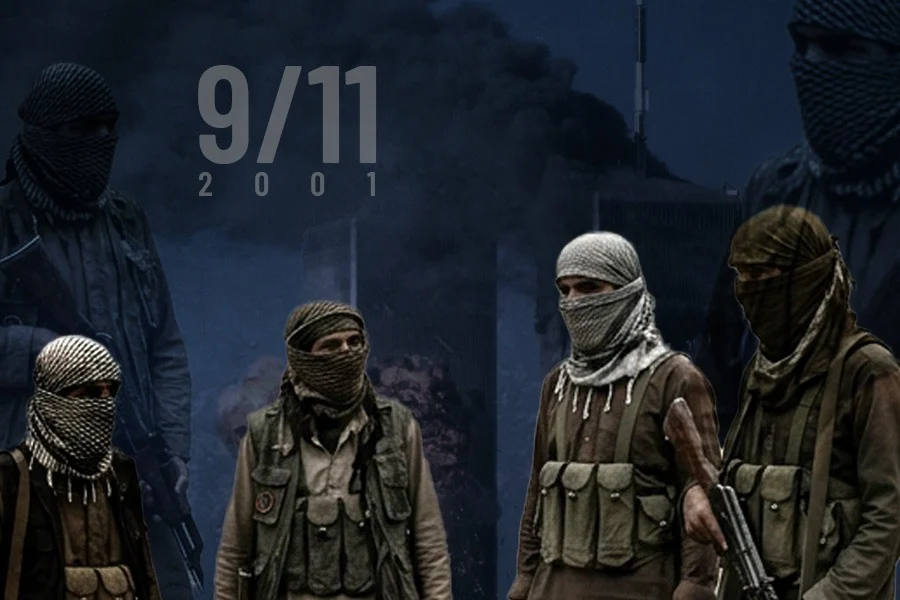
George W. Bush, the U.S. president at the time, was at Emma E. Booker Elementary School in Florida. After learning of the second plane’s impact, the scale of the attack became clearer to him. He delivered a brief statement at the same school at 9:29 a.m., after which the U.S. government entered one of the greatest security crises in its history. At 9:37 a.m., a third plane struck the Pentagon building near Washington, and at 10:03 a.m., a fourth plane crashed near Shanksville, Pennsylvania. This plane crashed following passenger resistance, before reaching its intended target. It was later determined that the attacks had been organized by the al-Qaeda network, and that 19 hijackers had taken part in hijacking the four planes. The September 11 attacks left 2,977 victims from 90 countries; all 19 hijackers were also killed in the course of the attacks. It was at this point that earlier warnings about the connection between the Taliban and terrorist networks took on new significance.
Osama bin Laden, the Taliban, and the Start of the War
Osama bin Laden, the leader of al-Qaeda, was present in Afghanistan, where the Taliban had granted him refuge. Following the September 11 attacks, the United States and its allies demanded that the Taliban hand over bin Laden and al-Qaeda’s leaders. The Taliban refused to hand him over, a decision that became one of the main factors behind the United States’ decision to launch a military attack on Afghanistan. In October 2001, the United States and its allies began military operations in Afghanistan. The first Taliban regime was overthrown, and afterward, a new political system was formed with the support of the United States and its international allies.
But the important question was this: was the United States’ goal solely to combat al-Qaeda, or was Afghanistan meant to become part of a far larger project? Instead of lasting a few years, the U.S. presence in Afghanistan continued for two decades. Thousands of soldiers from the United States, Europe, and Afghanistan were killed, and billions of dollars were spent. During this period, Afghanistan also witnessed war, corruption, poverty, insecurity, migration, and the deaths of a large number of its citizens. Nevertheless, two decades later, the very group the United States had entered Afghanistan to overthrow returned to power once again.
From the Fall of the Taliban to the Return of the Taliban
On February 29, 2020, the United States and the Taliban signed the Doha Agreement, an agreement that paved the way for the withdrawal of American forces and their allies from Afghanistan. In 2021, U.S. forces withdrew from Afghanistan, and on August 15 of that year, the Taliban entered Kabul, and the government of the Republic of Afghanistan collapsed. This was one of the greatest contradictions of America’s twenty-year war in Afghanistan. In 2001, the United States overthrew the Taliban government because of the presence of Osama bin Laden and the al-Qaeda network in Afghanistan and established a new political system in the country; yet twenty years later, it left Afghanistan, and the Taliban once again seized power.
Of course, the Taliban’s return was not the result of an “official surrender of Afghanistan by the United States”; rather, it was the outcome of a series of political and military decisions, the Doha negotiations, the structural weakness of the Republic government, and the rapid collapse of Afghanistan’s security forces. Nevertheless, for many people of Afghanistan, the final result was nothing other than the country’s fate being handed back once again to the very group the United States had gone to war to overthrow two decades earlier.
The question here is this: how is it possible that a country which continued its two-decade war under the banner of fighting terrorism in Afghanistan ultimately withdrew from Afghanistan under circumstances in which the Taliban once again dominates Kabul?
The Fate of Osama bin Laden
After the fall of the first Taliban regime, the fate of Osama bin Laden became a long game of pursuit and evasion. For years, the United States searched for him in Afghanistan and the border regions between Afghanistan and Pakistan. Bin Laden was ultimately found not in a remote cave in Afghanistan, but in a residential compound in the city of Abbottabad, Pakistan. The U.S. operation took place on May 2, 2011, and bin Laden was killed during the operation. The Central Intelligence Agency (CIA) later announced that, after years of tracking, its intelligence network had been able to identify his hiding place through information related to one of bin Laden’s couriers. Bin Laden’s body was also removed from the site after the operation, and the United States announced that it had buried him at sea in the Arabian Sea. But bin Laden’s death was not the end of al-Qaeda, just as the U.S. withdrawal from Afghanistan was not the end of terrorism in the country.
25 Years Later: Has Anything Changed?
We are now in the year 2026; 25 years have passed since September 11, 2001. Yet the troubling question is whether the threat that the world entered Afghanistan to fight has truly been eliminated. The relationship between the Taliban and al-Qaeda has repeatedly been a subject of debate and concern among security and international institutions. More importantly, during the Taliban’s second period of rule, Ayman al-Zawahiri, Osama bin Laden’s successor and the next leader of al-Qaeda, was present in the heart of Kabul. He was killed on July 31, 2022, in a U.S. drone strike in Kabul. This raised a major question: if the leader of al-Qaeda had been able to live in the heart of Kabul, not far from the centers of Taliban power, then how credible was the claim that all ties between the Taliban and al-Qaeda had been completely severed? Al-Zawahiri’s killing showed that the issue of al-Qaeda did not end with the fall of the first Taliban regime.
On the other hand, some family members and close relatives of al-Qaeda’s former leaders have also continued to appear in the group’s narratives and propaganda. In the years following September 11, messages and videos attributed to Hamza bin Laden, Osama bin Laden’s son, were also released, showing that al-Qaeda’s ideological and propaganda legacy did not simply disappear with the death of its leader. Therefore, if we assume that the issue of terrorism in Afghanistan ended with the killing of Osama bin Laden and Ayman al-Zawahiri, we may be repeating the same mistake the world made before September 11: seeing the signs, but failing to take them seriously.
The Price Afghanistan and the World Paid
In the September 11 attacks, 2,977 people from 90 countries around the world lost their lives. Thousands of families were left grieving forever, and the world entered a new phase of the war on terrorism. But alongside American victims and citizens of other countries, Afghanistan also paid a heavy price over the following two decades. Thousands of people in Afghanistan were killed in various conflicts, millions were forced to leave their homes, many families lost members, and generations of Afghanistan’s children grew up amid war and insecurity. The more painful question is whether, after 20 years of war, Afghanistan is truly safer today than it was in 2001. If the answer is yes, then why do the names of al-Qaeda and other terrorist groups still appear in security reports about Afghanistan? If the answer is no, then one must ask exactly what the cost of this long war was paid for.
Massoud’s Warning and a Lesson Still Unlearned
September 11 is significant not merely as the story of the collapse of two towers in New York or the attack on the Pentagon. This date is the story of the failure of a security system, a failure to recognize a threat, and at the same time, the story of warnings that were heard before the disaster but were not taken seriously enough. Massoud had warned in Europe about the danger of the Taliban and terrorism before September 11. He was assassinated only two days before the attacks on the United States. The European Parliament also acknowledged after his death that the West had not taken his message seriously enough. But 25 years later, the issue is no longer only why the world failed to hear Massoud’s warning; the bigger question is why, after 25 years of war, Afghanistan remains one of the places where concerns are raised about the activity of terrorist groups. The United States entered Afghanistan in 2001 to destroy al-Qaeda and overthrow the Taliban. Bin Laden was killed in Abbottabad, Pakistan, in 2011. Al-Zawahiri was targeted in Kabul in 2022. Yet the Taliban returned to power in 2021, and Afghanistan once again came under their rule.
This chain of events presents the world with a great contradiction: did the war on terrorism truly come to an end, or did only its form and geography change? Perhaps the greatest lesson of September 11 is this: terrorism does not always begin with a large explosion. Sometimes it begins with a warning, then an assassination, followed by silence and neglect, and finally, by the time everyone recognizes the danger, it is already too late to prevent disaster. Twenty-five years after September 11, the world still faces the same old question: if the warnings are ignored once again, will history repeat itself?
You can read the Persian version of this analysis article here:
۲۵ سال پس از ۱۱ سپتامبر؛ تروریسم شکست خورد یا فقط چهره عوض کرد؟