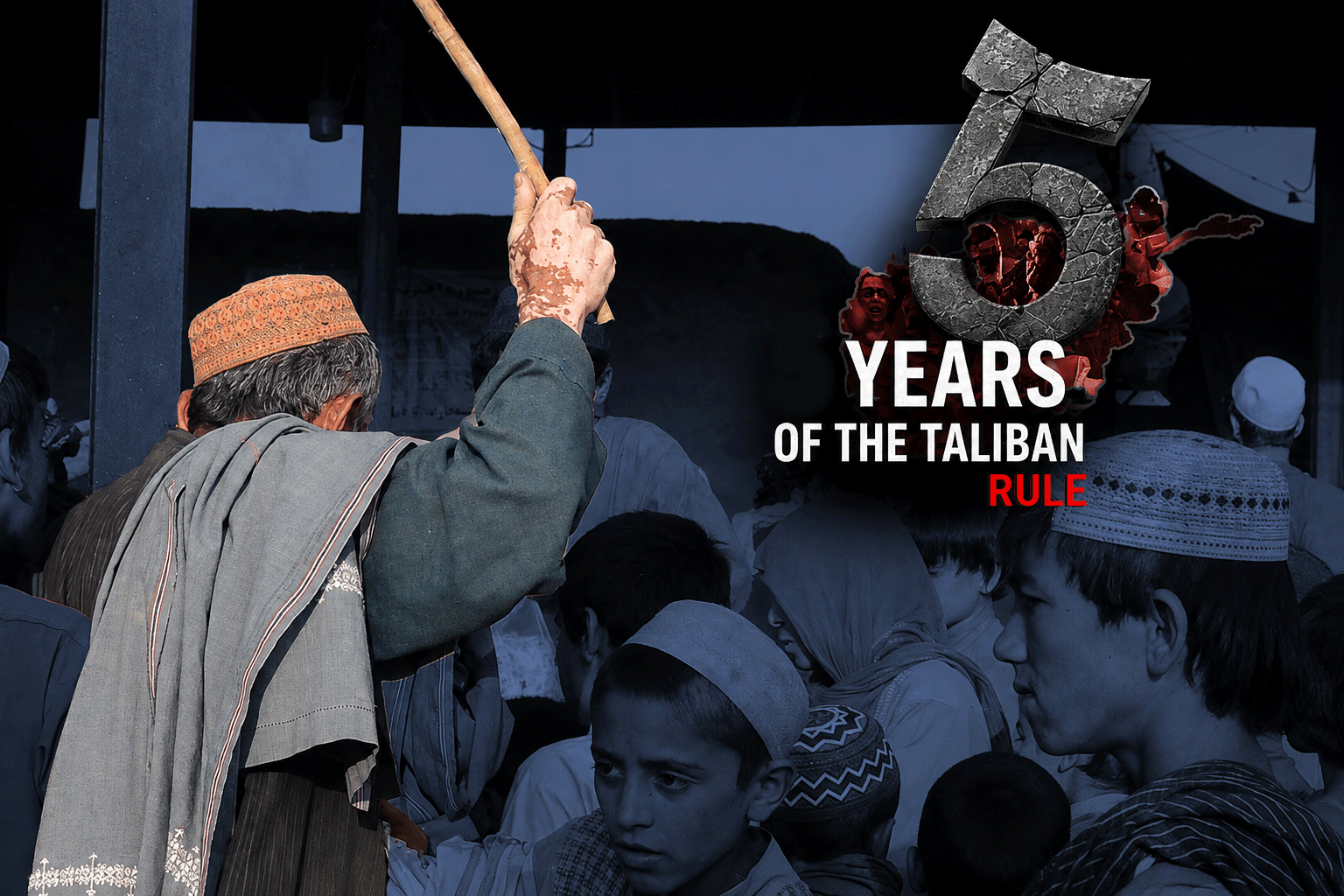
The Taliban seized power in Afghanistan on August 15, 2021, entering Kabul as the previous government collapsed, an event that changed the course of life for millions of citizens. Every year, the group commemorates this day as “Conquest Day,” marking it by raising their flags, holding military parades, displaying symbols associated with suicide attacks, and playing Taliban anthems.
Five years after this event, several citizens say they remember August 15 not as a day of freedom and victory, but as one of the darkest days after which their lives changed in horrifying ways. They add that even after five years, they still have not recovered from the shock of that change.
According to them, over the past five years, the closure of schools and universities to girls, restrictions on women’s work and movement, migration, unemployment, and the loss of educational opportunities have been part of the experiences that have overshadowed their lives since the Taliban took control.
These citizens told the Hasht-e Subh Daily that the people of Afghanistan have no reason to celebrate on this day, since in their view, what happened on August 15 was not merely the surrender of the previous government, but was accompanied by the loss of freedoms, rights, and values that people had worked for two decades to secure. They believe that participating in events commemorating this day disregards the suffering of families who lost loved ones during the war and after it.
Hania, a resident of Ghazni province, considers August 15 the beginning of one of the darkest chapters of her life, the day the doors of school closed to her with the Taliban’s arrival, and many of her hopes for the future were destroyed. She adds that after five years, she still has not been able to come to terms with Taliban rule and the restrictions imposed on her life, and therefore cannot regard this day as a “day of freedom and victory.”
According to Hania, while the Taliban commemorate 24 August as “Conquest and Freedom Day,” for many girls in Afghanistan, this same day marked the beginning of being deprived of school, work, and the ability to choose their own future.
Hania says: “When the Taliban returned, we had an exam on Sunday. We were coming home from school when chaos broke out on the way. When we got home, we saw that Ashraf Ghani had fled. We sat in front of the television for hours and could not stop crying. Because we were familiar with the Taliban, we knew this was the start of a dark day for us.”
She adds: “My father lost his job, my mother lost her job, and I was kept from my studies. Little by little, we sold our household belongings to survive. Every time the Taliban commemorate August 15 as a day of freedom, I remember that on that day they threw us into a great cage and bound our hands and feet.”
Sadiqa (pseudonym), a professor at Kabul University who also experienced the first period of Taliban rule, says August 15 reminds her of the Taliban’s return and the repetition of restrictions that women in Afghanistan had already experienced before. In her view, the past five years have shown that despite changes in the Taliban’s approach, restrictions on women’s education, work, and movement continue. She adds that the loss of her job and opportunities for advancement are among the most significant experiences left with her since the Taliban’s return.
Sadiqa says: “I have experienced both the first and second periods of Taliban rule. During the first period, education and movement without a male guardian were not possible, and poverty and hunger were widespread. Now too, women can only go to the market under certain conditions and with fear and anxiety, and education remains closed to girls and women.”
She adds: “We have no pleasant memories from the Taliban period that we would want to recount, but we have as many bad memories as you could wish for. Losing my job and losing the progress I had made in my life are part of these memories.”
Fawzia, a resident of Herat, considers the past five years among the bitterest periods of her life and says the Taliban’s restrictions have drastically changed women’s daily lives. In her view, Taliban rule beginning on August 15 revived memories of the group’s first period of rule that she had heard from her mother. According to her, many of the restrictions her mother described from that period have today been repeated in a different form in the lives of women and girls in Afghanistan.
Fawzia says: “When the government fell, my mother told me about the first Taliban period. She said the Taliban did not like girls and women leaving the house and going to school. Whenever they saw a woman in the street, they would whip her. Today we see almost the same behavior. We are not allowed to go to school, and if we leave the house, they might stop us under the pretext of our clothing.”
Kawsar, a resident of Kabul, says August 15 is not merely a reminder of a change of government for her, but the beginning of a period in which even being with family members did not always feel safe. She adds that one of her lasting memories is from the first months after the Taliban’s return, when she was in a car with her two brothers at Pul-e Sorkh waiting for her sister and sister-in-law, and a Talib stopped their car to check the family relationship between them.
Kawsar says: “We were sitting in the car with my two brothers, talking, when suddenly a Talib came up and knocked on the car window. He asked what this girl was to us. My brother said she was his sister. Then he started making trouble and asked for our identity cards. They wanted to make sure we really had the same father.”
She adds that similar experiences, particularly Taliban members entering her workplace without permission, have further eroded her sense of safety and privacy. According to Kawsar, these memories show her that after August 15, the Taliban’s presence was not limited to the imposition of official restrictions, but became part of women’s daily lives.
Madina, another resident of Kabul, remembers August 15, 2021 as the day when seeing Taliban faces in Kabul once again revived memories of the war years and the victims she had witnessed during those years. She says the Taliban’s presence in the capital was not merely a change of government for her, but the return of fears she had lived with for years.
Madina says: “Two days after the fall, Sirajuddin Haqqani entered Kabul, and over the past 20 years we had known Haqqani as one of the most frightening figures of the Taliban. When I saw him enter Kabul with such fanfare and the media covering him, I was terrified. I cried for hours like a child.”
She adds that on that day, she remembered the children who were killed during the war and the young people who were kept from their education because of insecurity and violence. According to Madina, these memories made August 15, for her, a day that went beyond the fall of a government, a day that brought Afghanistan’s war-torn past back before her eyes.
Madina adds: “Many people were kept from their education because of the war and violence caused by Haqqani and his network. That day, all these memories came back to life for me. My colleagues came to console me, but even they could not find anything to say that would calm me. After that day, I became stronger, for myself, for the girls of Afghanistan, for the future of girls, and for my family. After that, the Taliban’s temporary detentions, checkpoints, and interference in my work and life could no longer stop me.”
Qandagha, a resident of Panjshir, considers August 15 a reminder of the day the previous government fell, along with the displacement and loss of his family’s security. He says that on the day Kabul fell, after leaving the university, due to overcrowding and the lack of transportation, he walked the entire route from the university to Khair Khana and Panj Sad Family. He says that after returning to Panjshir and the continuation of clashes there, his family was forced to return to Kabul again, but in their absence, their house had been seized by the Taliban and parts of it destroyed.
Qandagha says: “They had taken our house. They had damaged the solar power system, broken the bathrooms and doors, and turned the entire house upside down. They did not even spare the grapevines or the well. It was very difficult for us to get our house back from them. For me, the commemoration of August 15 is a reminder of those difficult days and the uncertain future that we still do not know the outcome of.”
Five years ago, on August 15, 2021, the Taliban entered Kabul after capturing most of Afghanistan’s provinces, and with the flight of Ashraf Ghani, the former president, the republican government collapsed. Afterward, the Taliban took control of the country’s political structure and imposed extensive restrictions, particularly on the rights and freedoms of women and girls.
During this period, girls above sixth grade were barred from school education, and women were barred from university education, with extensive restrictions imposed on their work, movement, and presence in society. International institutions have also repeatedly warned about the intensification of these restrictions and their human rights and economic consequences.
Now, five years after the fall of the republican government, August 15 is “Conquest Day” for the Taliban, but for several citizens, particularly women and girls, it is a reminder of the beginning of a period marked by deprivation from education and work, social restrictions, migration, and the loss of life opportunities.
You can read the Persian version of this report here:
۲۴ اسد در خاطره شهروندان؛ از سقوط حکومت تا پنج سال محرومیت و ترس