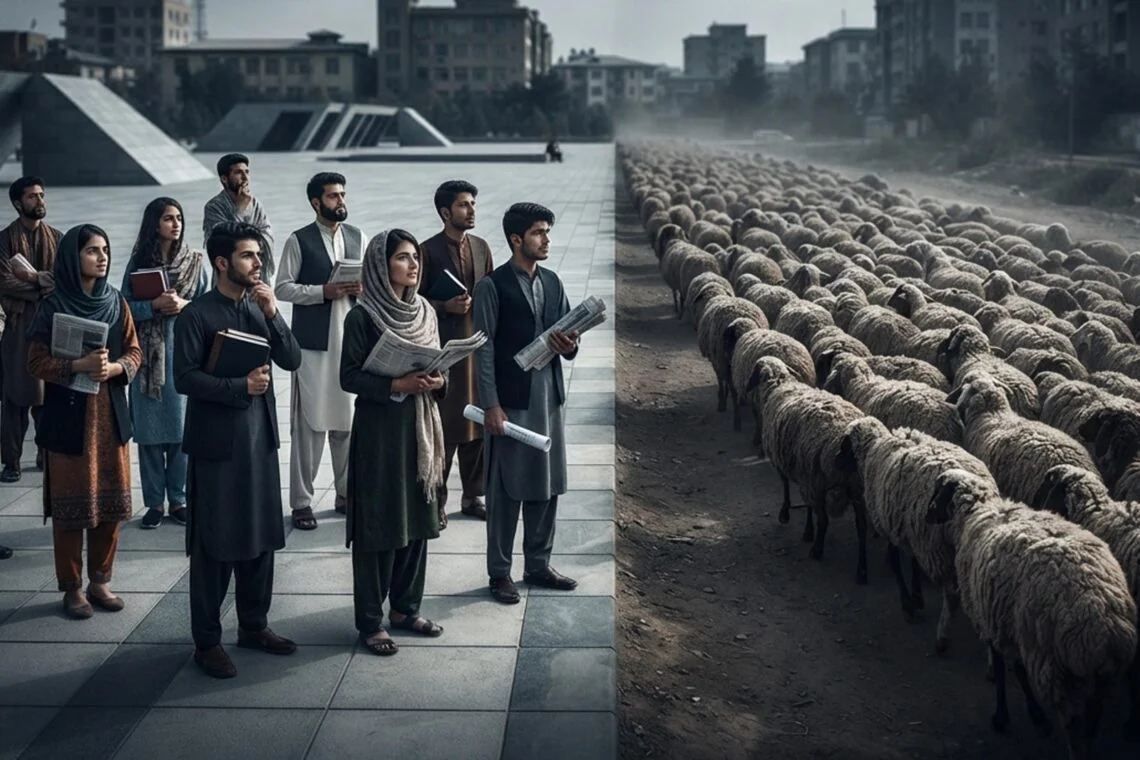
Metaphors in the language of power are not neutral; they reveal the worldview of rulers and draw the boundaries of citizens’ rights. For this reason, the symbolic statement of the Taliban Supreme Leader, who calls himself a “shepherd” and the people a “herd” or “flock”, expresses this group’s worldview about governance and the standing of the people. Totalitarian and authoritarian regimes in Islamic countries, under the guise of religion and Sharia, justify this symbolic view of the position of ruler and people by citing a hadith of the Prophet of Islam with a similar theme. Yet in a world 14 centuries removed from the Prophet, not only has the world been transformed and grown more complex, but human awareness of the self and the surrounding environment has expanded incomparably. For this reason, the principles, knowledge, skills and methods of governance, as well as the nature of the relationship between the ruler, as a public servant, and the people, as the source of the legitimacy of power, have undergone transformation.
In today’s world, a human being is, before anything else, a political being. In the words of Hannah Arendt, the humanity of a human being takes shape precisely in the “public realm” and through “action” and “speech”. Every human being is a unique and unrepeatable person who, on entering the public realm, expresses a point of view, engages in dialogue and contestation with others, and takes part in building the shared world. In such a framework, a “citizen” is someone who enjoys the “right to have rights”, and the state is not his owner but an agent of the collective will and a guardian of the sanctity of the law. Therefore, in modern governance, human freedom, social justice and equality, citizens’ enjoyment of fundamental rights, the separation of powers, political pluralism, fundamental freedoms (including freedom of expression and freedom of belief), the elected and temporary nature of rulers, gender equality, civil society, free media and political parties are counted among the foundational principles of modern governance, which together are referred to as democracy. This model can be seen as a narrative set against the Taliban’s narrative; a narrative whose representatives are the military movements opposed to the Taliban inside the country, a large part of the political parties, civil society, and elites in exile.
With this introduction, it can be said that in contemporary Afghanistan, since the rule of Amir Abdur Rahman Khan, we have constantly lived in the tension between two opposing paradigms: on one side, an unfinished and costly effort to transition to a civil order in which the human being is recognized as a “citizen with rights”, and on the other, the continual reproduction of patriarchal and totalitarian despotism that reduces society to a “herd”, “subjects” and a mass without will. Since the main focus of this commentary is to analyze and describe the attitude of the leadership and the group of the Taliban toward the rights of the people of Afghanistan, we will not address the pre-Taliban past.
The worldview and method of governance and treatment of the people by the Taliban have not changed much over three decades, from the time this group was formed until now. In both periods of their illegitimate rule, Taliban leaders have defined themselves as “shepherds” and the people as a “flock”. In practice, this view regards the leader of this group as a ruler with unlimited competencies and powers, and the people as subjects obliged to obey. The Amir is a person who is “deserving of reverence and irresponsible”, whose obedience is considered obligatory; irresponsible in the sense that he considers himself accountable to no authority. This notion forms the foundation of an authoritarian, master-and-serf order in which the will of the ruler carries the force of law for the subjects. For this reason, in both periods of this group’s rule, the country has lacked a constitution, and the relationship between the ruler (the Taliban) and the ruled (the people) has not been defined in legal terms. This is no coincidence; it is rooted in this very metaphorical belief in the “shepherd” and the “flock”.
In Taliban thinking, the rights and standing of the person in Afghanistan depend on the “benevolence of the Amir al-Mu’minin”. He can call the seizure of people’s land justice, or describe the issuance of a permit to a saffron farmer from Panjshir or Badakhshan on his own land as “the kindness and generosity of the Amir and the government”. In the Taliban’s ideal flock-like, master-and-serf society, not all members of the “flock” are equal; the privileges of a mullah differ from those of a non-mullah; a Pashtun is not equal to a non-Pashtun; just as the privileges of a Talib differ from those of a non-Talib. These differences remind one of the revolt of the animals against their human master in George Orwell’s book “Animal Farm”. After a successful rebellion, the animals make laws for themselves, and one of their seven commandments is that “all animals are equal”. But over time, the new rulers of the farm alter this commandment to justify their extensive privileges and the existing injustice; hence they write: “All animals are equal, but some animals are more equal than others!” Yes! In the clan-based and tribal order of the Taliban, the slogan “all Muslims are equal and brothers” exists, but in practice this slogan has no application or concrete reality.
Just a few days ago, the Taliban’s Minister of Justice called the leader of this group the “spiritual father” of the people of Afghanistan. Before that, Mullah Nida Mohammad Naeem, the Taliban’s Minister of Higher Education, had said that the leader of this group thinks not only of this world but is also concerned with taking the people to paradise. Nevertheless, these titles, descriptions and praises, and hiding behind the mask of religion, morality and goodwill, can in no way conceal the insatiable motive and desire of the Taliban Supreme Leader and of the group itself to monopolize power. Friedrich Nietzsche rightly pointed out that no despot ever admits that he rules to satisfy his thirst for power; rather, he always claims to have come to save the people, preserve morality, and guide them toward paradise.
The metaphor of “spiritual father” for the Taliban Supreme Leader is also noteworthy, and decoding it is important. In a traditional and patriarchal structure, the relationship between father and child, especially a minor child, is unequal and one-sided. In this model, the father, by virtue of his knowledge, experience, or connection to an absolute truth, has the right to decide for the child, to punish him, and to suppress any question or protest from him as “disobedience” or “insolence”. When this familial, pre-modern model is extended to the grand politics of a country, a great catastrophe occurs: the systematic infantilization of citizens. In such a structure, the people of Afghanistan are presumed not to be rational adults with a vote, but minors who forever need guardianship.
In this atmosphere, the concept of “right” gives way to “favor” and “duty”. If the ruler permits breathing or working, this permission comes from paternal kindness, and if he closes the gates of schools and universities to half of the population, that is, women, this action too is justified in the form of “prudence”, “goodwill” and “protecting the chastity and health of society”. This is what Montesquieu refers to as the worst kind of despotism; a despotism that dons the garb of morality, religion, and law so that the victim does not even have the right to lament, and if he protests, he faces not only physical suppression but also the label of “deviation”.
In her prominent work “The Origins of Totalitarianism”, Hannah Arendt shows well that preserving and sustaining the master-and-serf relationship, or in the Taliban’s own phrasing, the relationship between “shepherd” and “flock”, is not possible through force alone; rather, such regimes also employ the strategy of creating deep-rooted fear and gradually habituating society to “humiliation”. This is precisely where the education system and the media become important. The Taliban have turned the education system and the domestic media into systematic instruments of propaganda and brainwashing to embed their ideology in people’s minds and make sure that people not only accept this worldview but come to love it and remain loyal to it. Describing this process, Albert Camus writes that despotism first dries up minds, then cuts out tongues, and finally binds hands; but the catastrophe becomes complete when the people themselves applaud their chains.
In light of Camus’s words, can one become hopeless and pessimistic and abandon the struggle? The answer is no. History bears witness that no totalitarian and despotic system, however many tools of repression and propaganda it has at its disposal, can destroy the essence of human “agency” forever. Unlike the “flock” that the Taliban Supreme Leader speaks of, the human being is a creature with memory, history, and a liberating imagination. Nearly six centuries ago, Étienne de La Boétie, in his famous treatise “Discourse on Voluntary Servitude”, summarized the secret of the fall of all despots in one sentence: “Tyrants seem great only because we are on our knees before them. Rise and see how small they are.”
In the face of despotism, the solution is not to beg for compassion and mercy from the “shepherd” and the “spiritual father”, but to completely reject the worldview of shepherding, master-and-serf relations, and guardianship. As history attests, no matter how long the winter of despotism lasts, it cannot prevent the arrival of the spring of freedom and justice.
You can read the Persian version of this analysis article here: