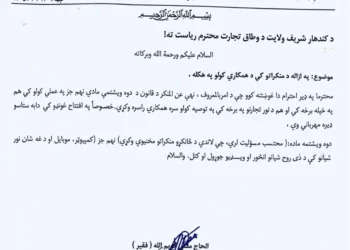
The United Arab Emirates (UAE) recently officially accepted the credentials of Badruddin Haqqani, the Taliban’s ambassador. This makes the UAE the second country, after China, to do so. Furthermore, several months ago, Sirajuddin Haqqani, the Taliban’s Interior Minister, was a guest in the UAE. His visit to Abu Dhabi garnered significant attention because he is under U.S. sanctions, with a $10 million bounty on his location specifications. Nevertheless, the UAE boldly hosted him.
Additionally, Mullah Mohammad Hasan Akhund, the Taliban’s Prime Minister, also visited Abu Dhabi recently. Although the stated purpose of his visit was for “medical examinations,” his meeting with Mohammed bin Zayed Al Nahyan, the President of the UAE, is undoubtedly significant. The key point in the visits of Haqqani and Mullah Hasan is that both chose Abu Dhabi as their first foreign destination after the Taliban’s return to power. These examples indicate a growing relationship between the two sides in recent months.
Beyond these recent developments, the relationship between the two parties has been warm and tension-free since mid-August 2021. The Taliban entrusted the management of the airports in Kandahar, Kabul, and Herat to an Emirati company named “GAC.” Qatar and Türkiye, the UAE’s rivals, attempted to push Abu Dhabi out of this domain but were unsuccessful. Mullah Abdul Ghani Baradar, the Taliban’s Deputy Prime Minister for Economic Affairs, and Mawlawi Mohammad Yaqoob Mujahid, the group’s Defense Minister, also visited the UAE separately, with the latter even meeting Tom West, the U.S. Special Representative for Afghanistan, in Abu Dhabi.
The UAE is one of the Gulf countries striving to act as a mediating force in regional and global conflicts when possible. Its mediation between Russia and Ukraine for the release of prisoners is an effort in this direction. So far, over 1,788 Ukrainian and Russian prisoners have been freed through Abu Dhabi’s mediation. Recently, 115 prisoners were also released with the UAE’s help. Mediation between two hostile nations, one of which is a major power and the other supported by major global powers, can enhance Abu Dhabi’s credibility. Meanwhile, Qatar, the UAE’s rival, has yet to become involved in the Ukraine conflict.
The most significant factor that has driven the UAE closer to the Taliban recently is Qatar’s involvement elsewhere: the Gaza conflict. For the past ten months, Doha has been entangled in the Gaza conflict. As a U.S. ally, Qatar is obligated to end the Gaza war using various mediation tools. More importantly, it hosts key leaders of Hamas, the main party in the Gaza conflict. So far, Doha’s diplomacy in Gaza has not yielded tangible results, though it did manage to establish a one-week ceasefire at one point. Qatar’s entanglement in Gaza has provided Abu Dhabi with the opportunity to pursue closer ties with some Taliban officials.
The UAE’s hosting of Haqqani and Mullah Hasan and its acceptance of the Taliban’s ambassador is no trivial matter. It appears that the UAE is particularly interested in closer ties with the Haqqanis. It is claimed that the Haqqanis have a family connection with the Emiratis. According to available information, one of the wives of Mawlawi Jalaluddin Haqqani, Sirajuddin Haqqani’s father, was a UAE national. Therefore, Abu Dhabi aims to invest in a more obedient Taliban branch. This is likely why they accepted an ambassador with the surname “Haqqani.” This individual may not be a Haqqani by blood but is certainly affiliated with the Haqqani network.
The fact that some Taliban officials have turned to the UAE does not imply a break with Doha. Qatar’s ties with the Taliban are too deep to be severed anytime soon. The Doha process, which has been held three times, has not led to significant outcomes despite the fanfare surrounding it. The prevailing belief is that continuing this process in its current form and nature cannot break the deadlock in Afghanistan. Therefore, it is not unlikely that Abu Dhabi will seek to present an alternative plan, hoping to play a primary and essential role if the Afghan crisis is resolved through dialogue. However, even in this scenario, the likelihood of success remains slim. The acceptance of Haqqani’s credentials is a serious attempt to keep the Taliban content and to distance them from Qatar. This is while none of Afghanistan’s neighboring countries have dared to accept the credentials of a Taliban ambassador. The Taliban will not forget this gesture by Abu Dhabi.
Recently, Mardif Al-Qashouti, the Qatari Embassy Counselor in Kabul, met with Mawlawi Abdul Kabir, the Taliban’s Deputy Prime Minister for Political Affairs, emphasizing the importance of maintaining relations between the two sides. This meeting is said to be a reaction to the recent visits of Taliban officials to the UAE. Al-Qashouti promised the Taliban that flights between Qatar and Afghanistan would resume.
The UAE’s relationship with Iran is also not particularly warm, while Tehran and Riyadh’s relations seem to be normal and tension-free. Saudi Arabia has done nothing in Afghanistan over the past three years that could be seen as undermining Iran’s interests. On the contrary, it closed its embassy in Kabul and withdrew its diplomats, which could be seen as favorable to Tehran. However, Abu Dhabi has remained an active player in Afghanistan, possibly aiming to prevent the Taliban from becoming overly dependent on Afghanistan’s neighbors, particularly Iran. Of course, the Taliban’s stance is also clear: they prefer the Arab Gulf countries over Iran. There are plenty of reasons to support this claim.
You can read the Persian version of this analysis here: