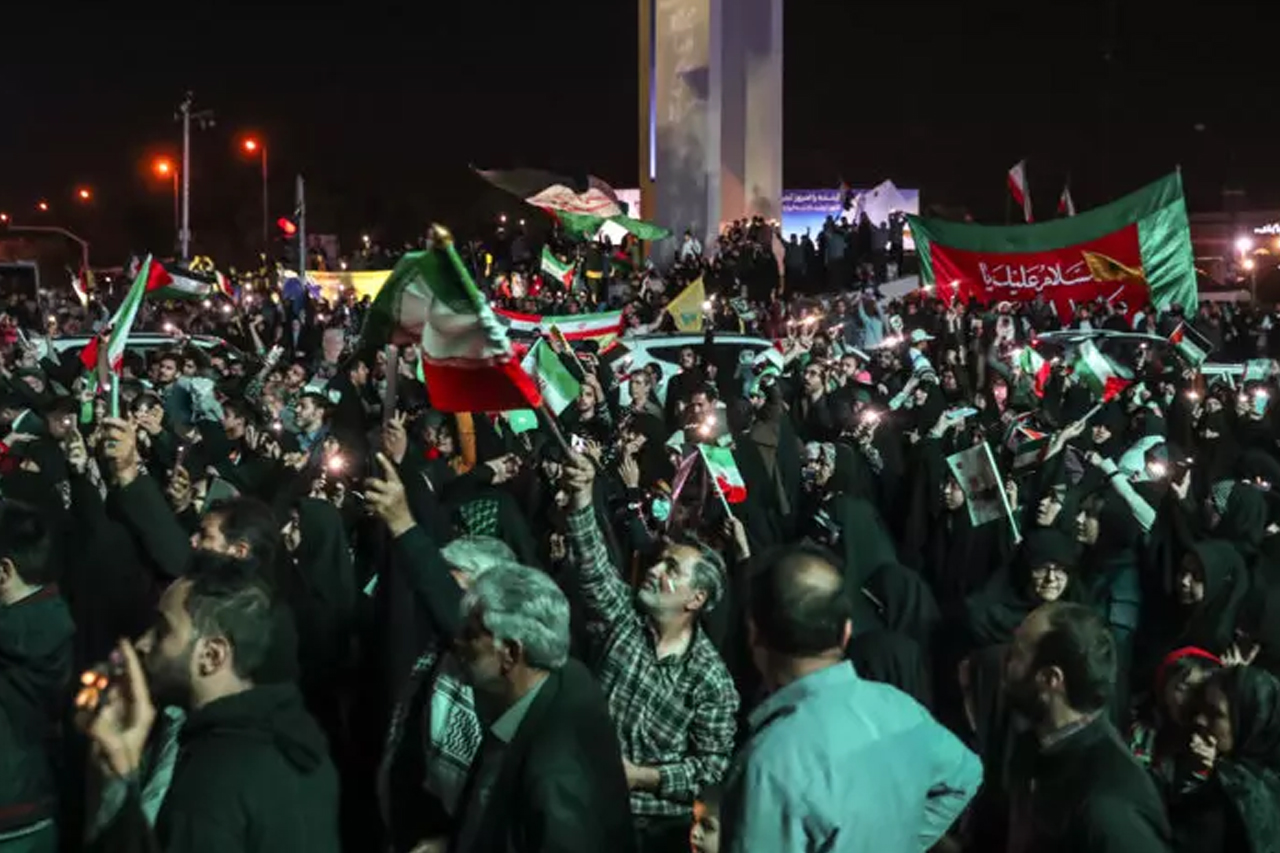
The recent attack by Hamas on Israeli soil has reignited the narrative of the Islamic Republic of Iran’s support for Palestine and the Palestinians. What makes Iran’s support for the Palestinians intriguing is its Shia orientation. While Palestinians are neither Shia nor Persian speakers, Shia Iran is arguably more committed to supporting the Palestinians than Sunni Arab states. The Islamic Republic’s presence in the Middle East is justified as a necessity to defend the Palestinians. Militant groups loyal to Iran, operating under the guise of the “Resistance Axis” in the region, also claim that the Palestinian issue is significant to them. The Islamic Republic even under the guise of supporting Palestinians, wishes for the destruction of Israel. While Sunni Arabs are striving to foster friendship with Iran, evidence suggests that despite the advantages of friendship with Israel for the Islamic Republic, it has not refrained from chanting slogans of Israel’s destruction.
The question arises: Why does the Islamic Republic go so far as to wish for the destruction of Israel in its support for the Palestinians?
To provide an answer to this question, attention to the four important following points is crucial.
1- Competition with Saudi Arabia as a driving factor
The victory of the Islamic Revolution in Iran was unsettling news for Saudi Arabia; because the fall of the Pahlavi monarchy, with which it had warm relations, led to the establishment of a new regime that advocated a Shia-based revolution. Riyadh, which considers itself the singular center of the Islamic world, found itself facing a new rival with the emergence of the Islamic Republic. Since then, Tehran and Riyadh have sought to undermine each other. For example, Saudi Arabia supported Iraq against Iran in the first Gulf War. In the second Gulf War, it supported Kuwait against Iraq. Saudi Arabia went so far as to establish the Gulf Cooperation Council to counter Iran, a council whose members are all wary of revolution and revolutionary fervor. In the Yemeni civil war, the two countries were indirectly involved in the conflict.
Tehran and Riyadh, both claiming leadership in the Islamic world, see the Palestinian issue as a yardstick for measuring their commitment to the rights of Muslims. However, this point is more evident in the minds of ordinary Muslims than necessarily in the policies of governments. Nevertheless, governments also strive to proceed cautiously in normalizing relations with Israel. Therefore, the Islamic Republic considers support for Palestinians essential for its credibility and to discredit Saudi Arabia. Especially in the past year, as the issue of normalization of relations between Riyadh and Tel Aviv has escalated, the Islamic Republic can better play the card of supporting Palestinians against Riyadh. For example, when asked about the normalization of relations between Riyadh and Tel Aviv on the sidelines of the annual United Nations General Assembly meeting, Iranian President Seyyed Ebrahim Raisi said, “Such an agreement will be a dagger in the back of the Palestinian people and their resistance.”
2- Iran does not want to be called the standard-bearer of the Shia Crescent
The Islamic Republic is known as the advocate of Shia Islam. Many believe its interventions in some Middle Eastern countries aim to consolidate the position of Shia Muslims. Shia communities in countries even with a Shia majority did not fare well before the establishment of the Islamic Republic. In Lebanon, with Iran’s support, a group known as Hezbollah emerged as the advocate of Shia rights, solidifying their position in power. The rule of the Houthis over a significant portion of Yemen’s geography is also attributed to Tehran’s support. The survival of Bashar al-Assad, the President of Syria, who belongs to the Shia Alawi sect, is also dependent on the support of the Islamic Republic. Iran termed the popular protests that began in 2011 in the Arab world as the “Islamic Awakening,” a term that was unpopular among Arab governments. When this so-called Islamic Awakening reached Syria, the Islamic Republic stood against it because the survival of Bashar al-Assad became important to it. In Iraq, Iran inadvertently benefited from the field being cleared. The US military intervention led to the fall of Saddam Hussein’s regime, a downfall from which the Islamic Republic and its loyal groups were not expected to benefit. The replacement of Sunnis with Shia in Iraq raised concerns among Sunni Arab governments, to the extent that King Abdullah II of Jordan announced the formation of a Shia Crescent under Iranian domination. His envisioned Shia Crescent includes countries such as Iraq, Iran, Lebanon, and Syria, with Iran being considered its driving force.
The Islamic Republic, despite the aforementioned examples, rejects claims that it is the standard-bearer of the Shia Crescent. Therefore, to rid itself of the stigma of Shia sectarianism, it resorts to supporting Palestinians, especially Hamas and Islamic Jihad movements. If these two groups, members of the Resistance Axis that Iran refers to, were not present, that axis would become a Shia movement inadvertently pitted against Sunni Arabs. To this end, the Islamic Republic seeks to portray the Palestinian issue as Islamic rather than purely Arab. Whereas in the past, the Palestinian dispute was pursued by Arab states under the banner of Arab nationalism. Ayatollah Ali Khamenei, the Supreme Leader of the Islamic Republic, had said: “The Islamic Republic of Iran has not been limited or affected by religious constraints and differences by the grace and favor of God. Just as it assists the Shia Hezbollah in Lebanon, it also supports Hamas, Islamic Jihad, and other Sunni groups in Palestine, and will continue to do so.” These statements serve as a response to claims labeling the Islamic Republic as the standard-bearer of the Shia Crescent. The loss for Palestinians, especially Hamas, is that Sunni Arab states, especially Saudis, do not support them against Israel because they compete with Tehran. However, the ongoing war in Gaza has clarified this point better.
Closer ties with the Taliban group can also be interpreted as part of efforts to rid the Islamic Republic of Shia sectarianism. However, there are other more influential factors at play. For instance, Ali Akbar Ahmadian, Secretary of Iran’s Supreme National Security Council, recently claimed: “The Islamic Republic has managed to find common ground with Hamas, which is Sunni. This approach is also evident in dealing with the Taliban government.”
3- Justification for hostility towards Israel
In the context of the Islamic Republic’s enmity with Israel, an important point is raised, namely, whether this enmity is solely due to the violation of Palestinian rights or if other factors, such as the previous friendship with Tel Aviv during the Pahlavi regime, are at play. The Islamic Republic does not have relations with three countries that had friendly relations with the Pahlavi regime: Israel, Egypt, and the United States. The Shah of Iran was the first ruler in the Islamic world to unofficially recognize Israel despite all opposition and maintained clandestine ties with it. The United States was also the biggest supporter of the Shah, and without its hospitality, the hostage-taking of American diplomats in Tehran would not have occurred. Anwar Sadat, the President of Egypt, also sought refuge with Mohammad Reza Shah, and when he died, his body was buried with honor and respect in Cairo. Tehran responded by severing ties with Egypt, which has not returned to normalcy even after 45 years. After Anwar Sadat was assassinated, a road in Tehran was named after his killer: Khaled Islambouli. This still poses an obstacle to the normalization of Tehran and Cairo relations. The Bonn Conference on Afghanistan is also a good example. Javad Zarif, Iran’s former Foreign Minister, claimed in media talks: “The Europeans wanted to revive the monarchy in Afghanistan; we intervened and prevented it.” Because, according to him, the Islamic Republic, which overthrew the monarchy, could not tolerate it in its neighborhood. Zarif even claimed to have been in sync with the US representative in this regard; a country that the Islamic Republic considers an enemy. This claim by Zarif contradicts claims he has repeatedly made in the media: “Iran supports a military solution in Afghanistan that the people of that country want and accept.”
The above examples illustrate the sensitivity of the Islamic Republic towards the Pahlavi monarchy and Mohammad Reza Shah. Therefore, many believe that the Islamic Republic’s hostility towards Israel is more due to its friendship with the Pahlavi regime than solely the violation of Palestinian rights and the occupation of their land. Egypt and the United States, who were supporters of Mohammad Reza Shah, have not yet normalized relations with the Islamic Republic. However, Tehran’s approach to Israel differs from its approach to Egypt and the United States.
4: The claim of supporting the oppressed among the arrogant
The claim of supporting the oppressed against the oppressors is put forward by the Islamic Republic and its supporters. This claim is based on Article 154 of the Islamic Republic’s Constitution, which states: “The Islamic Republic of Iran supports the struggles of the oppressed for their rights against the oppressors in every corner of the globe while observing complete non-interference in the internal affairs of other nations.” According to this claim, Palestinians are considered the oppressed while Israel is labeled as the oppressor, deemed unworthy of survival by the Islamic Republic.
However, the arguments used to justify this claim have not satisfied the opponents. They argue that the proponents fail to clearly define who the oppressed and oppressors are, not limiting them to Palestinians and Israel respectively, but rather encompassing other nations and people. The Islamic Republic seems insensitive to other nations and countries being either oppressors or oppressed. The clear example of China’s treatment of Uighur Muslims highlights this issue. Human rights organizations and Islamic countries have repeatedly accused the Chinese government of violating the rights of Uighur Muslims, yet the Islamic Republic has remained silent or occasionally attempted to justify China’s actions. For instance, following the signing of a 25-year strategic cooperation agreement between Iran and China in March 2021, Mohammadreza Keshavarzzadeh, Iran’s ambassador to Beijing, claimed that Uighur Muslims in China are not only not suppressed but also enjoy better living conditions. The reason for this silence and justification is clear: China is a major power and does not have good relations with the Western world, especially the United States. Therefore, the Islamic Republic, in its defense of what it calls the rights of the oppressed against the oppressors, is often accused by many of engaging in double standards.