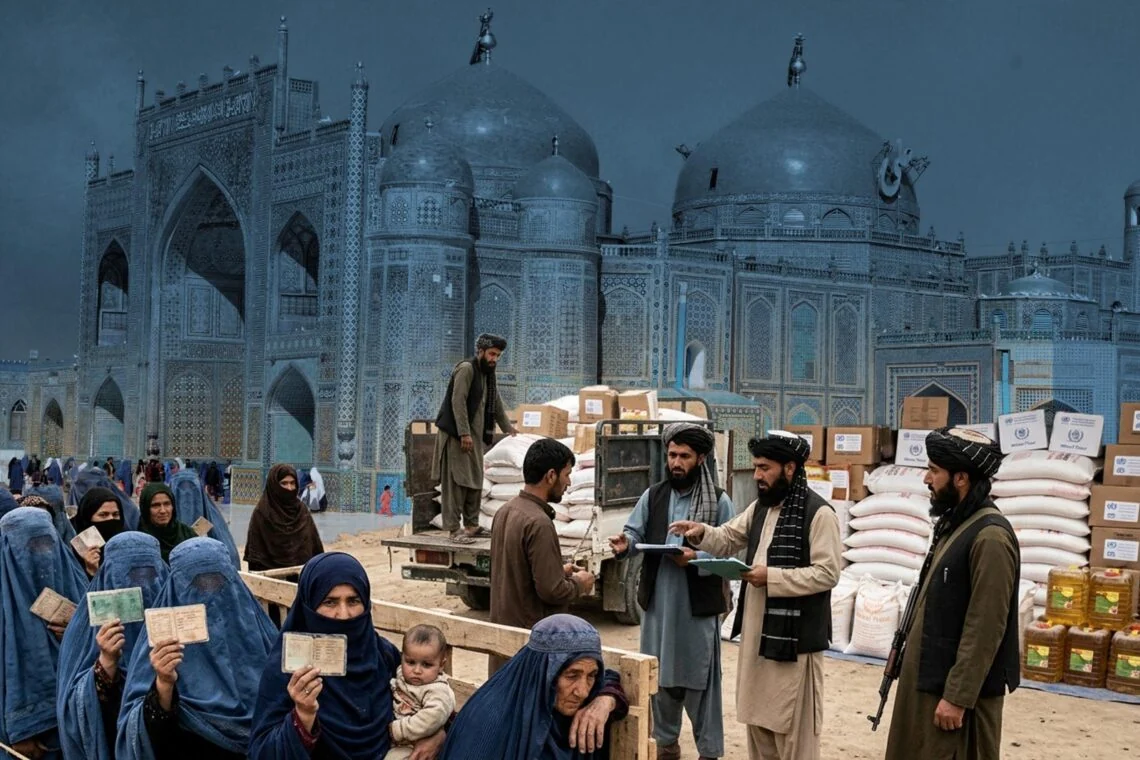
Sources in Mazar-e-Sharif, the capital of Balkh Province, have expressed serious concern over Taliban interference and the misappropriation of aid intended for people in need. They say that some aid organizations provide women with training and work opportunities in tailoring, handicrafts, and other professions, but most Taliban members enroll their own families, so the assistance does not reach those who need it. According to them, women and girls who have been deprived of education are also being denied training in these professions.
Local sources in some areas of Mazar-e-Sharif say that organizations offering tailoring training to women and girls and supplying the necessary equipment have seen most of this aid distributed by Taliban members and local elders, and it does not reach the needy.
Some women say that Taliban members are widely involved in the misappropriation of aid and in interfering with its distribution. They say that any organization wishing to operate in a given sector gives priority to individuals introduced by the Taliban. According to them, in some cases Taliban members even add people to the lists of aid recipients and then take half of their assistance for themselves.
These women say that the Taliban promise some individuals, particularly women in need, that their names will be added to the lists of aid recipients, but in return they demand that, after receiving the aid, they hand half of it over to Taliban members.
One woman says: “The organizations create opportunities for women to learn tailoring. First, the local elders make the decisions, and Taliban members are present alongside them. Whatever their level, they first enroll their mothers, sisters and wives in the tailoring courses, and they rent out their houses, because the institutions offer benefits to tailoring students, including a sewing machine and a monthly stipend.”
The woman adds: “This aid does not reach those who deserve it. Women who have been deprived of education, schooling and work are denied even tailoring training because they have no connections or acquaintances. To be enrolled in tailoring courses, they are forced to pay bribes or share the benefits they receive with the Taliban.”
The Hasht-e Subh Daily has previously found in several reports that the Taliban distribute humanitarian aid among their own families and relatives and extort money from poor people who receive this aid.
Meanwhile, the Secretary-General of the United Nations (UN) said in a report that, from April 1 to June 30, 2026, humanitarian organizations recorded 159 cases of Taliban restrictions on access to humanitarian aid. According to the report, 86 humanitarian activities were suspended as a result of these interferences. The Taliban’s Ministry for the Propagation of Virtue and Prevention of Vice was linked to 40 of these interferences, and in 24 cases, restrictions were imposed on the participation of women staff in humanitarian activities or on women’s access to aid.
Likewise, according to an assessment by the UN Office for the Coordination of Humanitarian Affairs (OCHA) of the state of access to humanitarian aid in July 2026, published in September, 16 of the 30 recorded restrictions on access to humanitarian aid involved interference in the activities of relief organizations.
The report states that in three cases Taliban officials interfered in the selection of aid recipients, and in three other cases they interfered in the implementation of humanitarian programs. In two cases, relief organizations were also forced to provide lists of their staff or sensitive information. According to the report, as a result of these restrictions, 18 aid programs were temporarily suspended, and two humanitarian centers were closed.
In addition, Edem Wosornu, a senior official at OCHA, told the UN Security Council in May 2026 that humanitarian organizations face pressure to influence the selection of aid recipients and project contracts. She also warned about the risk of humanitarian aid being diverted and stressed that the UN has strengthened its monitoring of aid distribution and its review of complaints to prevent abuse.
In one suspected case in Kunar Province, the UN conducted further investigations after receiving a report about the possible diversion of cash assistance. The organization announced that, during its review of the lists of aid recipients, no evidence of fraud or diversion of aid was found.
You can read the Persian version of this report here;
مداخله طالبان در توزیع کمکها در بلخ؛ زنان نیازمند از دریافت کمکها محروم میشوند