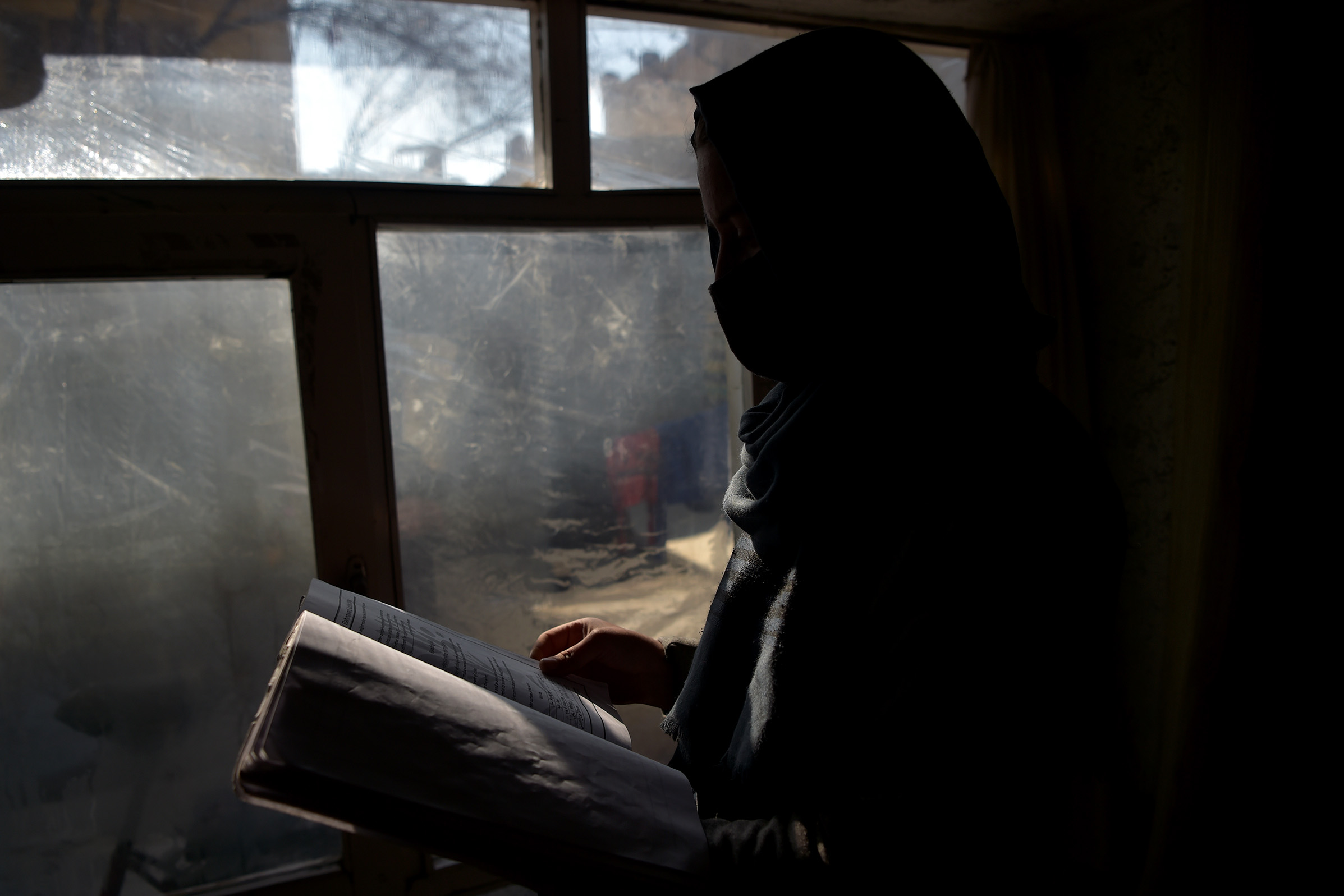
Today, once again, I picked up the pen to shout out the voices of girls that remain unheard. Whenever I tried to write about my fate and that of my peers, my pen ran dry, and my mind went blank. Even the pen seems afraid of reflecting our pain and refuses to touch the pages of the notebook. Perhaps the pen is tired, and the notebook no longer has space to accommodate our fresh pains. If I describe the sky these days, I could say that it has lost its color and blended with the gray world of women and girls here. It’s been a long time since the sun has risen upon our lives; the city sky reflects their oppression and cruelty, and the coldness of the air has turned the hopelessness of the bare-bodied girls into something tangible.
731 days have passed since the closure of schools for girls above the sixth grade. The girls of our country have been barred from education because education is considered a disgrace for the girls of this land, and we must not leave our homes until further notice, as leaving would be deemed dishonorable according to the religion of these rulers.
This is Afghanistan; Afghanistan that for years has bound women in the shackles of patriarchal tyranny, a land where being a woman like Rabia is a crime. It’s a land where women like Farkhunda are brutally murdered on the streets in inhuman ways, yet no one raises an eyebrow. It’s a land where girls have no right to education, work, or even life, yet the world remains indifferent. In the following narrative, you will read about a girl from the early days of Taliban rule in Afghanistan.
I stayed awake all last night, and as I gazed at the sky from behind the window bars, the pages of the book I held displayed the path to tomorrow. In the room, besides the ticking of the clock, no other sound could be heard, and these moments crafted a melancholic melody with the mournful sound of my heart. The storm was pounding on the house. It seemed to forewarn of a terrifying future. I glanced at the clock, which showed six in the morning. It was time; I had to head to school.
I immediately jumped up and set foot towards the doorway of our small house when a voice echoed from behind me: “Fatima, Fatima, do you hear me?”
It was my dear mother’s voice!
With a tired and troubled voice, bearing the signs of too much studying the previous night, I said yes. Her voice faded away. I went searching for her, to find her sitting in our small room, leaning against the wall, lamenting, “Last night, the Taliban seized Jalalabad, and they’re heading for Kabul until the early seven in the morning they will capture it too. Don’t go to school today, lest a calamity befalls you.” Then, with a choked sob, she continued, “My daughter, our livelihood is ruined.” I didn’t say a word, but something broke within me. The aspirations I had promised to fulfill paraded before my eyes; aspirations that would no longer come true. With weariness, I said, “But mother, I have an exam today, and I must go to pass this grade.” Mother, with patience, said, “Fatima, aren’t my words understandable? There’s no news of the school anymore, and the Taliban won’t allow girls to study.” I had listened to my mother’s words, but nothing changed in my mind, and I kept telling myself that going to school was imperative. With tears and sorrow, I told my mother, “Let me go, or else I won’t become the top student in the class.” Mother said, “Fatima, accept that going to school won’t heal our pains. Now, we must think how to survive.”
For a moment, I pondered my existence and what I wanted. Something resonated in my mind that said, “You’re Fatima, the daughter of a martyr, from a poor and fighting family. Your father was martyred fighting the Taliban, and you must take care of your younger sisters. Their future is in your hands. So, you must study!” Without a word, I put on my black clothes and stepped out of the house, and all along the way, I thought about shattered dreams, my throat tightened, and my eyes clouded. I kept telling myself, that Fatima was supposed to become a doctor. She was supposed to fulfill the aspirations of her martyr father.
I choked back tears, shed tears, and pondered the uncertain future; a future that was no longer in our hands, and the people of this city had to decide for us. Lost in thought, I heard a voice behind me say, “Fatima!” Hurriedly, I turned towards the voice and saw Zahra. Zahra, the kind and deserving member of our class who aspired to become a lawyer in the future. With a sad tone, she said, “News has come that the Taliban are set to take over the government. It means schools will be closed to us.” With a tearful voice, I replied, “I know the news.”
Zahra was crying bitterly. I gently touched her cheek and said, “Zahra, the power and authority of the oppressive regime are not enduring, and our dawn is near. So, don’t cry!” With a sob, she said, “Fatima, I don’t want to be illiterate like my mother. I want to become a lawyer. Is this wish of mine too big?” In response, I said, “Zahra, your wish is not too big; however, they have tolerated injustice and oppression upon us, and for now, we must be patient.”
After much discussion, we arrived at the school. The school gate was surrounded by girls who were fighting for their future. We joined the other girls. One girl said, “They won’t let us enter the school.” She was holding back her tears, trying not to burst into tears.
A while later, a voice echoed from the mosque: “Dear girls and sisters! Keep away from the school gates and return to your homes. Until further notice, schools are closed.” Whispering to myself, “Until further notice!” I felt my hopes slipping away and turned away from the school gate.