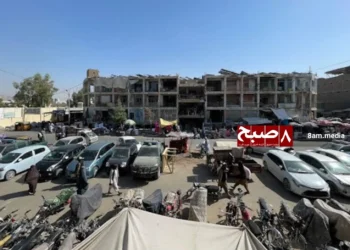
If we recall, Donald Trump, the president of the United States, a month after returning to the White House, expressed visible displeasure during a major rally over a military parade staged by the Taliban on August 15, the anniversary of their return to power and the collapse of the Islamic Republic. Speaking to the crowd, he said: “They [the Taliban] have a parade every year where they take our military vehicles, the ones with the big wheels, and drive them down a little street, as if that’s their military parade. When I see it, I get really mad. Mad. When I see it, I get mad.”
Indeed, in recent years, the Taliban have held grandiose military parades at Bagram Air Base, flaunting their arsenal with swagger and broadcasting images and videos across media and social networks. The intent was clear: to draw the world’s and especially Afghanistan’s neighbors’ attention to their stockpile of weapons, and to dispel any notion that they were a weak force lacking offensive and defensive capabilities. Taliban leaders, appearing in person at such events, delivered impassioned, populist speeches, extolling what they call the establishment of an “Islamic system” and urging citizens to offer full, unconditional support.
Now, given Trump’s past irritation, the question arises: in their fourth year back in power, will the Taliban once again stage a military parade in the same style as previous years at Bagram?
The reality is that the Taliban, like many other states and groups, is mindful of Trump’s defining trait, unpredictability, and generally seeks to win his favor rather than provoke his ire through clumsy words or actions. This unpredictability has become even more evident in recent months. Just two days before the start of the fifth round of nuclear talks with Iran, Trump, mid-discussion, nodded approvingly at the idea of a strike against the Islamic Republic, a gesture that underscored how difficult it is to read him. Thus, if the Taliban revert to their old-style parade at Bagram and, worse still, invite Chinese, Russian, and Iranian diplomats, they will almost certainly fuel Trump’s anger. Such a move could diminish Washington’s willingness to engage with the group.
The next question is: what happens if Trump becomes incensed at the sight of a Taliban parade? True, the United States is unlikely to launch a military strike on Afghanistan or reclaim its military hardware from the group. But it could place Taliban officials back on sanctions lists, something it has done before. More significantly, Trump could take the broader step of designating the Taliban as a terrorist organization, a measure with strong backing in the U.S. Congress and reportedly already under consideration. In addition, Trump administration officials could, even symbolically, meet with members of Taliban opposition forces, an act the group views as a nightmare scenario and will go to great lengths to avoid. Of course, all this depends on whether Trump remains committed to his previously articulated positions.
Given all of the above, on August 15 this year, the Taliban are likely to take Trump’s sensitivities into account. In doing so, they face three possible options, all designed to win the favor of the White House’s occupant:
- The Taliban could hold a parade, but on a smaller scale than in previous years and preferably at a location other than Bagram, a base whose fate Trump considers especially significant. This parade would avoid showcasing the heaviest and most advanced U.S.-made military equipment, the very kind that Trump singled out in his speech as a source of anger. Taliban officials, in turn, would exercise caution in their remarks, opting for language laced with diplomatic niceties rather than ideological rhetoric.
- The Taliban could proceed with a parade at Bagram in the same style and form as previous years, but with one crucial difference: they would secure Trump’s explicit approval beforehand. Given his distinctive temperament, Trump might not only grant permission but even express satisfaction, much as he did when recalling Iran’s missile strike on the U.S. Al Udeid Air Base in Qatar: “They called me and said they needed to launch an attack on us [the U.S.]. The call came from Iran, very respectful. That means they respect us. Because we had dropped 14 bombs, they said they’d like to hit us 14 times. I said, Go ahead.”
- The Taliban could forgo the parade entirely, again with the aim of pleasing Trump, while formally notifying the White House of the reason for their decision. In this scenario, the group would instead organize a commemorative political gathering where several leaders would deliver speeches. While this might earn Trump’s favor, it would likely displease rank-and-file Taliban fighters, many of whom remain deeply ideological and still view the fight against the U.S. as significant. It could also invite ridicule from the public. However, the Taliban are not especially concerned with public mockery; they can be expected to justify their decision with a range of religious and non-religious narratives.
Among these three options, the Taliban’s preference would likely be the second: it allows them to hold a parade in the traditional style while also currying favor with Trump, a dual advantage absent from the first and third scenarios.
You can read the Persian version of this analysis here:
۱۵ آگست و عصبانیت ترمپ؛ آیا طالبان باز هم «رژه نظامی» برگزار میکنند؟