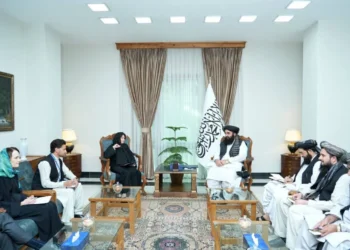
In recent days, Dr. Anwar al-Haq Ahadi’s interview with Amu TV, an Afghan international satellite channel, has sparked widespread reaction and debate. In the interview, Dr. Ahadi addressed issues of ethnic and national identity, presenting a perspective grounded in the argument that, globally, many nation-states derive their national identity from the ethnic, tribal, or founding group that established them. From this standpoint, he concludes that Afghanistan’s national identity should be defined as either “Afghani” or “Pashtun.”
Responses from Afghan citizens, particularly those living abroad, have generally fallen into three distinct categories. Each group, based on its own perspective, has analyzed the interview and reached differing conclusions. In some cases, the criticism targets Dr. Ahadi personally; in others, it is directed at the interviewing journalist, and in some instances, both.
The first group has sharply criticized Dr. Ahadi. According to this group, while some of his statements may reflect certain ground realities, his repeated emphasis and apparent pride in them starkly contradict human rights norms and religious values. From their perspective, elevating the values of a specific ethnic group to the standard of national identity constitutes a violation of the principle of human equality, a principle that is foundational in both human rights documents and religious teachings.
In contrast, the second group has expressed approval of Dr. Ahadi’s remarks. They appreciate the candor with which he articulated the objectives of certain segments of the Pashtun elite in Afghan politics. From their viewpoint, such discussions can serve an enlightening function and potentially increase political awareness among non-Pashtun Afghan citizens. They believe that openly presenting these perspectives could, in the long term, promote greater rationality in political behavior.
The third group’s response is markedly different. Composed largely of ethnically Pashtun conservatives, this group criticized both the interviewer and Dr. Ahadi for conducting and broadcasting the interview. They argue that Dr. Ahadi should not have exposed these issues so explicitly or revealed the hidden objectives of certain Pashtun elites. Some reactions within this group included vulgar language and insults, which are beyond the scope of this analysis.
In addition to these three groups, there is a smaller faction that regards the interview as lacking empirical, objective, and scholarly value. According to these critics, Dr. Ahadi, taking advantage of the global rightward political shift and Afghanistan’s current situation under Taliban rule, leveraged the circumstances for personal gain, engaging in what they describe as opportunistic political maneuvering.
Before offering my own assessment, it is important to briefly note Dr. Ahadi’s background. Born roughly 75 years ago in a traditional village in eastern Kabul province, Anwar al-Haq (sometimes spelled Anwarul Haq) Ahadi studied economics and political science at universities in Lebanon and Illinois, USA. He also served as an adjunct professor at several American universities. Before holding high-level economic and political positions in Afghanistan for over fifteen years, he briefly worked in banking in the United States. With over four decades of engagement in Afghan political theory, Dr. Ahadi also led the party known as Afghan Milat. (Afghan Nation) Currently, he oversees the Afghanistan Trust Fund under the UN Development Programme, managing Afghanistan’s frozen overseas assets following the Taliban’s return to power.
Regarding his recent statements, my view is that while they may reflect some on-the-ground realities, expressing them in Afghanistan’s current context is highly inappropriate and irresponsible. Afghanistan is a nation long afflicted by war, poverty, and suffering, now at one of its most sensitive historical junctures. On the one hand, the Taliban have, over the past four years, systematically dismantled the country’s physical, administrative, and moral infrastructure. On the other hand, widespread poverty, unemployment, lack of education, and the absence of basic living conditions have left the population demoralized, fearful, and hopeless. The Taliban exploit Afghanistan’s natural resources and assets in unprecedentedly personal and factional ways, depriving citizens of fundamental human values such as freedom, psychological security, and hope.
In such a context, Dr. Ahadi’s remarks do not merely deepen public despair; they are tantamount to rubbing salt into the nation’s wounds. Speaking in this manner to a suffering population is in stark conflict with both religious teachings and human rights principles.
Most importantly, the vast majority of Afghans, irrespective of ethnic, linguistic, or tribal affiliation, continue to live side by side and share their burdens, a fragile coexistence that mitigates some of their psychological suffering. Dr. Ahadi’s statements, however, directly threaten this delicate social fabric, exacerbating collective grief and sorrow. It can be said with confidence that his rhetoric, while expressed in calm language, insults the principle of coexistence and risks fueling animosity, hostility, and social discord. In doing so, Dr. Ahadi disrespects nearly forty million Afghan citizens, inflicting a wound that, although articulated softly, scorches the roots of a nation already suffering under the harsh sun of prejudice.
A look at Afghanistan’s history, both in modern times and in earlier eras, shows that no single group has ever been able to establish lasting and permanent authority in this land. Viewed through this historical lens, it can be stated with confidence that the Taliban, too, will eventually be removed from power, sooner rather than later, in my view. Yet Dr. Ahadi’s statements turn the day after the Taliban fall into a black day and the beginning of new miseries. His remarks exacerbate ethnic, linguistic, religious, and communal divisions, eroding the fragile and relative values that have underpinned Afghanistan’s nation-building and igniting the flames of conflict, not only across cities and provinces but deep within neighborhoods and households.
What Dr. Ahadi refers to as “ethno-national values” and his attempt to elevate ethnic values to a national level will, in the post-Taliban future, threaten the roots of the very ethnic groups he highlights. In the present context, such statements intensify identity-based hostilities and undermine Afghanistan’s already incomplete and fragile nation-building process. In my view, these perspectives not only jeopardize the identities of non-Pashtun communities, pushing them toward defensive identity-driven responses, but also harm Pashtun identity itself. They raise the critical question for Pashtuns: how effective has an identity that has dominated for nearly three centuries been if it could not even achieve modest progress or development, and what role could it possibly play in the future?
Given these realities, practical measures are urgently needed to mitigate the dangerous consequences of such statements. First, Dr. Ahadi should publicly and formally apologize for his remarks that have been perceived as offensive. Second, Pashtun elders and elites should clearly state that these comments do not reflect the collective beliefs of their community and are solely Dr. Ahadi’s personal opinion. Third, citizens and especially the intelligentsia can petition, including through online petitions, to the United Nations and its development programs, requesting that responsibility for the Afghanistan Trust Fund be transferred to another individual, as a person with such tribalist views is not fit to occupy this sensitive position. Finally, people and civil society groups should respond to Dr. Ahadi’s remarks not with insults or vulgarity but with reasoned critique and factual clarification, preventing the distortion or misrepresentation of ethnopolitical realities in Afghanistan’s historical record.
You can read the Persian version of this analysis here:
دکتور احدی و کوبیدن آخرین میخ بر تابوت ملتی بهنام افغانستان