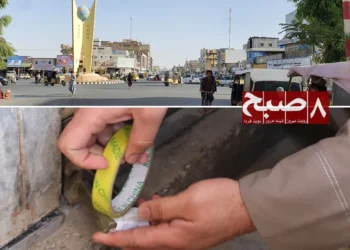

Several Kabul residents are voicing growing frustration over the mounting piles of garbage across various parts of the city. They say the volume of waste in streets and alleys has increased noticeably in recent days, while collection services have largely failed to keep up. The buildup, they add, has produced foul odors, drawn swarms of insects, and raised serious health concerns for families, particularly children. In some areas, residents say, waste is being dumped at unauthorized sites and left untouched for months.
Speaking to the Hasht-e Subh Daily, residents warned that without a regular and effective waste collection system, the situation could spiral into a full-blown public health crisis. They stress that the responsible institutions must not only expand municipal services but also launch public awareness campaigns, so that the proper use of garbage bins and a culture of environmental cleanliness take root among citizens.
Homaira, a Kabul resident, complains about the piles of garbage in her neighborhood. She says waste collection and the cleaning of drainage canals are consistently delayed, creating serious problems for residents. Families pay a monthly fee to a sanitation company to remove their household waste, she said, yet many neighbors still toss their garbage into the river or dump it on vacant plots of land.
She also criticized the performance of the Taliban-run municipality, saying the authorities are paying little attention to the issue and that garbage is rarely collected from streets or bins on time. “Collecting this garbage takes about one to one and a half months, and that is a serious problem,” she said. “Sometimes cleaning is carried out only once every three or four months. Now that private companies have been shut down, the municipality’s responsibilities have grown, and far greater attention must be paid to clearing canals, collecting waste, and tidying up neighborhoods.”
Zikrullah, another Kabul resident, says the accumulation of garbage across the city has become a habit for some people. He notes that Kabul’s sewage system runs in open canals, and many residents thoughtlessly toss their waste into them. According to him, the municipality is also slow to clean these canals and empty the bins.
“Unfortunately, in Kabul, throwing garbage onto the streets and into the canals, whether bins are available or not, has become a habit,” he said. “Because the city’s sewage system is open and people dump their waste into the canals, it has turned into an unconscious behavior. Many residents are simply unwilling to carry their garbage to a proper disposal point. This is not a new problem; it has gone on for years, and one or two generations have grown up with it. Solving it requires promoting a proper culture in society and strengthening a sense of responsibility and belonging to the city, so that people think about the cleanliness of their surroundings every time they throw something away.”
Zikrullah added: “Simply adding more garbage bins will not solve the problem unless people are encouraged to use them properly. Unfortunately, in Afghanistan, many have grown accustomed to this way of life. Changing the situation requires not only regular services but also awareness campaigns through the media, social networks, and responsible institutions, including the municipality.”
Shamsullah, another Kabul resident, says there is no designated location for disposing of waste in his neighborhood. He describes the buildup of garbage in residential areas as a serious challenge for which the Taliban have offered no solution.
“In the 315 and 500-Family neighborhoods of Khair Khana, no proper facility has been set aside for waste disposal,” he said. “There are bins in only a handful of places, including near the Lyce-e Maryam area, and even those are not enough.”
Shamsullah added: “Some private companies operate in residential areas, but in the city itself, especially near shops and commercial zones, there are no proper bins. As a result, many people throw their waste into the canals. Some even haul it down to the river and dump it there, which only worsens environmental pollution. As the weather warms, this could also pave the way for the spread of disease. We hope a fundamental solution will be found so that people are no longer forced to dump their garbage into canals and rivers.”
The Taliban-run municipality has previously stated that it collects garbage every 15 days or once a month, and that thousands of bins have been installed across the city. The institution has nevertheless emphasized that residents must also do their part to keep the city clean.
According to official figures, more than 4,600 tons of garbage are produced in Kabul each day, a large share of it plastic.
The same statistics show that the average Kabul resident generates between half a kilogram and one kilogram of waste daily. In total, the city produces roughly 5,000 to 5,500 tons of garbage each day.
Earlier, the United Nations Human Settlements Programme (UN-Habitat) and the United Nations Assistance Mission in Afghanistan (UNAMA) had warned that the lack of effective waste and sewage management in the country poses a threat to public health. According to the two agencies, Afghanistan faces serious environmental challenges, including plastic pollution, deforestation, and the depletion of water resources.
You can read the Persian version of this report here: