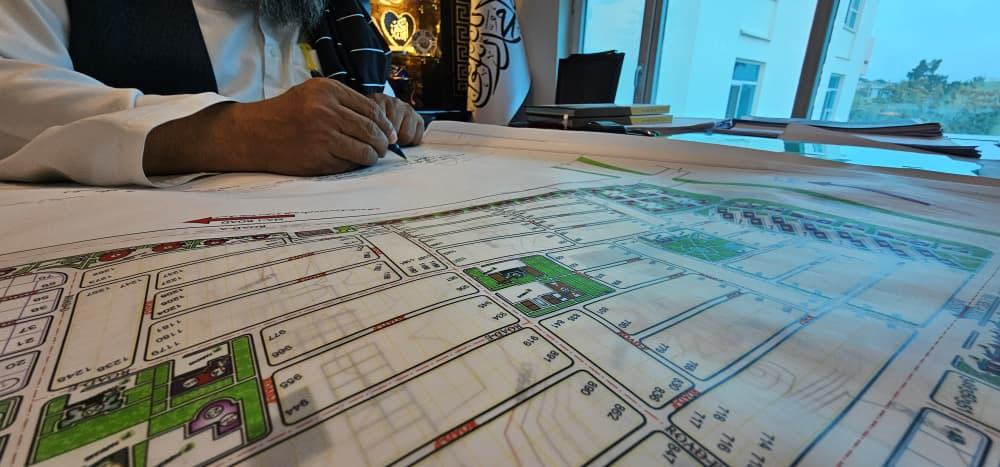
A number of Kabul residents say that a businessman from Khost province, claiming ownership of 20 hectares of land in Parcel 2.2 of Kabul New City, has demolished and seized about 200 residential plots and several other areas. According to them, this happened after a joint Taliban commission announced that the legal problems of the area had been resolved and land transactions resumed. Last year, the Taliban’s Ministry of Urban Development and Housing (MUDH) also announced that it had approved and signed the detailed plan for this parcel, which covers 534.4 hectares of land belonging to the Oxin Ariana company. People who bought land in the area based on the announcements of the Taliban commission and the MUDH are asking how the Taliban, despite their own official announcement, have now allowed this person to seize the land the people purchased and mark it out with boundary lines.
A number of people who bought land or invested in real estate in Parcel 2.2 of Kabul New City, based on the Taliban’s official announcement, say that land transactions in the parcel were halted after the Taliban took control of Afghanistan. Afterward, a joint commission was formed, with representatives of the Taliban’s Ministry of Justice, the Oxin Ariana company, and a number of landowners’ representatives, to examine and resolve the legal and ownership problems of the area. According to them, after about one and a half to two years of review, the commission announced that the legal and ownership problems of Parcel 2.2 had been resolved, and that people could confidently invest in residential plots, commercial areas, and other parts of this township.
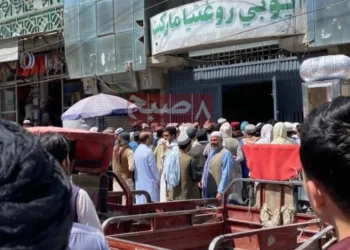
After the announcement was published, a number of citizens, trusting the decision of the Taliban commission, bought land and invested in the area. However, they say that last week a businessman from Khost province came to Parcel 2.2 and claimed ownership of 20 hectares of land. According to local sources, the businessman claimed that the land in question was his personal property. Following this claim, about 200 residential plots and several other areas were demolished using heavy machinery. The sources also allege that this action was carried out with the support of some Taliban officials.
Land buyers in the area ask why, if the land claimed by this businessman was truly his personal property, the matter was not raised and clarified during the joint commission’s review. They ask how the commission, after lengthy reviews, declared the ownership problems of Parcel 2.2 resolved and allowed people to buy and sell, yet now an individual claiming ownership of 20 hectares of land is destroying the properties that citizens have purchased.
According to them, this ownership claim has been raised at a time when the value of residential plots in the area has increased many times over. These individuals say that when transactions resumed, the price of each plot was about 8,000 US dollars, but its value has now risen to about 35,000 to 40,000 dollars. They add that if this person had a Sharia-based and legal right to the land in question, he should have presented his documents during the process of settling and reviewing ownership claims, rather than raising an ownership claim and seizing the area after the people had bought the land and its price had increased.
A source familiar with the situation in Parcel 2.2 told the Hasht-e Subh Daily: “When the Taliban came, all transactions in New Kabul were halted. Then a commission was formed, which included a representative of the Ministry of Justice, a representative of the Oxin Ariana company, and several landowners. About a year and a half later, people were allowed to buy and sell, and it was said that the problems had been resolved. At that time, the price of each plot was 8,000 dollars, but now it has reached 35,000 to 40,000 dollars. This person came and, in a moment, destroyed about 200 residential plots and several other areas with an excavator, and told the people that this property was no longer theirs.”
The source adds that most of the buyers are from low-income families who, because of financial hardship, had been unable to buy homes in other parts of Kabul city. He says: “The people of this area are poor. Most of those who could not buy a house in Kabul city came here and bought land for 8,000 dollars. They made the transactions with the permission of the Taliban commission, paid a one percent tax to the government, paid 400 dollars in commission to the company, and also handed over 9,000 Afghanis for the ownership deed. But today they are being told that their lands do not belong to them.”
Expressing concern about the buyers’ situation, the source says that the people paid all the legal and administrative costs of the transactions, but their capital and assets are now at risk.
He adds: “Injustice has been done to the people, and there is no one to ask about their rights.”
This person’s ownership claim comes at a time when the Taliban’s MUDH announced last year that Najibullah Hayat Haqqani, the group’s Minister of Urban Development and Housing, had approved and signed the detailed plan for Parcel 2.2, which belongs to the first phase of Kabul New City.
In the Taliban’s official statement, it was stated that Parcel 2.2, which belongs to the first phase of Kabul New City and is being developed by the Oxin Ariana construction company, would, under the approved detailed plan, provide a suitable foundation for urban order, standard services, and sustainable development in the area. According to the statement, the detailed plan for this parcel has been prepared for 534.4 hectares of land belonging to the Oxin Ariana construction company, and all construction and development activities in the area must be carried out in accordance with the specified plan.
These allegations about the involvement of senior Taliban officials in widespread corruption come at a time when the group has consistently claimed that it has eliminated corruption in Afghanistan. However, field reports by the Hasht-e Subh Daily show that a number of Taliban officials and mid-level members are widely involved in corruption.
Previously, a study by the George W. Bush Institute titled “Corruption and Kleptocracy in Afghanistan Under the Taliban,” published in 2024, showed that after the Taliban took control of Afghanistan, the lack of transparency in the awarding of government contracts, the sale of properties, and the issuance of licenses and concessions created the conditions for abuse of official powers.
Likewise, the Bertelsmann Transformation Index (BTI) 2026 report on Afghanistan shows that corruption among the Taliban and their affiliated networks has weakened the rule of law. The report states that influential Taliban officials in many cases remain immune from punishment, and that when members of the group violate the law or abuse their powers, they are rarely prosecuted.
Note: Land areas originally given in jeribs (1 jerib = 2,000 square metres) have been converted to hectares.
You can read the Persian version of this report here:
زدوبند طالبان در پروژه کابل جدید؛ یک تاجر زمینهای خریداریشده مردم را تصرف کرد