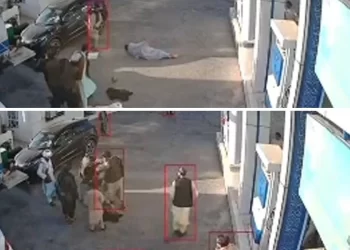

Ten days after the Taliban announced the initiation of the passport collection process under their control, they declared yesterday that the process has been halted. During these ten days, tens of thousands of people went to the passport office, but they were met with beatings, insults, whippings, and gun butts. Despite enduring such hardships, they returned empty-handed. Within the same ten days, thousands of women, children, elderly, and young people would gather at the passport office gates early in the night, enduring sub-zero temperatures in long queues, hoping to present their requests to the Taliban authorities by morning. However, even after enduring all that suffering, they were not successful. Taliban officials and fighters shredded the collected requests, throwing them into trash bins, while others discarded them along the roadside. Videos circulating on social media depict men and women searching for their requests on a road.
The Taliban’s treatment of applicants has consistently been inhumane and devoid of dignity. Taliban fighters, who have lived for years in mountainous areas away from human societies, lack the understanding of establishing communication with people and managing them. What these fighters have learned is warmongering in the harsh mountain fields. Now that some of these fighters have assumed non-military roles and others are armed, none of them know how to interact with the people. Humiliating and torturing the population is a common practice observed among all members of the Taliban. When dealing with people who want to exercise their basic rights in exchange for payment, they resort to whipping and gun butts. They have failed to learn how to communicate with people and, if unable to manage an office, understand that it is not the fault of the people.
The head of the Taliban-controlled passport office complained ten days ago, stating that 20 people from a single family come and obtain passports. He believes that the distribution of passports is a favor and kindness that this group extends to the people, not the fundamental right of the citizens of a country. Therefore, according to the representation of each family, one person should receive a passport.
Certainly, the passport distribution situation is a concrete example of Taliban management. Those who have taken control of the country are pushing it towards collapse in all aspects. The discourse on human rights and individual and social freedoms in Afghanistan has come to an end. Those who express the slightest of these rights or demonstrate their desire for freedom and rights are brought into Taliban prisons and endure the most brutal forms of torture. Many have lost their lives under the inhumane torture of this group in prisons, as reported by the media. Other areas do not fare any better than the passport office or human rights issues.
The most valuable commodity that the Taliban sold to the Afghan people at an exorbitant price was security and freedom. However, this commodity no longer exists, even though it never truly did. The widespread attacks occurring under the name of ISIS throughout the country have also eroded the physical security of the people. Furthermore, Taliban abductions under the pretext of detaining individuals for non-Taliban attire have left people with little peace and a sense of security.
The group’s relationships with the ethnic groups residing in Afghanistan vary significantly. While all people are under the pressure and torture of the Taliban, some ethnic groups experience harsher mistreatment and violence from this group, leading to their torture. Beyond borders, the group’s relations have experienced strange fluctuations. With most neighboring countries, except China, which has engaged with the Taliban over the past two years with glittering promises, tensions exist. Currently, all borders with Pakistan are closed—a country that is Afghanistan’s largest trading partner, connecting Afghanistan to international waters and hosting millions of Afghan migrants. Even these migrants in Iran and Pakistan are affected by the Taliban’s positions, constantly grappling with the right or wrong stance of this group.
The ongoing situation in the central passport office or its provincial units is ultimately attributed to the mismanagement and failures of the Taliban—a group that, over the past two years, has struggled even with the simple task of passport distribution. On the other hand, this saga is linked to the black market trade, which the Taliban oversees from the passport office. This illicit trade forces people to buy passports. The constant halting and resumption of passport distribution for several days have various reasons. One of these reasons is internal conflicts within the Taliban for control over financial resources and revenue-generating institutions.
The prolonged suspension of this office was due to the dispute between the Haqqani network and the Kandaharis over dominance in this administration. Eventually, the Kandaharis managed to sideline the Haqqanis and take control of the office from the influential figure, Alim Ghol Haqqani. It was a clear power struggle between Sirajuddin Haqqani and Mullah Brother, with the latter emerging victorious. Another reason for these interruptions is poor management. The Taliban cannot manage even this simple task. They are unfamiliar with technology, administrative work, and the management of a customer service process. Nevertheless, the black market factor also significantly influences the continuous halting of this office’s activities.
Before the Taliban came to power, the passport distribution process was quite normal, and any applicant could easily obtain their passport within two to three working days. However, when the distribution process fell into the hands of the Taliban, millions of people struggled to obtain passports, but over the past two years, they have been unsuccessful. Those planning migration or seeking medical treatment in neighboring countries, who cannot obtain passports through normal means, are forced to turn to the Taliban-controlled black market. The Taliban and their middlemen charge one to two and a half thousand dollars for each passport. Undoubtedly, senior Taliban officials are involved in this black market trade, although the market would not thrive so visibly without their explicit support. Mullah Brother, who lost the mines to Mullah Hibatullah in their competition, has taken control of economic institutions and revenue-generating offices, and the central passport office is one of them. If, during this period, only 100,000 passports were sold at an average price of $1,500 each, the revenue would reach $150 million. Even if half of this quantity was sold, the significant black market income of $75 million over the past two years is noteworthy. The share of middlemen in this trade is unlikely to exceed 5 to 10 percent. The remaining money goes into the pockets of specific individuals within the Taliban regime. On the one hand, the continuous suspension of passport distribution has increased the number of applicants. Now that they have once again halted the acceptance of in-person applications and provincial units are closing down, the black market is gaining more momentum. Perhaps, every time they see a decline in the market, they temporarily halt the passport distribution process.