• 8AM.MEDIA
  • ویب‌سایت فارسی
  • پښتو ویب‌پاڼه
  • اۉزبېکچه ویب‌سایت
  • Podcast
Thursday, September 24, 2026
Hasht-e Subh
  • Home
  • News
    • Afghanistan News
    • World News
  • Opinion
    • Editorial
    • Analysis
  • Reports
    • Daily Reports
    • Investigative Reports
  • Society
    • The story of people
  • Women’s Word
  • Columns
    • Three Years After Afghanistan’s Fall: The Taliban’s Resurgence
    • Towards Equality
    • The Resurgence of the Taliban: Two Years Since Afghanistan’s Fall
    • Hebatullah Report Special Edition
    • Resistance for Education Special Edition
    • Special Column on Taliban’s Education Curriculum
    • Nawroz
  • Interviews
  • Contact Us
    • About Us
    • 8AM MEDIA Annual Awards
    • Submit an Article to Hasht-e-Subh
  • 8am.mediaBack
Subscribe
No Result
View All Result
  • Home
  • News
    • Afghanistan News
    • World News
  • Opinion
    • Editorial
    • Analysis
  • Reports
    • Daily Reports
    • Investigative Reports
  • Society
    • The story of people
  • Women’s Word
  • Columns
    • Three Years After Afghanistan’s Fall: The Taliban’s Resurgence
    • Towards Equality
    • The Resurgence of the Taliban: Two Years Since Afghanistan’s Fall
    • Hebatullah Report Special Edition
    • Resistance for Education Special Edition
    • Special Column on Taliban’s Education Curriculum
    • Nawroz
  • Interviews
  • Contact Us
    • About Us
    • 8AM MEDIA Annual Awards
    • Submit an Article to Hasht-e-Subh
  • 8am.mediaBack
No Result
View All Result
Hasht-e Subh
No Result
View All Result

The conflict between the Army and the Religious Schools in Pakistan

By: Fahim Sotuda

Moqim mehran Moqim mehran
27 February 2024 - Solar Hijri Date: 1402/12/08 [t_time:1709027844]
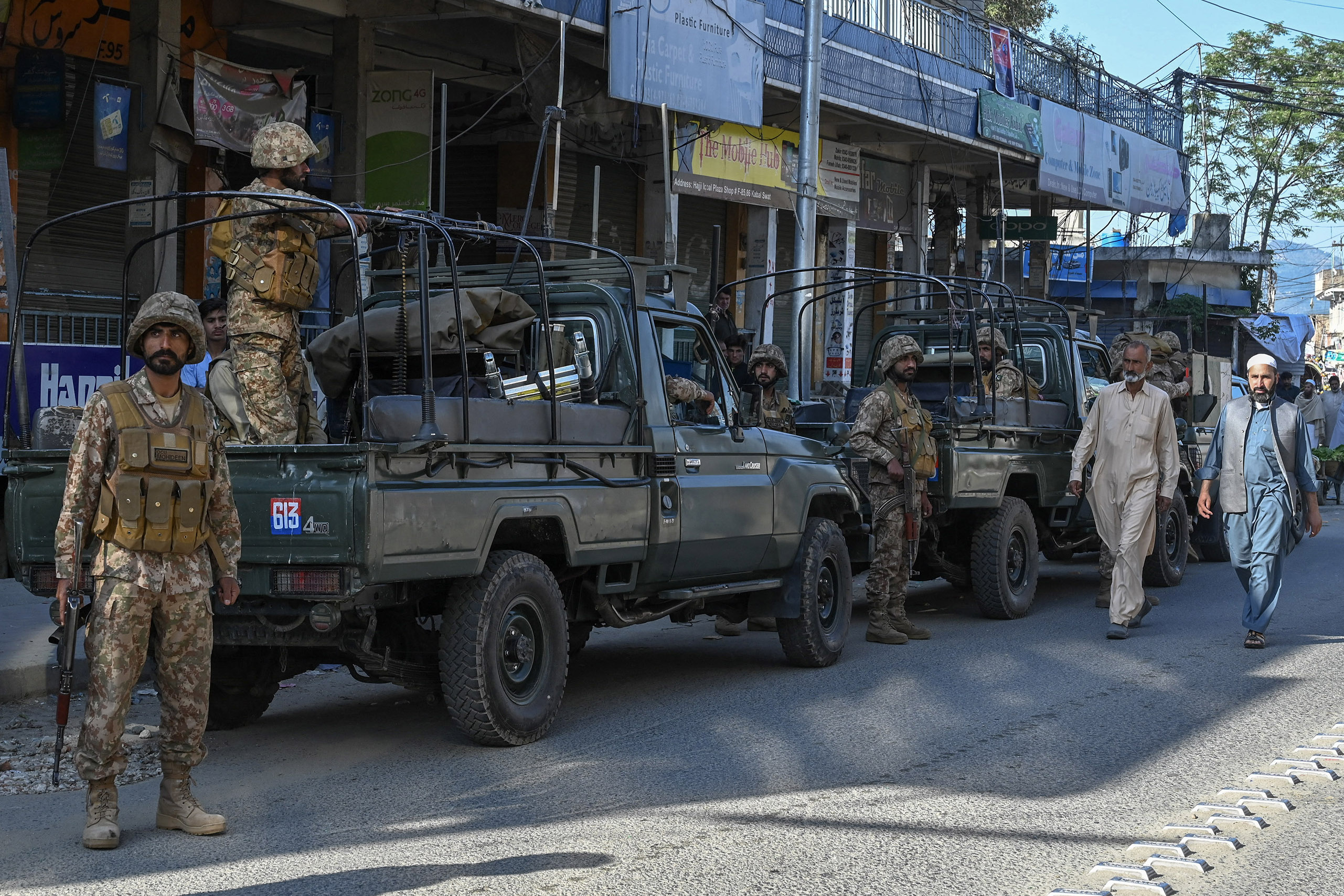
Explosion Near a Road Claims Lives of Five Pakistani Soldiers in Balochistan

Abdul MAJEED / AFP

In the past two decades, religious schools in Pakistan have drawn Afghanistan into a deadlock. These schools and their students, through the fatwas they issued and the clerics they nurtured, embarked on a war against the aspirations of the Afghan people and their efforts to build a democratic, humane, and prosperous society. Despite receiving financial, advisory, and arms support from the global community, particularly the United States and its NATO allies, the people of Afghanistan succumbed to what the extremists in Afghanistan received from Pakistani schools and ultimately the generals of that country. This defeat was profoundly humiliating and distressing. Representatives of extremism and backwardness prevailed over representatives of tolerance and development, demeaning them. However, this situation did not remain confined to Afghanistan. Pakistan, which served as a breeding ground for terrorists exporting to Afghanistan, with its schools acting as factories producing terrorists and fundamentalists, is now entangled in similar trouble. This trouble has posed a serious threat to the mighty Pakistani army.

Religious schools that were supported for the cultivation and export of terrorism to Afghanistan and, of course, India, have now turned against the army of this nuclear country. These schools and their students, having succeeded in Afghanistan in favor of civility and development, now have a greater incentive for further power and a need for engagement to involve their graduates. This engagement is now feasible within the borders of Pakistan.

In this war, religious schools target the army in various parts of Pakistan. To undermine the army’s authority, they penetrated the heart of Islamabad last year and carried out a bombing attack there. The increasing proliferation of these schools attracts unemployed Pakistani youth, particularly in underdeveloped states like Khyber Pakhtunkhwa and Balochistan. These youth, in some cases, simply attend these schools for food and shelter but leave as graduates with titles like Quran reciters and clerics, having been trained in various types of weapons, learned bomb-making, and undergone mental indoctrination for warfare. Although religious schools are abundant throughout Pakistan, they primarily focus on underdeveloped and impoverished areas, where more disillusioned and unemployed youth are easily preyed upon. The productivity of these schools is in producing militants who either bolster the ranks of the Taliban, join ISIS-Khorasan, or become recruits for other extremist groups. Since the market for group formation is still vibrant in certain areas of Pakistan, the possibility of new groups emerging from among these students of religious schools exists.

Despite the penetration of religious schools into various layers of Pakistani society and the continuation of their expansion of influence, the core of society, even in these heavily schooled and underdeveloped areas, has not reconciled intellectually with these schools and their administrators. A concrete example and evidence of this claim is the result of the recent elections in the country. Although these elections are facing widespread allegations of fraud, considering the results currently announced, it indicates that the hardline Islamist parties have not received significant support. The Jamaat-e-Islami party, led by Siraj-ul-Haq, who considers himself the representative of Pakistan’s Sufi drinkers and the heir to Indian-British Islamists, couldn’t even secure a single seat in the National Assembly. Similarly, the Jamiat Ulema-e-Islam party, led by Maulana Fazl-ur-Rehman, did not exceed its seat count of four, while Fazl-ur-Rehman himself suffered defeat in the Ismail Khan constituency against a member of the Pakistan Tehreek-e-Insaf party and failed to enter the assembly. However, these elections have many unknown angles that make judgment difficult. Additionally, although some analysts believe that in the recent elections, Islamist parties suffered defeats, the discussion of Islamism and secularism was not raised during the election campaigns. Most Pakistanis view the People’s Party and the Pakistan Muslim League-Nawaz as traditional parties that have wielded power within families. Their support for candidates supported by the Pakistan Tehreek-e-Insaf was somewhat oppositional to these traditional parties. However, the shift towards the Pakistan Tehreek-e-Insaf instead of Islamist parties indicates a distance from them. The defeat of hardline Islamist parties in these elections indicates that the people of Pakistan still do not have a good rapport with radical Islamism. This is fortunate for the Pakistani army. In the army-school conflict, generals have more public support.

The Pakistan army is currently engaged in battles on several fronts. The management of the Afghan Taliban, according to Islamabad’s wishes, involves serious clashes with Pakistani generals. Enmity with India and competition with Iran are also simultaneously pursued. Inside Pakistani territory, various military fronts are fighting against this army, from armed Baloch liberation groups to ISIS, TTP, and other terrorist groups residing in Pakistan. Most of these groups somehow have connections with the religious schools of this country. Therefore, the Pakistan army must understand that the fight against these groups must occur at the source. However, this action may incite public opinion against the army if hardline clerics can use it as a weapon.

The main problem of Pakistan and its army is neither India as an enemy nor parties like Pakistan Tehreek-e-Insaf as internal challenging forces, but rather the main problem is the religious schools of this country and their productivity. The future war of the Pakistan army will be with these religious schools. This war, which has already begun, will last for years and will weaken the Pakistan army. Considering the extensive activities of these schools and the penetration they are expanding among the masses of society every day, the army’s fate will not tolerate that public opinion forever favors this institution over Islamist forces. If the Pakistan army does not act promptly, it may lose public support, and at that time, it will be these schools that will emerge victorious over the army.
ShareTweetSendSendShare

Related Posts

Steve Witkoff - the U.S. special envoy (Photo: AP)
World News

Witkoff: We Held Extensive Talks with Iranian Delegation Through Mediators

23 September 2026 [t_time:1790142280]
A Pakistani soldier stands near the Afghanistan-Pakistan border (Photo: Reuters)
Afghanistan News

Pakistani Security Sources Claim They Prevented ‘Terrorists’ from Entering Pakistan From Afghanistan

23 September 2026 [t_time:1790138901]
Pakistan’s foreign minister speaks during a meeting of the Organisation of Islamic Cooperation Contact Group on Afghanistan (Photo: ForeignOfficePk)
Afghanistan News

Pakistan’s Foreign Minister Calls for Lifting All Taliban Restrictions on Women

23 September 2026 [t_time:1790136917]

Latest

Loading latest news...

Popular stories

  • Hamza bin Laden - the son of Osama bin Laden (Photo: Social Media)

    Al-Qaeda Releases Hamza bin Laden Message on 9/11 Anniversary

    Share
    Share Tweet
  • UN Report Reveals Shifts in Family Attitudes and Rise in Domestic Violence in Afghanistan

    Share
    Share Tweet
  • Pakistani Army Says Five Killed Over Alleged Links to Terrorism

    Share
    Share Tweet
  • Asian University for Women: Protesting Students Face Expulsion

    Share
    Share Tweet
  • U.S. Defense Secretary Calls Washington Post Worse Than Iranian State Media

    Share
    Share Tweet

Podcast

Insights
Insights

Join Lynne O’Donnell for 8AM’s podcast series, Insights.
Lynne talks with generals, diplomats, soldiers, journalists, politicians, activists, people who have front row seats for conflicts around the world, and citizens with a story to tell, happy or sad. For this first series, Afghanistan is the focus. Lynne and her guests talk about the collapse of the republic in August, 2021, and the impact since — for the people of Afghanistan, for the security of the region, for the safety of the world. It’s important, interesting and insightful.

Insights/22: Controlling the Narrative with Mina Sharif
byinsights8am

Controlling the Narrative

Lynne O’Donnell talks with Mina Sharif, author, activist, women’s rights campaigner, educator and mentor. They discuss who controls the narrative and who speaks for Afghanistan’s people when the Taliban appear to have seized control not only of the country but of the message, too.

Have a listen

Insights/22: Controlling the Narrative with Mina Sharif
Episode play icon
Insights/22: Controlling the Narrative with Mina Sharif
Episode Description
Episode play icon
Insights/21: Media Meltdown with Zahra Joya
Episode Description
Episode play icon
Insights/20: Terror Inc with Scott Richards
Episode Description
Episode play icon
Insights/19: Busting Stereotypes with Bushra Gohar
Episode Description
Episode play icon
Insights/18: Media Matters with Waliullah Rahmani
Episode Description
Episode play icon
Insights/17: What Goes Around Comes Around with Sima Samar
Episode Description
Search Results placeholder
Hasht-e Subh

8AM Media, also known as Hasht-e-Subh Daily, stands as Afghanistan's premier independent and non-profit newspaper, resonating as a beacon of journalistic integrity since its establishment in June 2007 by esteemed Afghan journalists and human rights advocates. With a steadfast commitment to citizen journalism and civic education, Hasht-e-Subh Daily has earned its place as the most esteemed publication in the nation.

Publisher: Sanjar Sohail
Email: [email protected]
Executive Director: Parwiz Kawa
Email: [email protected]

Read More

UN: 205 Earthquake-Resistant Buildings Constructed in Nangarhar with South Korean Support

The Girl Who Dreamed for Others

Afghanistan: A New Battlefield as Iran and America Redraw the Taliban’s Role in Regional Power

Earning a Living in Fear and Humiliation: Taliban Morality Police Drive Working Women Deeper Into Isolation

Afghan Migrant Women Describe the Difficulties of Life in Iran

Editor’s Choice

Every Saturday morning, 8AM MEDIA English Services Department will guide you through the week’s biggest stories from Afghanistan and the international community.

Subscribe

© 2026 - ©Hasht-e Subh Daily

No Result
View All Result
8am.Media
پښتو ویب‌پاڼه
ویب‌سایت فارسی
اۉزبېکچه ویب‌سایت
  • Home
  • News
    • Afghanistan News
    • World News
  • Opinion
    • Editorial
    • Analysis
  • Reports
    • Daily Reports
    • Investigative Reports
  • Society
    • The story of people
  • Women’s Word
  • Columns
    • Three Years After Afghanistan’s Fall: The Taliban’s Resurgence
    • Towards Equality
    • The Resurgence of the Taliban: Two Years Since Afghanistan’s Fall
    • Hebatullah Report Special Edition
    • Resistance for Education Special Edition
    • Special Column on Taliban’s Education Curriculum
    • Nawroz
  • Interviews
  • Contact Us
    • About Us
    • 8AM MEDIA Annual Awards
    • Submit an Article to Hasht-e-Subh
  • 8am.media

© 2026 - ©Hasht-e Subh Daily