The U.S. decision to leave Afghanistan in the way that it did last year has had terrible consequences. The most consequential of all may prove to be the Taliban’s overhaul of Afghanistan’s public education system.
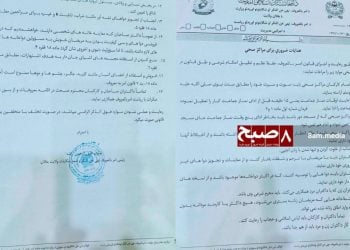
The Afghan newspaper Hasht-e-Subh obtained a copy of the Taliban’s proposed modification of the country’s school curricula. The Dari translation begins: “the current curriculum was made under the Kabul puppet administration, and funded by Jewish and non-religious countries,” which sets up both the document’s tone – one fueled by conspiracy, paranoia, and defensiveness and void of any pedagogical principles – and the proposed gutting of the curriculum that follows.
Hasht-e-Subh’s December 17 story provides a detailed summary of the document, which proposes removing entire subjects from the curriculum, and much more. Textbooks will be stripped of all images of living things; of particular concern are depictions of little girls and people doing sports, as well as anatomy images in biology textbooks. Also prohibited will be any mention of democracy and human rights in a positive light; the encouragement of peace, women’s rights and education; the United Nations (an “evil organization” according to the report); mention of music, television, parties, and celebrations including birthdays; non-Muslim figures such as scientists or inventors (Thomas Edison is highlighted as an example); mention of mines and their dangers (because of their association to the Taliban); radio (“colonial media”); population management; and mention of elections.
Even Afghan historical and literary figures the Taliban disapprove of, such as celebrated poets and Shia national figures, will be erased from the curriculum. Ancient and revered Afghan cultural traditions, ranging from the Attan dance and Nawruz to indigenous musical instruments and women’s colorful traditional dress are to be stripped from textbooks. Other traditions can be mentioned but only to explain why they are shameful; for instance, teachers should emphasize the “ugliness” of the giant Buddhas of Bamiyan, and celebrate the Taliban’s destruction of such idols. “Non-Islamic beliefs” like “love for all human beings” should be omitted.
No room is left for guesswork, as their aims are starkly laid out. Members of the Taliban’s revision committee state that the purpose of the curriculum is “to maintain and expand the ideological interests of the Taliban,” and in Hasht-e Suhb’s assessment, “the Taliban seek to cultivate an ideology that is in conflict with other religions and cultures.” In their own words, the Taliban committee recommends that the “seeds of hatred against Western countries should be planted in students’ minds.”
The curriculum will focus on “propagating the Taliban’s narrative of history, focusing on the Islamic world and ignoring the non-Islamic world” and will prioritize propagating jihad, articulating justifications for the use of violence to advance the Taliban’s goals, and encouraging children to fight jihad. Textbooks must explain the Shariah rules of killing in war, including the justified killing of other Muslims for certain goals, retaliation in kind, stoning, and amputations, and should explain that child marriage is acceptable with a father’s consent. Poverty, natural disasters, and life challenges should be explained as “divine punishment.” Oh, and also, “students should be taught about the rewards of breeding horses during jihad.”
While there is a long history of authorities manipulating school curricula to support ideological aims, the Taliban’s plans represent what may amount to the most radical – and consequential – example of this the world has yet seen.
And it was all foreseeable. In fact, the Taliban’s revision of the curriculum, and the original Pashto document, dates back to 2020, to around the time of the signing of the Doha Agreement with the United States, over a year and a half before the Taliban were actually ruling Afghanistan. It’s clear that the curriculum was and is of high priority on their agenda.
It was also predictable because this is not the Taliban’s first go at running an education system. In its previous rule, the Taliban transformed the Afghan education system into a network of poorly managed madrassas. Secular subjects like science and history were removed, girls were shut out, mullahs replaced trained teachers, corporal punishment was part of schooling, and sexual abuse was rife. School became a place where children’s bodies and minds were at risk; little in the way of learning and development took place. As an Afghan woman said back in 2000, “They won’t let us go to school, because they want us to be illiterate like them.” And for the boys who could go to school, the purpose of school was to shape them into Taliban.
The governments of the countries that until recently were present in Afghanistan, ostensibly committed to democracy and women’s rights there, must realize the acute danger that lies ahead once the Taliban’s changes to the curriculum come into effect, and the children who experience that school system become adults. There are risks both on the hard security side – a school system that plays a crucial function in the propagation of a violent and dangerous ideology – and also on the humanitarian, development, and human rights side.
This school system will not produce citizens with the knowledge and skills to have viable livelihoods in the 21st century; it will not form individuals who can help yank Afghanistan into the modern global economic community. Rather, the Taliban’s curricular changes are setting Afghan students up to fail in the modern world. A high school diploma from an Afghan public school will be less than worthless; it will be a stigma on the global market. And perhaps most critically, the school system the Taliban are standing up is a profound disservice to millions of children, violating their basic human right to access a decent education, and as a result, to have better life opportunities.
Politicizing the public school system so that it essentially becomes a branch of the Taliban’s militant wing, churning out young people indoctrinated in the Taliban’s uniquely anti-humanist ideology, is an atrocity in disguise. It doesn’t have the observable bloodshed of a massacre, or the visceral horror of a genocide, but the consequences may be as ugly, and the impacts will be grave and far-reaching not only for Afghanistan, but for the world. The world has underestimated the power of education systems to foster terrorism and violent ideologies when in the hands of the wrong people. And the Taliban are the wrong people.
So, what can be done?
The presence of the United Nations in Afghanistan has not prevented the Taliban from driving forward their plans to enforce a Taliban curriculum over the entire public school system. All the statements of condemnation from democratic governments around the world in response to the ban on girls’ secondary education have not influenced the Taliban’s decision to pull their country into the dark ages by shutting girls and women out of education. The Taliban are not interested in listening to practical advice, even when it’s in their own best interest, and they don’t care about international finger wagging. So what can the international community do in the face of this impending crisis?
They can circumvent the Taliban completely and ensure Afghan children and youth can access a real education. This can be done through several ways.
One is to support Afghans leaving Afghanistan for the purposes of accessing education. Ensuring access to safe refuge – a right in itself – and facilitating escape from the Taliban’s Afghanistan is one way that governments can now also uphold the right to education.
Another way is to fund and scale alternative, independent education systems, including some of the many virtual schools that have cropped up since August 2021 and the ban on girls’ education. These schools need support to enhance their quality and to reach more students. Donor governments can also support foreign schools enrolling Afghan students remotely, funding tuition and other costs to make attendance accessible for students in Afghanistan. This would allow Afghan students to access education and earn a credential from a recognized educational institution outside of their own country, so that they are not denied opportunities such as access to reputable institutions of higher education or jobs that require a recognized high school diploma from a competent accreditation authority.
Additionally, governments interested in countering the terrible crime the Taliban are inflicting on Afghan children and youth can invest in access to education for displaced people. Afghans now account for the second greatest proportion of displaced people, after Syrians, though the exact count isn’t currently known, because Afghans are leaving faster than official statistics can keep up with. What is clear is that millions of Afghans have determined that life under the Taliban is no life at all, and have made the difficult choice to leave.
Many are in precarious, unstable conditions where they lack durable solutions for resettlement, waiting in so-called third countries. There, access to education is challenging or not seen as a priority. Investing in the education of these Afghans is comparably easy; there is no having to work with or around the Taliban. And the payoff can be significant. Refugees who can access education go on to become the engineers, doctors, teachers, and leaders of their societies, and may eventually be one of the most important assets in a future post-Taliban Afghanistan.
The best way to have stopped the human rights atrocity now threatening millions of Afghan children, and the security risks that would follow from Afghanistan’s schools being transformed into Taliban training camps, would have been to never have brokered the Taliban’s ascent to power in the first place. But it’s too late for that.
If the governments that share in the responsibility for Afghanistan’s current political situation – the United States and the coalition countries that were part of ISAF – still have any shred of commitment left to the values they once loudly propagated in Afghanistan, like the right to education, they must make every effort to find alternatives to give as many Afghan children as possible access to a real education, and to protect them from the harms of a Taliban education. Just as nefarious forces can manipulate education to produce hate and violence, so can education be manipulated to yield peace.