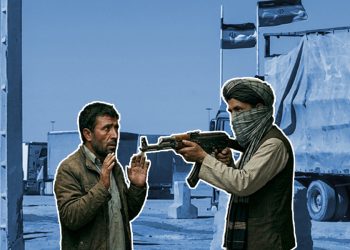
As the world celebrated the start of 2023 with festive lights and fireworks, Afghanistan was plunged deeper into darkness and obscurantism. Since August 2021, the country’s conservative Islamist rulers have shattered the myth of the “Taliban 2.0” narrative that was promoted during negotiations to enable the US withdrawal from Afghanistan in 2021. Instead, they have shown a determination to ruin the lives of Afghans, eradicating women from public life and plunging the country into poverty and catastrophe.
The Afghan Ministry of Economy’s recent decision to bar women from working at NGOs has had severe consequences for the Afghans. The order, issued on December 24th, stated, “all female employees who are working in their respective departments should stop their work until further notice,” it also warns that does not comply with this order risks having their license to operate in Afghanistan revoked.
The ministry confirmed the letter’s content to The Associated Press and said it had received “serious complaints” about the female staff working for NGOs not wearing the “correct” headscarf or hijab.
In response, several major international aid groups, including the International Rescue Committee (IRC), Save the Children, the Norwegian Refugee Council, CARE International, and Islamic Relief, announced that they would halt their operations in Afghanistan until all female staffs are able to return to work.
“We cannot effectively reach children, women, and men in desperate need in Afghanistan without our female staff,” the Norwegian Refugee Council, Save the Children, and Care International said in a joint statement.
The International Rescue Committee, one of the major aid organizations — which employs over 8,000 Afghans, 3,000 of whom are women — told in a separate statement Sunday that it would also halt operations.
The order came days after the extremist group ordered universities to close to women, warning strong global condemnation and sparking some protests which were forcefully dispersed by the Taliban and triggered widespread criticism inside Afghanistan.
One female aid worker, who wished to remain anonymous, said that she has been in contact with several women who are struggling to cope with the desperation and uncertainty caused by the ban.
She said, “We worked with several girls and women with their mental health since the Taliban took over the power; I am worried about women’s who received free mental health consultations in our organization; after the Taliban banned us from working.”
The ban on women working at NGOs is just the latest in a series of measures that have restricted the rights and opportunities of Afghan women. The ban on university education that preceded it has also had a negative impact on the mental health of many women, as it has denied them the chance to pursue their dreams and build a better future for themselves and their families.
Filipe Ribeiro, country representative of Doctors Without Borders/Médecins Sans Frontières (MSF), said, “More than 51 percent of our medical staff in Afghanistan are women. We are talking about nearly 900 doctors, nurses, and other professionals who strive every day to give thousands of Afghans the best care possible. MSF operations couldn’t exist without them.”
“After the Taliban took over the country, my all-male member families who worked at the Minister of Interior Affairs and National Directorate of Security lost their job, and was the only family member who worked to bring food on the Table.” 29 years old, Najiba, an international aid agency employee in Kabul, told Hasht E Suhb.
She burst into tears and added, “We all lost everything, freedom, education, work, and hope; we are all living under darkness, waiting to die from starvation and mental health.”
The impact of this ban on women’s employment at NGOs will be significant, as it will disproportionately affect women who rely on these jobs for their livelihoods and the support of their families. It will also have a negative impact on the provision of much-needed humanitarian and development assistance in Afghanistan, as these organizations play a crucial role in providing basic services and support to the Afghan people.
“Banning women from work would violate the most fundamental rights of women, as well as be a clear breach of humanitarian principles,” the UN statement stated. “This latest decision will only further hurt those most vulnerable, especially women and girls.”
Humanitarian Catastrophe
The humanitarian situation in Afghanistan is grave, with the country ranking as the second-most severe in the world behind East Africa. Periodic disasters, decades of war, chronic poverty, drought, extensive food insecurity, corruption, the COVID-19 pandemic, withdrawal of international forces, and regime change have resulted in millions of Afghans in need of humanitarian assistance over half the country’s population. The situation has become especially dire since the Taliban took over Afghanistan. Acute malnutrition is spiking across the country, and 95 percent of households have been experiencing insufficient food consumption and food insecurity. At least 55 percent of the population is “expected to be in crisis or emergency levels of food insecurity” through March 2022, according to the United Nations.
The UN Office for the Coordination of Humanitarian Affairs (UNOCHA) estimates that a record 28.3 million people will need humanitarian and protection assistance in 2023, up from 24.4 million in 2022 and 18.4 million in 2021.
In addition, disaster risk is becoming an increasing driver of underlying needs. A national drought was officially declared in June 2021 and is the worst in more than 30 years.
The situation is particularly dire for children, with an estimated six million children, many dangerously malnourished, just one step away from famine.
Afghan children are starving to death nearly every day. A February 2022 survey by Save the Children found that 82 percent of Afghan families had lost wages since August 2021, and almost one in five were sending children to engage in labor (for minuscule wages), while 7.5 percent stated they were resorted to begging or requesting money or food from the charity.
David Miliband, CEO of the International Rescue Committee, recently stated, “The current humanitarian crisis could kills more Afghans than the past 20 years of war.”
SIGAR recently released a report warning of increasing unemployment in Afghanistan. According to a survey conducted by Gallup in August-September 2021, 89% of Afghans surveyed said that their local economies were getting worse, 75% reported not having enough money for food in the previous 12 months, and 58% reported not having enough money for adequate shelter. The current ban on female staff working in local or foreign NGOs boosts the unemployment numbers.
It is crucial that both women and men be involved in addressing the needs of the Afghan people. Female aid workers are particularly vital in this regard, as they are often able to better assess the needs of households and speak with women in a way that male staff may not be able to. Without the participation of women in these efforts, it will be impossible to effectively address the needs of the population and provide the humanitarian assistance that is so desperately needed.
Condemnation
The recent ban on Afghan women working at NGOs has drawn condemnation from the United States, donor groups, and the European Union.
US Secretary of State Antony Blinken said on Twitter, “Deeply concerned that the Taliban’s ban on women delivering humanitarian aid in Afghanistan will disrupt vital and life-saving assistance to millions.”
“Women are central to humanitarian operations around the world. This decision could be devastating for the Afghan people,” he added.
The chargé d’affaires for Norway, which funds aid in Afghanistan and hosted talks between the Taliban and civil society members in January, called for the ban to be “reversed immediately” and warned that it would “exacerbate the humanitarian crisis and hurt the most vulnerable Afghans.”
The European Union, in Joint Ministerial Statement, said that it was assessing the effect on its aid in the country, “risk millions of Afghans who depend on humanitarian assistance for their survival” and condemned the Taliban’s decision as a violation of women’s rights.
Women are essential to the delivery of humanitarian and basic needs operations in Afghanistan. Without the participation of women, NGOs will be unable to reach the country’s most vulnerable populations to provide humanitarian assistance.
Right now, every day, Afghans are being punished by the Taliban regime’s harsh policies that are leaving millions on the brink of starvation.
It is crucial that the international community stand in solidarity with Afghan women and work toward equality and justice for all.
The situation in Afghanistan is complex and will require a multi-faceted approach to address the root causes of the crisis and ensure a sustainable solution.
Bio:
Mujtaba Haris is an Afghan researcher and writer. He has written extensively about the human rights, humanitarian crisis, security, and development situation in Afghanistan. He has been published in several international media outlets.