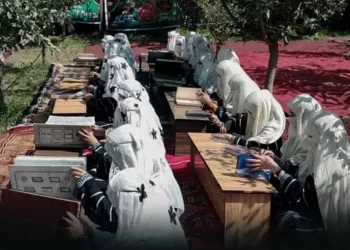
The hardline Islamist group Taliban implemented a nationwide ban on university education for women, further restriction on women’s fundamental rights to education and freedom. Since the Taliban seized Afghanistan, they have increased restrictions on all aspects of women’s lives, reach to the last deterioration of women’s rights in the country.
The Taliban’s Minister for Higher Education, Neda Mohammad Nadeem, has issued a letter to all government and private universities instructing them to enforce the ban. The letter reads: “You all are informed to implement the mentioned order of suspending the education for girls until further notice.”
The spokesman for the ministry, Ziaullah Hashimi, confirmed the order in a text message. This move is the latest in a series of restrictions imposed by the Taliban on women’s freedoms, as the group has increasingly cracked down on women’s rights.
The current restriction on women’s education is a significant setback for Afghan women, who have made progress in recent years in terms of access to education and participation in the workforce. The ban on university education will prevent many talented and ambitious young women from seeking their goals and will likely force them into early marriage or to remain at home.
“I had nightmares after the Taliban banned my teenage sisters and over 5 million girls from attending secondary school, without noticing that the Taliban will do the same for me.” Nasrin, a Law student at Kabul university, told Hasht-e Suhb.
With the tired voice and tearful eyes added: “I am broken; all my dreams to help my country and to have a sustainable life shuttered to pieces.”
The ban comes less than three months after thousands of girls and women sat through the university entrance exams (Kankor) across the country, with many aspiring to choose teaching and medicine as future careers.
“I am shocked; while I sacrificed my favorite subject, journalism, for literature to become a teacher, now they are even restricting us from studying the subject that they imposed on us, it is insane.”
Mahjabeen, a 20 years old high school graduate said to Hasht-e Suhb.
It is essential to recognize the impact that this ban will have on Afghan society and to continue working toward gender equality and empowering women in Afghanistan.
Two decades ago, the Taliban’s fundamentalist approach to education, significantly higher education, caused widespread destruction and stagnation in Afghanistan. And this narrow-minded and restrictive approach to women’s education hinders the country’s progress and development, it will leave little room for innovation or critical thinking.
The suppression of higher education can have far-reaching and long-lasting consequences for a nation and its people. It is vital to prioritize and protect women’s fundamental rights to work and education in order to foster growth and development.
According to Sima Bahous, the U.N. Women executive director, current restrictions on women’s employment in Afghanistan are estimated to result in an immediate economic loss of up to $1bn, or up to 5% of the country’s GDP. Meanwhile, as per UNICEF analysis, keeping girls out of secondary school costs Afghanistan 2.5% of its annual GDP. “If the current cohort of three million girls were able to complete their secondary education and participate in the job market, girls and women would contribute at least $5.4 billion to Afghanistan’s economy,” UNICEF said in a statement.
This highlights the importance of ensuring equal employment opportunities for women and the harmful impact restrictions can have on a nation’s economy. It is essential that women are able to participate fully in the workforce and contribute to the growth and development of Afghanistan.
Resistance
On December 20, 2022, a group of around 50 women in Afghanistan held a peaceful protest march against a recent ruling by the Taliban that bans female students from attending universities. The women, dressed in hijabs and some wearing masks, gathered in the capital city of Kabul to chant slogans against the ban. However, the event turned violent when security forces reportedly beat and detained some of the participants and journalists covering the protest, witnesses and women protestors told Hasht-E-Suhb.
Shahla Arefi, one of the protesters, stated that female members of the security forces, who were not wearing any uniform, had infiltrated the march and immobilized those who tried to flee when armed Taliban men arrived. The Taliban have not yet commented on the incident yet.
Since the hardline Islamists took power, they have suppressed brave Afghan women who risk everything to advocate for their basic rights.
On November 4, the Taliban arrested several prominent women human rights defenders, including Zarifa Yaqubi, Farhat Popalzai, and Humaira Yusuf, as well as their colleagues. Amnesty International’s, condemned the arrests as an attempt to suppress peaceful protests and dissent against the Taliban’s oppressive policies.
Academia Under the Taliban
The Taliban’s rule in Afghanistan in the 1990s had devastating consequences for the country’s higher education system; higher education had been forbidden for girls in the Taliban-controlled areas, which led to the prevention of half of the population from participating in academics. Hundreds of female lecturers and administrative university female staff were banned from working. Academic freedom and institutional autonomy were utterly destroyed, and women’s educational and social rights were severely violated. These dark years brought the higher education system to the brink of total collapse, with the country’s progress and development severely impacted as a result. The suppression and stagnation of higher education can have far-reaching and long-lasting effects on a nation and its people, as seen in Afghanistan during this time.
The Taliban’s recent rise to power in Afghanistan has raised concerns about the future of the country’s education sector.
The regime claimed that Islam and Sharia were the sole legitimate sources and benchmarks for determining which subjects could be taught in schools and universities and subjects contradicting Sharia law from the curriculum are removed.
The recent rise of the totalitarian regime has significantly impacted the country’s higher education system, which is now on the brink of collapse. The group’s policies, such as the segregation of girls and boys and the requirement for women to wear the hijab in higher education institutions, as well as the request for private universities to coordinate their hiring with a particular unit in the Ministry of Higher Education, faculty members have left or are leaving the country. The higher education sector is once again ruled by a theocratic system based on Islamic fundamentalism.
Education in Islamic Countries
On December 20, Turkey and Saudi Arabia condemned the Taliban’s decision to ban women from working outside home in Afghanistan. Turkish Foreign Minister Mevlut Cavusoglu called the ban “neither Islamic nor humane” and urged the Taliban to reverse it. The Foreign Ministry of Saudi Arabia, which has recently begun to allow women more liberty, expressed “astonishment and regret” at the decision and stated that it was “astonishing for all Islamic countries.” The restriction of women’s rights and opportunities is a violation of their human rights and goes against the principles of equality and justice. It is vital for authorities to respect and protect the rights of all individuals, regardless of gender.
The Quran encourages both men and women to seek education, and Prophet Muhammad considered it a religious duty for both genders. In fact, most Muslim women have the right to education and work. According to a World Bank report, working women make up 30% of the 450 million women in Muslim-majority economies, and labor force participation rates are increasing for women faster than men in nearly all Muslim-majority economies. In Indonesia, the largest Muslim-majority country, women’s university enrollment has increased from 2% in 1970 to almost 33% today. In Saudi Arabia, half of the university-age women attend university, which is higher than in several other countries, including Mexico, China, Brazil, and India. However, Afghanistan has witnessed some of the most severe abuses of women’s rights, forbidden to attend public and private universities, including a permanent ban on schools for girls above the 6th grade, making it the only country in the world to prohibit women’s education.
International Reaction
Shutting down the university doors was the last step that the Taliban took to discredit academia and restrict Afghan women.
U.N. Secretary-General Antonio Guterres condemned the decision, calling it another “broken promise” from the Taliban and a “very troubling” move.
“It’s difficult to imagine how a country can develop, can deal with all of the challenges that it has, without the active participation of women and the education,” Guterres said.
The U.S. State Department released a joint statement with the U.K., Canada, European Union, and other Western allies condemning the ban and calling on the Taliban to respect the rights of all Afghans, including women and girls. Education is a fundamental right for all individuals, and the international community must stand united in condemning the Taliban’s actions and push for the reversal of this harmful and discriminatory ban.
Despite these statements, the International community should take urgent and sufficient measures through diplomatic pressure on the Taliban to guarantee respect for women’s and human rights.
Bio:
Mujtaba Haris is an Afghan researcher and writer. He has written extensively about the human rights, humanitarian crisis, security, and development situation in Afghanistan. He has been published in several international media outlets.