
The Hasht-e Subh Daily, in a field investigation, has found that women and girls in some madrasas study Islamic teachings in a highly restrictive environment steeped in fear and silence. The use of mobile phones is prohibited in these centers, and stringent security measures, including thorough searches upon entry and mandatory full coverage (burqa and mask), are enforced. All girls are instructed to cover their faces, remain silent, refrain from asking questions, walk quietly, avoid laughing, and be obedient and compliant. Some students in these madrasas view the restrictions imposed by the Taliban on women as a “valuable measure.” Some of these students describe mandatory hijab for women as a “diamond.” Additionally, instructors at these madrasas teach girls that women cannot marry without the permission of their “guardian,” and if a girl is betrothed by her father or grandfather in childhood, she has no right to annul the marriage upon reaching puberty. One of the clerics at a madrasa examined by the Hasht-e Subh Daily stated: “If a man jokingly says to his friend, ‘Your daughter is now my wife,’ and the other party agrees, the offer and acceptance are complete, and that young child is legally considered the wife of that man.”
Following the closure of modern schools and universities to girls, many have turned to madrasas. Some girls who have enrolled in these madrasas say that with all other doors closed to them, they have been compelled to choose madrasas.
This report is based on field findings and interviews with girls from two madrasas in Kabul. These girls believe that, with all other opportunities closed, they must take advantage of the open doors of madrasas to gain more knowledge about religion and Islam.
The investigation of this report reveals that female students in these madrasas come from various social backgrounds, but most are from families with better economic conditions. These girls confirmed that they often feel lonely at home, which has driven them to madrasas. They noted that their families typically did not allow them to attend modern regular schools or university, but they are now freely attending madrasas.
To escape loneliness and the pressures of home life, these girls try to stay in their classrooms after lessons, but madrasa administrators force them to leave and do not allow anyone to remain after classes end. Among these girls are single women over 30 years old who prefer to spend more time at madrasas to escape their home environment. These two madrasas also have instructors from Pakistan.
Some girls studying in these madrasas expressed satisfaction with their attendance, stating that they have become entirely different people compared to before. They believe their moral and personal character has changed, but they still hope that modern regular schools and universities will reopen soon.
Due to security concerns, this report refrains from disclosing details about the identity of these girls. In interviews with the Hasht-e Subh Daily, the girls said that before attending madrasas, they had little knowledge of the Taliban’s beliefs and ideology, but their presence in these madrasas has even changed their style of dress. They noted that they previously wore colorful clothing and paid attention to their appearance, but now they wear black burqas with masks underneath, as this is what they have been taught at the madrasa. Although these girls adhere to the Hanafi School of thought and state that covering the face is not mandatory in this sect, they prefer to cover their faces due to the perceived insecurity of society.
Most students in these madrasas stated that they do not view the restrictions imposed by the Taliban on women as negative, but rather describe them as a sign of the “value of women.” One girl, who still hopes for the modern regular schools to reopen, said that the Taliban’s Morality Police have aligned their appearance with Islam, but it is unclear to what extent their hearts and intentions align with Islamic teachings. She recounted an incident where one girl wore glasses, but the Taliban’s Morality Police prohibited her from using them, which she found strange and thought-provoking.
Although this girl was not fond of wearing a burqa and believed that, according to their sect, full-face covering is not required, she was compelled to wear a burqa and mask because the madrasa taught that society is “corrupt.” She believes that Islam does not condemn women to confinement at home, but given the current circumstances, she feels forced to accept it.
Dress Code and Security Measures
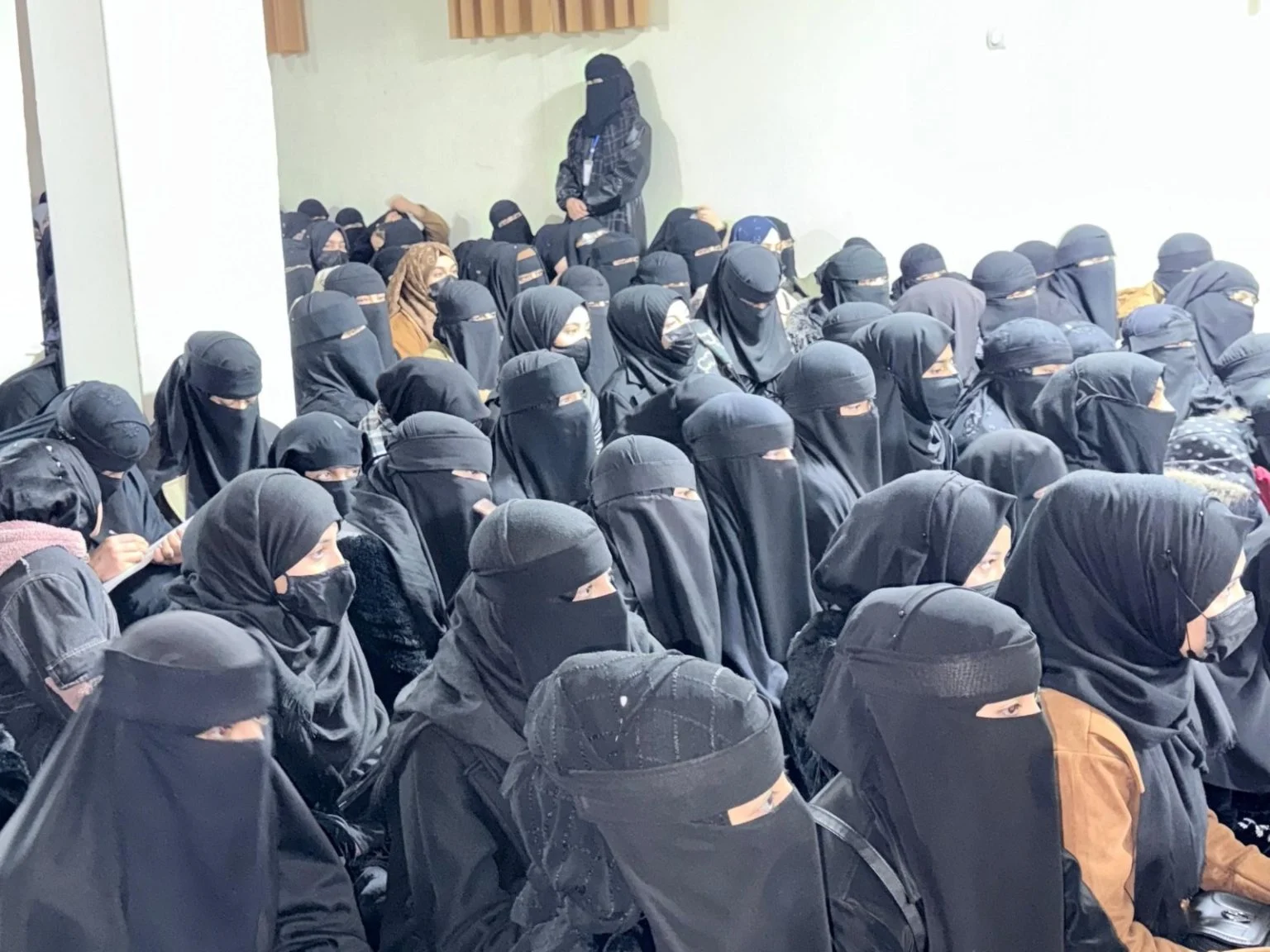
Girls attending these madrasas are required to wear black clothing that covers them from head to toe. Female students are mandated to wear a burqa and a mask underneath, and entry is not permitted without full coverage. Additionally, all entrants must carry a special card and are thoroughly searched at the madrasa entrance.
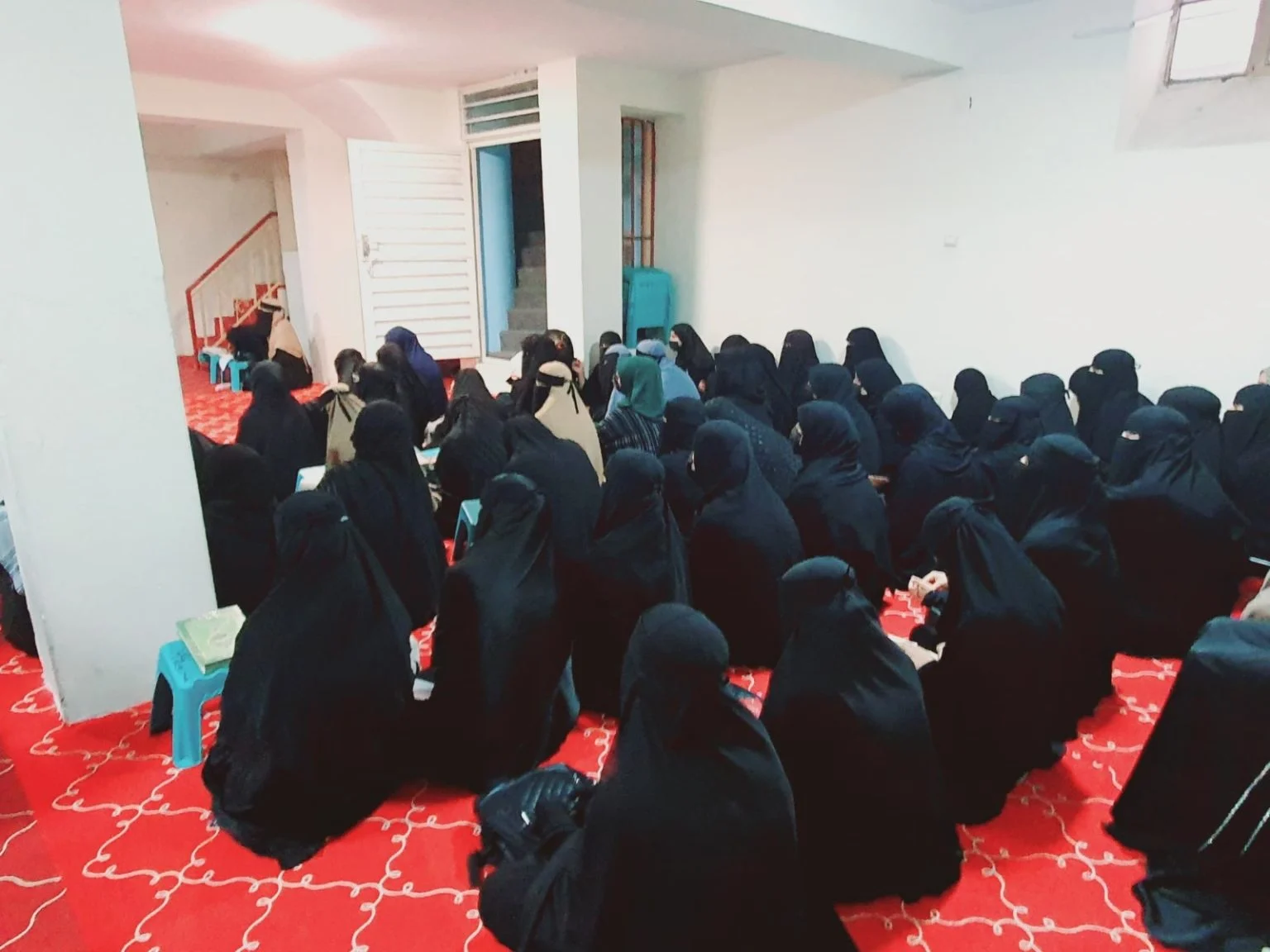
Female students in these madrasas do not have chairs and sit on carpets inside classrooms, with a small blue table placed in front of each for their books. In one of these madrasas, mobile phones are prohibited, but complete silence prevails in all classrooms and madrasa premises, which are equipped with security cameras.
Experience in These Madrasas
Observations by the Hasht-e Subh Daily indicate that no one laughs or makes a sound; everyone is quiet and calm, as if fear pervades the environment. The madrasa atmosphere is deeply melancholic, silent, and restrictive. All women and girls are told to cover their faces, remain silent, walk quietly, refrain from laughing, and always be obedient and compliant. The material taught in classes lacks academic rigor and is aimed at negating women’s freedoms. A pervasive atmosphere of fear, coercion, and silence dominates these spaces.
Observations show that the girls have adopted silence and are withdrawn; it appears they have been instructed not to speak with anyone. The investigation found that even when approached warmly, the students were not friendly, observing others with deep, curious stares and asking, “Why aren’t you silent? Why are you talking or asking questions?” Their responses were typically short and curt, rarely extending beyond that.
When asked about freedom, decision-making, or their future, most girls remained silent. Some responded only with brief smiles or glances, as if afraid to express what was in their hearts. Observations indicate that for many students, even thinking about “freedom” has become taboo. When asked, “If you had the choice, would you still come here?” their expressions grew heavier. Some lowered their heads, others hesitantly said, “I don’t know,” and one whispered under her breath, “We don’t have the right to choose, so this question is pointless.”
The investigative report’s findings suggest that silence is a normal and accepted practice in this environment. The female students sometimes appeared anxious even in the presence of another girl who, like them, merely asked questions or engaged in conversation, as if only their bodies were present in the madrasa while their minds were fleeing from something intangible. They tried to avoid thinking, choosing, or even hearing their voices in simple conversations. Some had innocent gazes, while others’ eyes were filled with fear and anxiety. Many of these girls held a completely “positive” view of marrying Taliban members, saying, “If you are good, you’ll get a good husband; it doesn’t matter if he’s a Taliban member.”
Educational Content
Subjects taught in these two madrasas include jurisprudence, principles of jurisprudence, Islamic beliefs, Quran memorization, exegesis, recitation, and Arabic grammar. The report highlights, as an example, a lesson on marriage for women, addressing the topic of “individual choice.” The lesson, titled “Guardianship of Men over Women,” is not only taught in classes but also shared in the madrasas’ WhatsApp groups.
In this lesson, the mullah teaching the girls poses a question: “Can a widowed or divorced woman marry without the permission of her father, brother, or guardian? If someone marries without their guardian’s permission, is the marriage valid?” He then answers, stating, “Most non-Hanafi schools of thought believe a woman cannot marry without her guardian’s permission. If she does, the marriage is incomplete and not legally valid.” He attributes this view to a saying attributed to the Prophet of Islam, emphasizing that a girl cannot marry without her guardian’s consent.
He then continues, stating that a minor girl cannot be married without her guardian’s permission, and if such a marriage occurs, it is invalid. He adds, “Consider a girl married off in childhood, which is common in some areas; even in infancy, girls are betrothed. If a father marries off his daughter or arranges a wife for his son at a young age, the marriage is valid under Islamic law.”
The instructor further explains, “At a young age, no one knows if the right decision was made. Therefore, Islamic law grants a special right to a girl married off young. If a girl was married in childhood without the consent of her legitimate guardian—her father or grandfather—but with her brother’s permission, she has the right to annul the marriage later.”
He continues, “For example, if a girl’s brother arranges her marriage in childhood, and upon growing up she finds the husband or his family unsuitable and is dissatisfied, she can go to court and request the marriage’s annulment without needing a divorce from her husband. This applies if the marriage was arranged by someone other than her father or grandfather, such as a brother or uncle. In such cases, the marriage can be annulled. Boys also have the right to divorce in such cases.”
Mandatory Guardianship
In exegesis lessons, the cleric explains that if a girl’s marriage was arranged by her father or grandfather in childhood, she has no right to reject or annul it upon reaching puberty. He calls this “mandatory guardianship,” meaning the legitimate guardian (father or grandfather) has full authority to decide for the girl in childhood, and this decision cannot be changed even after she matures.
Discretionary Guardianship
In one of the exegesis lessons taught at these madrasas, the topic of “discretionary guardianship” is raised. The cleric explains that under discretionary guardianship, a woman or girl can marry without the permission of her father, uncle, or brother, and such a marriage is legally valid. He adds, “While it is preferable under Islamic law for a woman to have a guardian for marriage, if she doesn’t or marries without permission, the marriage is not void.”
Marriage and Divorce in the Madrasas’ Interpretation
The cleric at this madrasa tells the girls in one lesson that matters of marriage and divorce are “very delicate and sensitive.” He says that sometimes, a single “word” can make two people husband and wife. He explains that even if someone jokingly says to an infant girl, “This girl is my wife,” and her guardian confirms it, saying, “That’s fine,” the girl is legally married to that man.
The cleric claims, “One of our classmates was married and had a young daughter, an infant, perhaps one or two months old. This classmate was joking with another. The second classmate said, ‘Congratulations on your daughter; won’t you give her to me?’ The first responded, ‘Go ahead, she’s yours.’ Here, offer and acceptance took place, which are conditions of marriage. If the girl is a minor, as we discussed earlier, since her guardian was present, the marriage is legally binding. Even though they were joking, in matters of marriage, joking has no place. Once said, whether in jest or seriousness, it is accepted.”
The cleric offers a similar interpretation of divorce, stating, “If you jokingly say to your wife, ‘I divorce you,’ the divorce is valid. Joking has no place in marriage and must be taken seriously.”
The cleric says non-Muslims are not granted the right to marry, and God has commanded Muslims not to marry their daughters or sons to non-Muslims. He interprets that marriage, especially decisions about it, lies with guardians, even if the child does not consent. He claims, “A believing girl marrying a believing slave is better than a Muslim girl marrying a free non-believer.” According to him, “It’s better for a Muslim girl to marry a Muslim slave than a free non-believer, as faith and religious belief are more important.”
The cleric claims that before Islam, men’s interactions with women during menstruation differed. According to him, some groups, like Christians, made no distinction between menstruation and other times, engaging in sexual relations without restriction. In contrast, groups like Jews were extremely strict, to the point that during menstruation, they did not eat with women, live in the same room, or even assign a “slave” to prepare special food for them. Thus, among non-Muslim Arabs, interactions with women during menstruation were highly restricted and stringent.
Social Media and Hijab Promotion
Some of these madrasas use the social media platform Facebook for promotional purposes. In a video posted on one madrasa’s Facebook page, a young girl is seen speaking critically to another student, saying, “Fereshta, are you still dressing like this? The world has changed!” In response, the girl, presumably Fereshta, firmly says, “I’ve changed too, not to please others’ eyes but for the satisfaction of my heart and my God.”
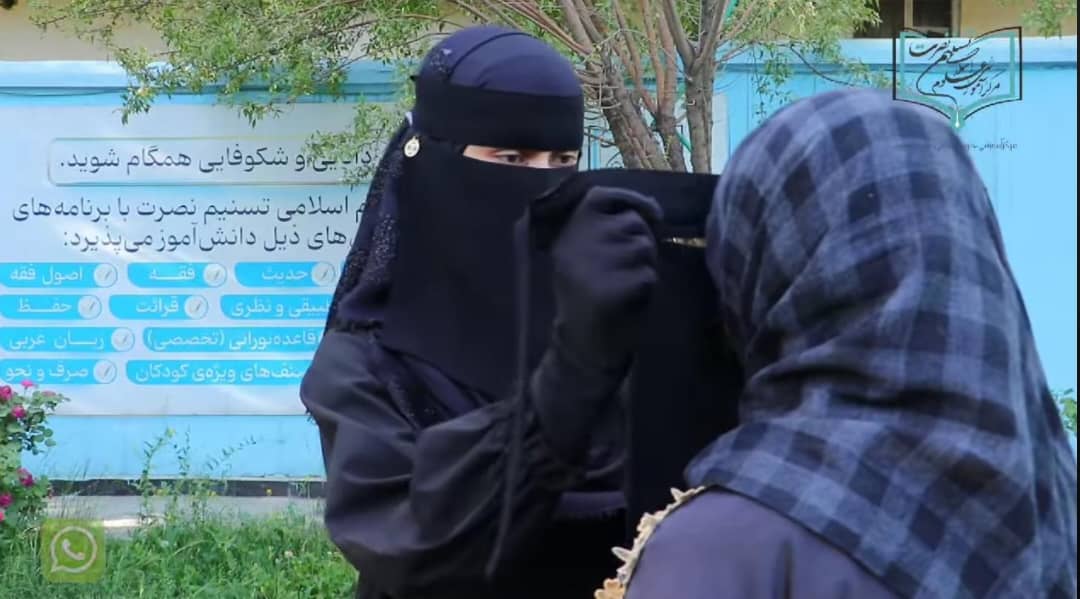
In the continuation of this promotional video, a third person enters the conversation, saying, “I’m torn because of your mindsets about whether to wear hijab or not.” In response, the first girl, with a convincing tone, says to her, “You’re a diamond, dear Zahra. Diamonds aren’t always displayed in a showcase; they’re kept and covered because they’re valuable. Hijab is not just clothing; it’s a symbol of dignity.”
Since taking control of Afghanistan, the Taliban have banned girls above the sixth grade from attending modern regular schools and universities and have issued dozens of other restrictive decrees against women and girls.
You can read the Persian version of this investigative report here:
برقع، سکوت و ازدواج اجباری؛ دختران در مدرسههای دینی چه میآموزند؟