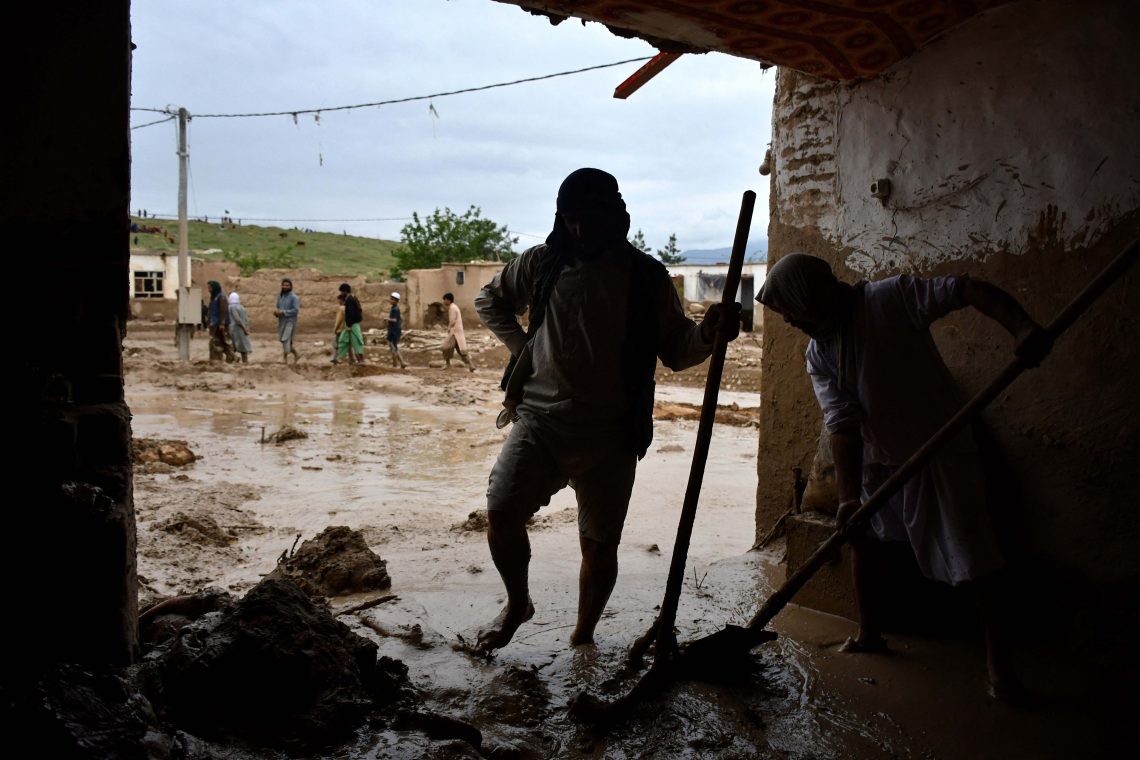
Devastating floods in recent days have resulted in significant human casualties and substantial financial losses in several provinces across Afghanistan. The destruction of main and secondary roads, the loss of agricultural products, and the suffering of thousands of citizens are among the consequences of the severe storms and heavy rains in the provinces of Nangarhar, Kunar, Panjshir, Kapisa, and Maidan Wardak. The Taliban have confirmed that as a result of floods and severe storms in Nangarhar province, 47 people have been killed and more than 350 others injured. Additionally, about 10 people have been killed in the provinces of Kapisa and Kunar. The United Nations High Commissioner for Refugees (UNHCR) has stated that a large number of displaced persons and refugees were living in the flood-affected areas of Nangarhar. Meanwhile, the Washington Post has reported that Afghanistan is grappling with climate change alone, while the Taliban attribute natural disasters to divine acts or foreign conspiracies.
Local Taliban officials and doctors in Nangarhar province have confirmed that as a result of severe storms and rains on Monday, July 15, 2024, 47 people have been killed and about 350 others injured. Most of the victims are women and children.
Additionally, Saifullah Khalid, the head of the Taliban’s disaster response in Nangarhar province, has said that floods in the districts of Surkh Rod, Behsud, and some other areas of this province have resulted in over 47 deaths and 350 injuries, as well as severe damage to 400 houses, 60 power pylons, and people’s orchards and farmlands.
Sources in Nangarhar have also confirmed that floods in the outskirts of Jalalabad City, Surkh Rod district, and several other areas of this province have caused severe damage, resulting in power outages and the breaking of trees on the roads.
Storms and heavy rains in the Surkh Rod district of Nangarhar have also claimed the lives of 11 members of one family. Relatives of this family have told the media that 11 members had gathered to celebrate the birth of a newborn when suddenly a storm swept through the district, killing 11 people.
Flood victims in Nangarhar province have described the storms and heavy rains in this province as unprecedented. Simultaneously, a video clip of the storm accompanied by heavy rains has been circulating on social media, showing the intensity of the rainfall.
On the other hand, images published in some areas of Panjshir province also show that the destructive power of the floods has been extensive, destroying people’s orchards and farmlands and blocking roads to traffic in some areas.
Furthermore, local Taliban officials in Kapisa have said that as a result of the floods in this province, three people have lost their lives, and people’s farmlands and trees have been severely damaged. According to the Taliban, 35 houses and dozens of acres of farmland have been destroyed, and dozens of livestock have perished. Additionally, five more people, including women and children, have died due to the floods in this province, and 38 residential houses, hundreds of acres of farmland, several water supply networks, and roads have been destroyed.
Floods in Maidan Wardak province have also destroyed hundreds of acres of farmland and dozens of orchards, causing significant financial losses to the residents of the flood-affected areas.
Floods in Badakhshan province have caused the death of 300 livestock in the Jurm district of this province. Sources said that 150 acres of farmland and dozens of water canals have also been destroyed due to the floods in this district.
Meanwhile, the UNHCR has said that the flood-affected areas in Nangarhar have hosted a large number of displaced persons and returnees. The organization has emphasized that it is present in the area and is assessing the needs of the affected people.
However, Najibullah Sadid, an environmental expert, has shared images saying that satellite images show that the extent of the floods in the districts of Surkh Rod and Sultanpur has been severe. He wrote: “As predicted, this year’s monsoon in the Indian subcontinent is strong, which may cause destructive floods in the region and eastern Afghanistan. The new climatic conditions require continuous and effective combat; otherwise, people’s living conditions will become increasingly difficult.”
Meanwhile, the World Food Programme (WFP) has stated that Afghanistan is the sixth most vulnerable country to climate change and natural events.
The Washington Post has reported that Afghanistan is grappling with climate change alone. According to this report, due to the educational and academic restrictions imposed by the Taliban on women, Afghanistan has remained isolated and deprived of foreign financial aid for essential actions like climate change adaptation.
This media outlet has also reported that the Taliban debate whether natural disasters in Afghanistan are “God’s work or foreign conspiracy.” The report states that Afghanistan is currently dealing with the impacts of global warming alone, with the Taliban blaming foreigners for the floods and poor government management. According to the Washington Post, some Taliban commanders view global carbon emissions as a new invisible enemy.
Lutfullah Khairkhah, the deputy minister of higher education for the Taliban, said in his opening speech at the Jalalabad conference, held to address climate change: “Just as our country was attacked, our climate has also been attacked. We must defend our climate, water, and soil as much as we defend ourselves against invasions.”
According to the report, Afghanistan has remained isolated due to the Taliban’s restrictions on women and deprived of foreign financial aid for essential climate change adaptation actions.
The report states that considering the dry deserts, deforested areas, and flood-prone valleys, Afghanistan is among the ten countries most vulnerable to climate change.
Kanni Wignaraja, the regional director for Asia and the Pacific at the United Nations Development Program (UNDP), said that prolonged droughts in Afghanistan have hardened the soil so much that sudden floods have become more severe and caused greater damage.
The Washington Post claimed in this report that before the Taliban took over, international donors estimated that Afghanistan needed more than $20 billion for climate change preparedness between 2020 and 2030.
You can read the Persian version of this daily report here:
از تغییر اقلیم تا «توطیه خارجی»؛ سیلابهای اخیر ۶۰ کشته و بیش از ۳۰۰ زخمی برجا گذاشت | روزنامه ۸صبح