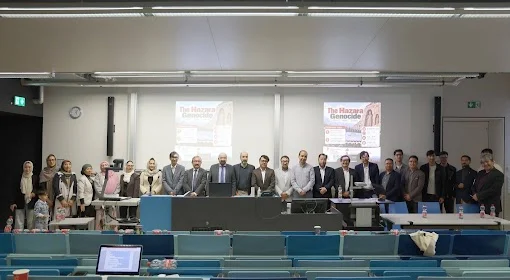
September 25, the International Day of Remembrance for the Hazara Genocide, was commemorated at an academic and cultural event attended by university professors, researchers, civil society and human rights activists, and women’s rights advocates. Participants emphasized the importance of thorough documentation and international advocacy.
The event was held on Friday, September 25, at the Dusseldorf University of Applied Sciences in Germany. The issue was discussed through two sessions featuring speeches and a panel discussion.
Several speakers reviewed historical atrocities against the Hazara community, including slavery, property confiscation, killings, and forced displacement. They stressed the need for thorough documentation and international advocacy.
Dawood Ali Najafi, Afghanistan’s former transport minister, said at the event that statements and street protests alone are not enough. He said the Hazara community should move toward professional documentation, academic research, and establishing think tanks.
Meanwhile, during a panel titled “Discrimination, Risk of Genocide and the Future of the Hazara,” participants discussed the geopolitical roots of the repression of Hazaras and emphasized a shift from traditional forms of solidarity to more modern and inclusive forms.
Panel participants also called for the establishment of a documented case file to pursue international legal action over the repression of Hazaras.
Some participants also highlighted the multiple layers of discrimination faced by Hazara women, mechanisms for documenting and transferring evidence to international institutions, and the need to coordinate the fragmented activities of the Hazara diaspora.
At the end of the event, a statement by the Federation of Hazara Organizations in Germany was read out. It emphasized preserving historical memory, documenting the truth, and seeking justice. It also expressed support for academic research, historical documentation, and recognition of crimes committed against Hazaras.