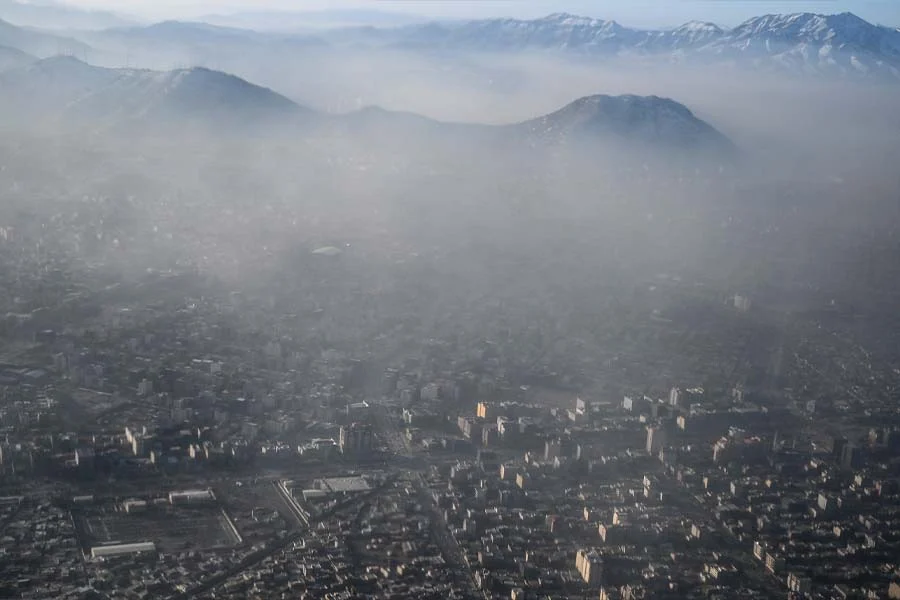
A number of Kabul residents have expressed concern over the increase in dust in various parts of the city. They say Kabul is breathing amid dust and air pollution, and the continuation of this situation has made daily life and commuting more difficult for people. Meanwhile, environmental experts warn that the continuation and increase of dust could have widespread consequences for human health, the environment, and the economy, and could impose high social and economic costs on society.
Omid (pseudonym), a resident of Kabul, complains about the increase in dust in the city. He says that alongside other problems Kabul residents face, the rise in dust has become one of the serious challenges. According to him, the implementation of unfinished Taliban road construction projects across various parts of the city has increased the amount of dust and polluted Kabul’s air.
This Kabul resident says: “The demolition of several areas before the completion of unfinished projects, in a crowded and polluted city like Kabul, has caused many problems, including increased traffic congestion, confusion for people commuting, and most importantly, an excessive increase in dust in the city of Kabul.”
Omid adds: “With winter approaching and construction increasing, this situation could turn into a pollution crisis. I think this measure by the Taliban is carried out more for appearances than to provide standard services.”
Zainab (pseudonym), a resident of the Barikot intersection area of Kabul, also complains about the increase in dust in the city. According to her, Kabul is engulfed in dust and air pollution, and this situation has caused many problems for the lives of citizens.
This Kabul resident says: “Since they have dug up everywhere, they have made the air and environment very polluted, and this situation is very difficult for us. It should not be that they fix one place and then move to another, but they have covered everywhere in dust, which has caused many illnesses for people. Wherever we look in the city, everywhere is filled with dust.”
Jamil (pseudonym), a resident of the Chahari Shahid area of Kabul, says that he has developed an allergy due to the increase in dust in the city. According to him, due to the Taliban’s unplanned construction work, the amount of dust in the city has increased, and traffic congestion has also intensified.
This Kabul resident says: “We have had enough of the dust; my eyes are irritated and I have a sore throat. Also, we leave home clean, but when we return, all our clothes are covered in dust. The roads are severely congested. At the same time, on one route, two or three sections are under construction simultaneously. A route that takes half an hour now takes one hour.”
Jamil adds: “The Taliban should finish one place and, once the work there is done, start another, so that there is neither congestion nor inconvenience for people. Even the trees along the roads cannot be seen under the layers of dust.”
Sardar (pseudonym), a taxi driver on the route from “Kote Sangi” to “Chahari Shahid,” also complains about the increase in traffic congestion due to the slow pace of construction on this route. He calls for the swift completion of road construction projects and overpasses in Kabul city.
This taxi driver says: “At every intersection, we are stuck in traffic for at least 15 minutes, and stones and mud from road construction work have also been dumped at the intersections. The congestion is worse at Baraki, Karte Parwan intersection, Dehan-e Wilayat, and Chahari Shahid. On some of these routes, vehicles remain stopped for up to an hour. I ask the Taliban municipality to try to complete the road construction projects and overpasses as soon as possible.”
Meanwhile, Sayed Mohammad Sulaimankhil, an environmental expert, says that the increase in dust has serious consequences for human health, society, the economy, and other aspects of people’s lives, and could harm all sectors.
This environmental expert says: “If the increase in dust is not prevented, this situation could cause enormous economic, health, and social damage.”
This comes as, some time ago, a number of Kabul residents complained about the prolonged road reconstruction process in various parts of the city. They had said that the continuation of these projects has created serious problems for people’s daily commuting.
These residents had emphasized that the use of alternative routes is also fraught with serious difficulties due to the poor condition of the roads, dust in the dry season, and mud during the rainy season.
You can read the Persian version of this report here:
کابل در میان گرد و خاک؛ مردم از افزایش آلودهگی هوا شکایت دارند