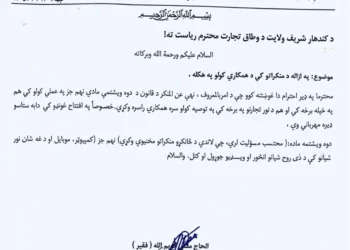

Several rickshaw operators in Nangarhar province are complaining about the Taliban’s ban on these vehicles, saying the decision has stripped them of their only source of income and livelihood. They say they had purchased their rickshaws through great hardship and by investing all their savings in order to provide for their families, but now find themselves unable to meet their households’ daily expenses. The drivers add that the ban has not only failed to resolve traffic congestion but has actually led to a surge in the number of Suzuki minivans on city streets. Meanwhile, some economic analysts warn that under the current difficult economic conditions, this decision carries severe consequences for family livelihoods. In their view, the ban not only destroys the drivers’ capital investment but also limits access to affordable transportation for citizens, particularly low-income residents and women.
Tawab (pseudonym), a rickshaw operator in Nangarhar, is among those voicing complaints about the Taliban’s ban. He says he had invested all his savings in purchasing the rickshaw and is now deeply worried about how to cover his family’s living expenses.
The Nangarhar resident says, “A year ago, we bought this rickshaw after enormous hardship. The income wasn’t much, but it was at least enough to put food on the table for my children, morning and night. About eight months ago, the Taliban began imposing restrictions on rickshaws in Nangarhar, but we could still manage to work to some extent. Now, for some time, they have banned rickshaws from operating entirely.”
Tawab adds with visible distress: “I am utterly heartbroken. I put every bit of my savings into buying this rickshaw. Now, no one is willing to buy it at a fair price, and I am not allowed to use it for work either. I do not know what to do. I have no money to open a shop or start a street stall. The only source of income for my family has been taken away.”
Ahmad (pseudonym), another resident of Nangarhar province, says the Taliban banned line rickshaws nearly nine months ago. According to him, the decision has not resolved the traffic problem but has instead caused a sharp increase in the number of Suzuki minivans in the city. He says, “Before the ban, the number of rickshaws in Nangarhar had grown significantly. But after they were banned, a new problem emerged. The number of Suzuki minivans has since increased, and this has made traffic congestion in the city even worse.”
Ahmad attributes the rise in both rickshaws and Suzuki minivans to the dire economic situation faced by residents. He says: “The economic situation in Nangarhar is extremely bad. Many people have turned to driving as a way to put food on the table for their families. Some borrow money to buy a rickshaw or a Suzuki minivan, and some even sell their wives’ gold jewelry just to get a vehicle to work with and earn an income. Poverty and unemployment are the main drivers behind the increase in rickshaws and Suzuki minivans.”
Meanwhile, Masoud Amir, an economic analyst, says the ban on rickshaws will have at least four major economic and social consequences. He states: “The first consequence of this decision is an increase in economic pressure on families. At a time when poverty in Afghanistan is on the rise, the loss of income for thousands of families will have a very damaging effect on their livelihoods.” He adds that the ban will also result in the destruction of people’s capital.
Mr. Amir says: “Each rickshaw costs approximately one thousand to two thousand and five hundred dollars. Following the ban, owners can no longer sell their rickshaws, which means the capital they invested in purchasing them effectively becomes worthless. For those who bought their vehicles on installments, the financial burden on already struggling families will be even greater.”
The analyst identifies the second consequence of the decision as a serious disruption to citizens’ mobility. He says: “A large portion of the population cannot afford taxi fares, and the removal of rickshaws limits their access to affordable transportation. This will also hinder people’s access to various public services.”
He further adds: “The ban on rickshaws will hurt the transport of goods and the movement of citizens, particularly women, creating serious obstacles to their access to services and essential facilities.”
This comes as some time ago, several rickshaw drivers in Mazar-e-Sharif, the capital of Balkh province, told the Hasht-e Subh Daily in interviews about being subjected to extortion by the Taliban, broad restrictions on their movement, and ongoing harassment by the Morality Police of the Ministry for the Propagation of Virtue and Prevention of Vice. According to them, due to the stagnation of the job market and the lack of employment opportunities, large numbers of Mazar-e-Sharif residents have turned to rickshaw driving. They say they are worn down by the constant extortion carried out by various Taliban bodies, but have no choice other than to endure it.
You can read the Persian version of this report here:
ممنوعیت فعالیت ریکشاها در ننگرهار؛ رانندهگان از دست رفتن منبع درآمدشان نگرانند