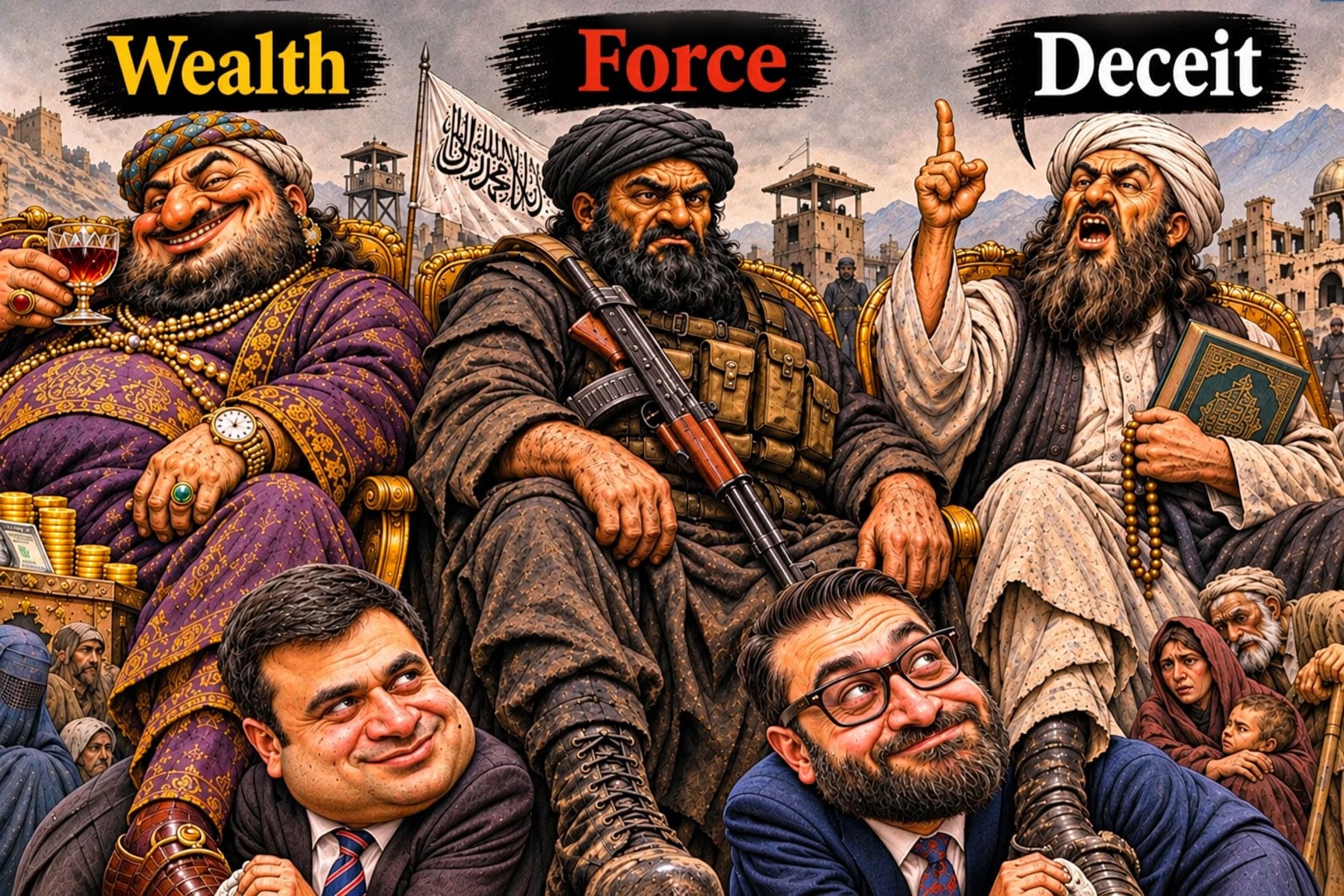
The emperor, consumed by his own grandeur and status, falls for the deception. His ministers and courtiers, terrified of being exposed as fools, pretend to admire the splendid garments he is supposedly wearing. Eventually, the emperor parades proudly before his people, who applaud him, until a child cries out the simple truth: “But he isn’t wearing anything at all!”
The story is not merely about a deceived emperor. It is about the psychology of power, collective pretence, and those who believe that changing names and appearances can somehow change reality itself. Parts of Afghanistan’s political landscape today bear a disturbing resemblance to Andersen’s tale. The difference is that, this time, the price of these imaginary garments has been paid not by an emperor, but by an entire nation, with its lives, its displacement, and its stolen future.
On October 24, 2026, the newly established Afghanistan Majority Party published a paper entitled The Role of Non-Governmental Organizations (NGOs) in Weakening States and National Political Institutions. The paper criticizes NGOs as instruments of foreign influence, social engineering, and the erosion of national institutions.
Criticism of foreign-aid dependency, corruption in certain projects, and the inefficiency of parallel administrative structures is entirely legitimate. But when NGOs are broadly placed in the dock, a fundamental question arises: Did NGOs bring down the Afghan Republic, or did systemic corruption, the concentration of power, and the disastrous decisions of those in office also contribute to its collapse?
If NGOs controlled everything, what responsibility did the presidency, government ministries, armed forces, and intelligence agencies bear? Who appointed ministers? Who replaced military commanders? Who managed major contracts and determined national security policies?
If NGOs were effectively running the country, what exactly were the Republic’s senior officials doing? And if they were not, why is the responsibility of those who held real political power being pushed aside?
Grandiose terms such as “colonialism,” “hegemony,” and “social engineering” are no substitute for evidence or accountability. If a particular project undermined the state, the authors should identify the project, its funding, those responsible for managing it, and the consequences it produced. Condemning civil society as a whole cannot absolve those who exercised state power of their responsibilities.
Criticism of NGOs becomes credible only when the same standards of scrutiny are applied to government officials, state contracts, and political decisions.
There is, however, an even more fundamental question for the authors of this paper: What exactly do they mean by “national institutions”?
Does every institution operating under Taliban control qualify as a national institution simply because it is part of the state? Can a system that excludes women from many professions, denies girls secondary and higher education, and rejects free political participation legitimately claim to represent an entire nation?
Afghanistan needs public administration, hospitals, schools, and sustainable public services. But the existence of government buildings does not, by itself, confer national legitimacy. A national institution is not defined by the sign above a ministry or the seal of those in power. Its legitimacy rests on equal public service, independence, transparency, and respect for citizens’ rights.
At a time when the Taliban have banned political parties and severely restricted civil society organizations, calling for stronger state institutions without explaining how they should remain independent and accountable creates a serious ambiguity. Is the objective a lawful and accountable state, or a centralized apparatus of power that tolerates no independent oversight?
Strengthening the state is not the same as strengthening the rulers’ monopoly on power.
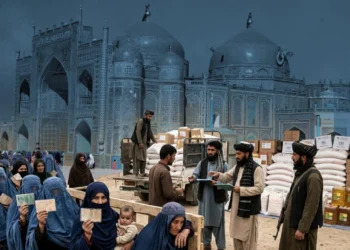
Sacks of flour, yellow water containers, and emergency shelters are not symbols of development. They are signs of poverty and the failure of economic and political structures. Yet how can humanitarian assistance to a starving family be portrayed as a threat to the state when those exercising authority cannot provide for the population’s most basic needs?
Emergency assistance is no substitute for long-term institution-building. But humanitarian workers should not be blamed for the crisis that makes their presence necessary. Whether an NGO, a government ministry, or an institution operating under Taliban authority, any organization that derives resources and legitimacy from the perpetuation of poverty must be held accountable.
State-building means reducing people’s dependence on emergency assistance, not declaring an apparatus “national” while it benefits from the continuation of that dependence.
Against this background, the involvement of Fazly, the former head of Afghanistan’s Administrative Office of the President and a close associate of Ashraf Ghani, in the Afghanistan Majority Party raises further questions about political responsibility. According to Afghanistan International, he fled Kabul around the same time as Ghani.
No one should be denied the right to engage in political activity. But establishing a new party cannot replace the obligation to explain one’s record in public office.
On August 15, 2021, Afghanistan experienced more than a change of government. A political system that was supposed to protect its citizens collapsed. Afghan security forces fought and sacrificed their lives on the front lines, while millions of civilians were left to face the consequences of the collapse as several of the country’s most senior officials departed.
The responsibility for this catastrophe cannot be placed on a handful of individuals alone. The Doha Agreement, the United States’ withdrawal, the Taliban’s military advances, systemic corruption, and failures of leadership all contributed to the Republic’s downfall. Nevertheless, reports by the Special Inspector General for Afghanistan Reconstruction (SIGAR) also identified the concentration of power, the narrow circle of presidential loyalists, and a crisis of legitimacy among the factors that weakened the Republic.
In psychology, “projection” refers to the tendency to attribute one’s own unacceptable faults or shortcomings to others. A similar danger exists in politics: rather than examining their own role in failure, former officials may construct a new narrative in which others become the principal culprits.
It must be said plainly: One cannot hold power yesterday, evade responsibility today, and return tomorrow dressed as the nation’s savior.
The very name “Afghanistan Majority Party” raises a separate question. What does “majority” mean? An ethnic majority? A political majority? A majority of the population? Which election or independently verified data establishes such a claim to representation?
The choice of this name does not, by itself, prove ethnic nationalism. But in a country deeply scarred by discrimination and political exclusion, the use of terms such as “majority” and “minority” without clear explanation deserves scrutiny.
If the intention is to revive a political logic that divides citizens into the natural owners of power and those relegated to second-class status, that is not national politics. It is the reproduction of exclusion, colonial domination, and subjugation in a new disguise.
Afghanistan is not the property of any self-proclaimed majority. It belongs to all its citizens, who are entitled to equal rights.
Another question concerns the conduct of political factions over the past five years: How can genuine opposition to the Taliban be distinguished from the opportunistic use of anti-Taliban rhetoric?
Any allegation of clandestine dealings between political figures, their associates, and Taliban structures must be examined based on credible evidence. Verbal opposition alone does not establish political independence. Equally, accusations of being a “fifth column,” when made without evidence, can themselves become instruments for silencing political opponents.
But if it is established that individuals who publicly portrayed themselves as the Taliban’s fiercest opponents were secretly negotiating or cooperating with the same movement, the issue goes beyond ordinary political disagreement. It becomes a question of deception and betrayal of public trust.
The measure of political integrity is not a Western suit, an academic title, fiery speeches, or an impressive party name. It is documented conduct and accountability.
And now we return to Andersen’s tale, to the two swindlers who deceived the emperor with an imaginary suit of clothes.
In Afghanistan’s tragic version of the story, the emperor was not merely left naked. The palace collapsed, soldiers paid with their lives, women were stripped of their rights, and an entire generation saw its future stolen.
Yet instead of answering for their earlier deception, the two swindlers opened a new shop. This time, rather than selling invisible fabric, they began selling glittering words: “Majority,” “Independence,” and “National Salvation.” And once again, they expected applause.
But this time, the child points toward the ruins of the palace and asks:
“Where did the palace’s wealth go? Who opened the gates to the enemy? And why are the very people who failed to protect the palace now claiming they can save it?”
The two swindlers fall silent. This time, the people are no longer interested in admiring imaginary garments. They are demanding an accounting of the past.
Afghanistan’s tragedy is not simply that its emperor stood naked. The greater tragedy is that, after the palace was destroyed and the nation displaced, yesterday’s tailors have returned under new names, opened another shop, and still expect the people to applaud them.
New clothes cannot erase the past. History may be rewritten a thousand times, but a people who have paid their price with their lives and their future cannot be forced to forget.