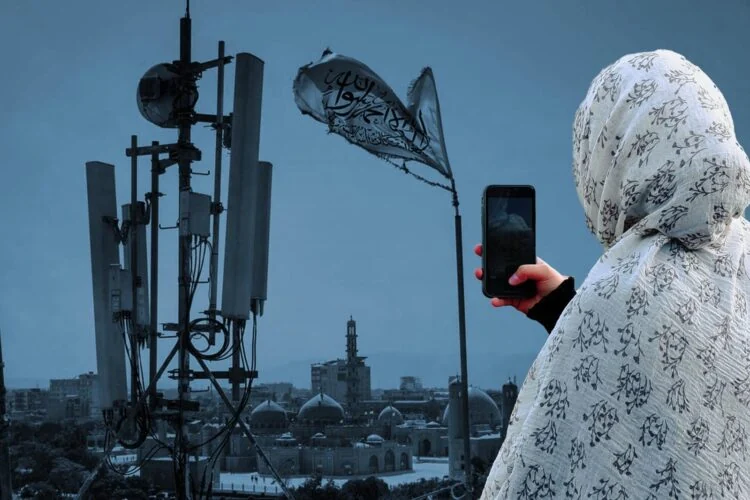
Following the closure of secondary schools and universities to girls and women in Afghanistan, online education has become a way for some of them to continue their studies. However, this opportunity also faces serious obstacles in remote areas. Unreliable internet connections, the high cost of internet packages, a lack of technical equipment and economic difficulties have made it harder for girls to access online education. In addition, family opposition and social restrictions have added to their challenges, making it even more difficult for some girls to continue their studies.
For girls living in remote areas, accessing an online classroom can sometimes be as difficult as going to school. Some have to leave their homes and sit for hours on hilltops in cold and snowy weather to connect to the internet and attend online classes. Others travel to neighbouring villages to take online exams because internet access in their own communities is either unavailable or unreliable.
Parasto Afghan, a resident of Shilan Korga village in Ashtarlay District of Daikundi Province, is one of the girls who has to walk from her home to a hill to attend online classes. Parasto says: “You may not believe it, but where we live, even making a phone call with a small, basic Nokia phone is difficult, let alone using smartphones, which we need to connect to the internet. To attend my classes, I walk for 10 to 15 minutes to reach an area on a hill outside our home where the internet works. Depending on the class schedule, I sometimes sit on that hill for one to one and a half hours in the cold so I can listen to my lessons and avoid falling behind.”
Parasto’s difficulties in accessing the internet are not limited to walking long distances and sitting on a hill. Daikundi’s cold, snowy winters, the presence of animals along the route and concerns about her safety when leaving home are among the other challenges she faces when attending online classes.
She says: “Where we live, winters are extremely cold and snowy. Snow sometimes reaches one metre or even more. In such conditions, I am always worried that I might get stuck in the snow or that my phone might run out of battery when I leave home to connect to the internet. In summer, animals roaming the streets and the presence of drug addicts are also among the things that frighten me when I go out to study.”
Parasto adds that poor internet connectivity has repeatedly caused her to lose contact with her teachers and classmates during seminars and classes. She says that sometimes she cannot hear her teacher, cannot see the course material shared through screen-sharing, and is occasionally disconnected from class because of the weak network.
She says: “It has happened many times that my phone suddenly shuts down or the internet disconnects while I am giving a seminar. Sometimes I cannot hear the teacher, sometimes I cannot see the course material being shared on screen, and I have been disconnected from classes many times because of the weak internet connection. On exam days, I also have to travel to another village, about half an hour away from where we live, to take my exams. Although the internet there is not very good either, I have no other choice. Many times, the connection has weakened during exams, causing the answers I had written to disappear. I have then had to write them all over again under stress and with limited time.”
Despite all these difficulties, Parasto has not given up on her education. She says she does not want to fall behind in her studies because of her difficult living conditions and is trying to continue her education with whatever resources she has.
She adds: “Despite all these problems, I do not want to surrender to my circumstances. Although my situation is difficult, I continue studying and refuse to give up. We have to keep trying so that we do not fall behind in our education.”
Alongside poor telecommunications networks, the high cost of internet access is another major challenge for girls who want to continue their education online. For families facing economic difficulties, paying for internet packages while meeting their daily needs is a struggle. Under these circumstances, online education, which was supposed to provide girls with an opportunity to continue their studies, has become inaccessible to some of them.
Mabina Yaqoubi, a resident of Chah Ab District in Takhar Province, was a Grade 10 student before the Taliban takeover. After schools were closed, she briefly turned to online education using her mother’s mobile phone. However, her family’s financial difficulties and the high cost of internet access prevented her from continuing her studies.
Mabina says she was able to continue her education online for only a few weeks. However, due to her family’s financial problems and their inability to pay for internet access and provide the necessary equipment, she was forced to stop studying. She says being deprived of education deeply affected her mental well-being and that she went through a difficult period.
Recalling those days, she says: “When I was forced to stop studying, it was truly difficult for me. I did not know what to do or how to cope with the situation. I live in a family that faces serious financial difficulties, and this has had a negative impact on my ability to continue my education.”
Mabina adds that during that period, she often compared herself with girls in other countries who had access to education. These comparisons made her reflect on her situation and deepened her pain over being deprived of the same opportunities.
She says: “I often wondered why girls in other countries can go to school and university without worries and work towards their future, while we are deprived of such opportunities. I also dreamed of studying, going to university and building the future I had imagined for myself. But now, I do not even have the opportunity to finish school.”
Mabina says she often wished she had the resources needed to continue her education online, at least allowing her to follow her lessons and complete school. However, poverty and the lack of reliable internet access deprived her of this opportunity as well.
She says: “When I heard that some girls were studying online, I would tell myself that if I had the money to pay for the internet and the necessary equipment, I could continue my studies and finish school.”
Over time, Mabina’s efforts to find a way to resume her education have still not succeeded. However, she says being deprived of education has not completely extinguished her hope, and she is still waiting for an opportunity to return to her studies.
She adds: “I tried very hard to continue my education, but unfortunately, I did not succeed. Those days were extremely difficult to endure, and I went through a very hard time. Even so, I still hope that one day a way will be found for me to resume my education and achieve my dreams.”
Economic difficulties and poor internet access are not the only barriers to online education. For some girls, family opposition to owning a smartphone and continuing their studies through the internet has also become a serious obstacle. Some families do not consider online education necessary for girls and, in some cases, even refuse to provide them with a mobile phone or personal SIM card.
Zahra, a sixth-semester student at an online university, is among the girls who have faced strong opposition from their families to continuing their education. Before the Taliban takeover, she had begun studying law. However, after universities were closed and women were confined to their homes, she experienced serious mental and physical difficulties.
Zahra says being deprived of education and confined to her home placed severe psychological pressure on her, to the extent that her physical health was also affected.
She says: “Being confined to my home and deprived of education had a very negative impact on my mental and physical health. I went through extremely difficult days. I was under so much psychological pressure that sometimes I lost the ability to move my legs from the knees down and could not walk properly. Over a period of 90 days, I lost a severe and alarming amount of weight. My mental health deteriorated so much that I even had to take psychiatric medication. The pressure of that period affected my physical health as well.”
Despite her condition, Zahra’s family was unwilling to allow her to continue her education. According to her, her family members believed that unmarried girls should not have mobile phones and that online education was of no benefit to them. To persuade her family, Zahra even had to explain that the online university she attended was exclusively for girls and that all its teachers and students were women.
She says: “Despite all these problems, my family was unwilling to let me continue my education. They continued to insist on their beliefs and maintained that girls should not have mobile phones and that online education was useless for girls and nothing more than a waste of time.”
After her two brothers moved to Iran and Germany, Zahra took advantage of an opportunity her family provided to buy a mobile phone so she could stay in contact with them. She managed, with difficulty, to begin her online education. However, even after buying the phone, she was not allowed to have a personal SIM card.
Continuing her education remains financially difficult for Zahra. She says that throughout her six semesters of online study, her family has not given her even one rupee to buy an internet package. As a result, she has turned to tailoring and beadwork to cover the cost of internet access and other expenses.
Zahra says: “I cover all my internet expenses myself. I do tailoring and beadwork, work for which I receive around 150 Afghanis a week if the employer pays me. Sometimes they pay me and sometimes they do not. I also do tailoring to cover the cost of the internet and my other expenses. Even if I cannot afford my internet package for a month, I have no one I can borrow even one rupee from to activate it.”
Despite these challenges, Zahra says she does not want to abandon her education because of financial difficulties and family opposition. She is trying to cover her educational expenses with the small amount of money she earns from tailoring and beadwork so she can continue her studies.
Alongside these challenges, uncertainty about the future of their education and the recognition of degrees from online universities is another concern facing some female students. They do not know whether their degrees will be recognised after completing their courses or whether they will be able to use the knowledge they have gained to find employment.
Darya, a student at an online university, was in her fourth semester at the Faculty of Computer Science before universities were closed. She is now trying to continue her education online. However, she says uncertainty about the future and concerns over whether these efforts will lead anywhere have reduced her motivation and that of many other girls.
Darya says: “The closure of schools and universities was truly difficult for us. Like everyone else, we have dreams. We want to study, progress and make decisions about our future. But when years pass under such dark conditions and we do not know when we will be able to return to academic life, this uncertain and unsettled future becomes truly exhausting.”
She adds that despite all the difficulties, she continues to study online, but this form of education cannot fully replace in-person learning. According to Darya, difficult economic conditions and limited employment opportunities for women have also made continuing education online more uncertain.
She says: “Sometimes I ask myself whether all these efforts will ever pay off. Will we ever have the opportunity to use the knowledge we have gained through online education? This is truly worrying for me. Sometimes I think that continuing online classes may be pointless because, despite all the difficulties and efforts I make, the uncertainty surrounding my educational future leaves me exhausted and discouraged. But then I tell myself that if I give up these studies as well, what will be left for my future? That is why, despite all the difficulties and discouragement, we have to keep going because we have no other option.”
Darya’s concerns are not limited to the difficulties of online education. She does not know how much recognition the degree she receives at the end of her studies will have or whether she will be able to enter the job market with it.
She says: “Will these studies really be useful? Are degrees and certificates from online universities as valid as those from in-person education? Will we even receive a degree at the end of this programme? Will I one day be able to get a job with this degree? In short, when everything is uncertain and unsettled, a person’s energy and motivation are drained. You work hard towards a goal, but you cannot give it your full effort because you do not know what the outcome of all this work will be.”
Darya says being deprived of education does not simply mean losing academic opportunities. It also takes away time and an important part of girls’ lives. She stresses that the international community and international organisations should take practical action to end girls’ exclusion from education instead of repeatedly issuing statements.
She says: “The truly irreparable thing in all of this is time. Perhaps after many years, the Taliban will leave one day and schools and universities will reopen. But a girl who is 14 today will never be 14 again. The childhood and youth being taken away from us can never be restored. What is even more painful is that I feel time is passing, but our lives have come to a standstill. Why should we be victims of political decisions? What have we done wrong to be deprived of an ordinary life, the right to education, the right to choose and the right to make decisions about our future? We only want to study, progress, make decisions about our future and live like other people. Is that too much to ask?”
Alongside online education, radio-based educational programmes have also been proposed as an alternative way for girls in rural areas to continue learning. The Afghanistan Analysts Network, in a report written by Sharif Akram and published on March 22, 2026, examined the role of radio education in providing learning opportunities for girls in rural communities.
The report shows that, because of their low cost and easier accessibility, radio-based educational programmes have become one of the few ways for some girls to continue learning, particularly in remote and conservative areas. However, this method also faces limitations in terms of educational quality, access and academic recognition, and cannot fully replace formal education.
Under these circumstances, providing affordable and reliable internet access, offering financial support to school and university students, ensuring access to educational equipment and recognising valid degrees from online universities could help address some of the existing challenges. However, none of these measures can replace the reopening of schools and universities and ensuring girls’ right to in-person education.
These girls are not simply asking for internet access or the opportunity to attend online classes. They want to go to school and university like other girls, study freely, acquire skills and make decisions about their futures. With each passing year and the continued denial of education, achieving these aspirations becomes increasingly difficult for more girls.