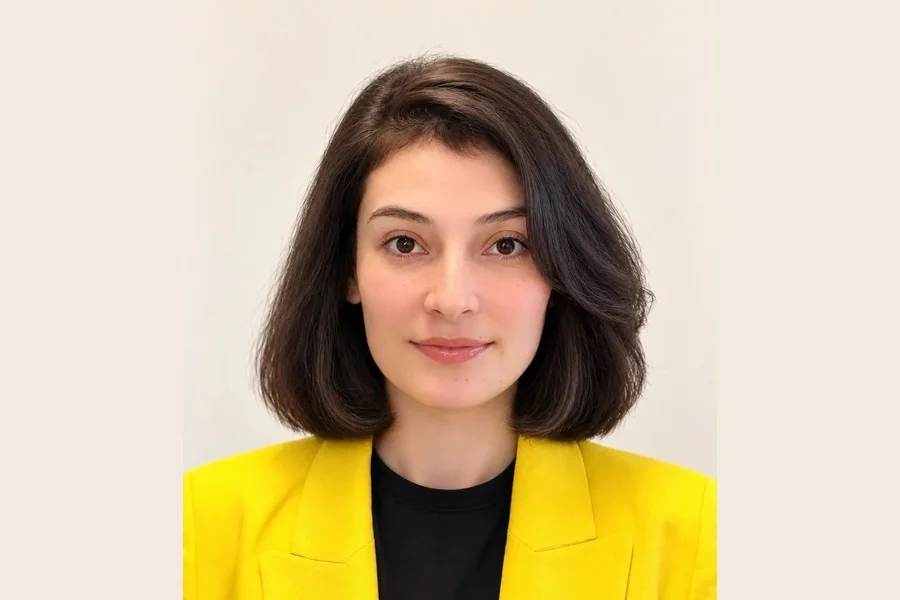
Note: Nazanin Wali is the recipient of a distinguished award from Rome Business School (RBS) and an admitted master’s student at the school. She is a psychology graduate of the American University of Central Asia (AUCA). She has been active in journalism, support for migrant women, the production of educational programs in Persian and Pashto, and digital education. In recent years, Nazanin has also become interested in artificial intelligence and its connection with psychology. In this episode, we spoke with Nazanin about her life and educational journey, her experience of migration, her view of the world, her media activities, and her achievements.
The Hasht-e Subh Daily: Contrary to custom, I would like to start our conversation with your recent achievement, one that is very valuable for all of us girls in Afghanistan. First of all, congratulations. Without a doubt, you deserve this award. Tell us about the admission process and how the winner of this award was selected. Who was involved in this process, and who else might have received this award? Fortunately, you won. Based on what criteria is this award granted, and why does it matter? Overall, tell us about your admission to the university and your selection as the winner of this award.
Wali: Thank you for your question. The award I received takes the form of a discount toward master’s studies in artificial intelligence and completing the courses in this program. Usually, when people apply to study artificial intelligence, a limited number of those who are admitted receive awards. These awards are granted taking into account people’s previous work, the global situation, and other criteria, and on that basis one person is selected.
They had two awards in the field of artificial intelligence, and in other programs there were also awards set aside for women and for those who apply earlier. I think the business school has allocated four to five awards for students. The award I received is called the Go Global Incentive Grant. It is granted to those who want to work at the international level, have achievements beyond one or two countries, and strive to have an impact internationally and beyond borders. There is also the hope that the recipients of this award can become future leaders at the global level and render a service to the world and, overall, to humanity.
Fortunately, taking into account my perseverance and efforts and the work I had previously done in Afghanistan, Germany, Kyrgyzstan, and other countries, they decided to give the Go Global Incentive Grant this year to me. With this award, I can cover a large part of my education costs with a special discount and lower payments, and continue my studies.
I think this award is very important because Afghanistan, at the time we lived there and grew up, was a war-torn country, and the educational conditions were such that studying was very difficult for a girl.
Now, when we apply for admission to a university, particularly in this case, we are treated like other pupils and students. That is, they consider all the prerequisites of a program, without paying attention to who has come from which country and what hardships they have been through. They evaluate applicants comparatively and select the one who has performed better. For this reason, I think this award is very important because, despite the problems we had inside Afghanistan, fortunately we managed, as a woman from Afghanistan, to get here and, in a way, bring the voice of the women of Afghanistan to RBS.
Also, this opportunity creates the ground for a girl from Afghanistan, whether myself or other girls in the future, to study at RBS. I hope other girls will also find this opportunity in the future and that, at least through RBS, the talents of the women of Afghanistan will be introduced: what abilities they have and, if conditions are favorable for them and their voices are heard, how far they can go.
The Hasht-e Subh Daily: Without doubt, individual achievements, even if symbolic, go beyond the individual level and can in some way help the whole society. Even if it is only the introduction of talents and abilities, it can still be impactful. Could you tell us what your first reaction was at the moment you learned about receiving the award? For you, who have traveled a long road from Afghanistan to Germany, how did this success feel and what did it come to mean?
Wali: Generally, every time I reached an achievement before, I was very happy. But this time my initial reaction was of the kind where, as they say, a person freezes for a few seconds. I truly froze for a few seconds. I wanted to find my own feeling: was I happy or sad? What was I feeling at that moment? I could not identify my feeling or put it into words. At the same time, I was very happy for myself that, despite decades of migration and the hardships I had been through, I had found an educational opportunity. When I see how much the situation has changed in Europe for those who are not from European countries and have a migration background, and how many more opportunities have been provided for them, it makes me glad. Despite all these challenges, when I found a good educational opportunity myself, I was happy.
But at the same time, I felt a strange pain too: these conditions have become favorable for us, but unfortunately, millions of women and girls inside Afghanistan are still waiting for the most basic rights and human dignity. For this reason, at first I had very conflicting feelings and did not know what I should feel. But later I thought about how I could share this joy with the women of Afghanistan and celebrate alongside them.
For this reason, I decided to dedicate the field I am studying, my contract, and also the award I received, all of it, to the women and girls of Afghanistan, especially the girls inside the country who still hope to study technology and artificial intelligence.
The Hasht-e Subh Daily: Wonderful. It would be good to talk about your childhood too. You were born during the first period of Taliban rule, a period that, like today, was very difficult for the people of Afghanistan, especially women, who faced many restrictions. Can you tell us about your family atmosphere and the environment in which you were raised? Overall, what memories of that time remain in your mind, memories whose images are still alive and clear for you?
Wali: I was born when the first Taliban regime was in power. My birth as an infant, and afterward my life as a girl child, had no standing in those conditions. Even humanity and human beings had no proper standing in that period. The first period of Taliban rule is known to the entire world through the image of a woman who was shot in a football stadium. In my opinion, for a child, seeing such scenes builds a very terrifying picture of the world. I do not have very good memories of that period, particularly as I do not remember many things. Fortunately, not much from that time has stayed in my memory. But I can say this: even if human memory does not recall that period, the feelings and experiences a person went through at that time stay within them in some way.
With the return of the Taliban, I felt that all those childhood traumas and everything my being remembered from that time became fresh again for me, and this is happening in conditions where the women of Afghanistan are experiencing a worse situation today. At that time, inside the house, my dear father and the family members tried very hard to learn reading and writing with the minimal resources we had available. We studied English. My older sisters, my brothers’ wives, and all of us tried in some way to get an education.
There were courses held in secret. For example, some institutions had organized medical classes. My sister and my brother’s wife attended those classes and worked in pharmacy and medicine. In a way, we were trying to find a path for our lives and our future. But unfortunately, all of this carried its own dangers. This is what led us, in the last days of the first Taliban regime, to be forced to leave Afghanistan illegally and migrate to Pakistan. In this way, at that young age, I also experienced the difficult and bitter path of migration.
For this reason, I feel what is happening inside Afghanistan today with my whole being and can understand the pain of women. For me, this situation is like experiencing that same painful period of my childhood again.
The Hasht-e Subh Daily: You also had the experience of migration in childhood and, at the same time, lived in an environment where women tried to find a space for themselves, even if this space was underground and hidden. This is a very important point that, unfortunately, has been talked about little. We have many narratives about restrictions from the first Taliban period, but unlike today, at that time girls had little access to social media and the means of publishing personal narratives. Today, girls write for themselves, publish their pieces, create blogs, and make their voices heard by others through social networks and online media. But at that time, because of the lack of access to such means, we had fewer narratives of women’s lives and their hidden efforts. Thank you for sharing this part of your experience with us.
Can you tell us about your childhood dreams? Is the Nazanin you are today the one you imagined as a child? Did you know from that time that you wanted to become somebody in the future? You grew up with a pen and a book from the very beginning, and your family tried to have you study and receive an education. Did you also think about continuing your education and your future career path at that time?
Wali: I am generally a very inquisitive person. Although my views may change every few days, I always want to know something else, learn something new, and pursue whatever comes to mind that I think I should learn. For example, I want to know what a field has to teach, and then I go after it and learn. For this reason, from early childhood until now, I never had a fixed vision of following only one path, that is, of wanting something in childhood and ultimately becoming that. Rather, from the first days I remember, what has remained common between then and today is my interest in learning. I liked to learn then, and I still like to learn. Only the fields and skills I want to learn change.
I think that for my family and for me, education was a kind of resistance against all the problems and hardships we faced in Afghanistan. My dear father had focused the entire family’s attention on our studies and our education, and insisted that we must study and get an education. In psychology, we have a term called Selective Attention. It means that a person focuses their attention on one subject and may not notice other subjects, or notice them less. I think my father used this same method. He had directed our attention more toward education, and in this way we were less aware of the unfortunate events that were happening in the surrounding environment and in Afghanistan. Fortunately, this method had a good effect on us.
From the first days, I really liked writing poetry, though I have not talked much about this interest. I still very much like to recite and read the poems of Rumi. Sometimes I write things myself, but not to the extent that I could say I am a poet. They are just pieces that I like to write and keep for myself. In childhood, I very much wanted to become a police officer. Perhaps this interest was because of the situation of our lives in Afghanistan in those days, when the Taliban were in power and, after that, during the transitional government period, there were many security problems in the country. After that, I gradually became interested in journalism, then psychology, and now technology and artificial intelligence. I think the path of life shapes a person, and it has been so for me as well. At different stages of life, I became interested in different scientific fields and wanted to learn them. At present, too, I am very interested in the world of technology, especially artificial intelligence.
I can say that, in a way, I am indebted to this very situation in Afghanistan, because after the fall of the Republic government, I was able to hold some training courses online for women inside Afghanistan. For this reason, I realized how important it is for people to have access to technology and digital tools, and that people should have correct information about these tools. One of the courses I held for women was about digital security. I realized how important it is for a person to be able to protect their security through digital tools and to have enough knowledge about technology to take care of themselves in today’s world. For this reason, I moved more toward technology, gained knowledge about it, and eventually reached topics related to artificial intelligence. Today, too, I am interested in this field and its subfields.
The Hasht-e Subh Daily: Wonderful. You first started studying psychology at Kabul University, but your studies there did not continue, and after receiving a scholarship, you went to AUCA. Now you have also become interested in technology and artificial intelligence. When we review your work and educational background, we see that you have a combination of different experiences, and these experiences have, in some way, connected with each other and shaped the path you follow today.
How did this interest in artificial intelligence take shape? Especially since you came from psychology and moved toward artificial intelligence. What connection do you see between understanding the human brain and artificial intelligence? Given that you studied psychology and now want to pursue this field academically, what made you interested in this path?
Wali: Thank you very much for describing the combination of my past work with such a positive view. It is truly important for a person to understand how each field can give them the ability to learn the next one. I initially chose psychology because I was very interested in the functioning of the body’s organs, especially the brain. I was interested in biology and human behavior. It was interesting to me why people behave in different ways and why human behavior has made the world the way it is today. For example, why does a person distance themselves from their own humanity to the point of attacking another person? How can we control these behaviors? How can we manage human behavior in a way that benefits humanity?
After that, during psychology courses, we learned how intelligence is produced in the human mind, how memory works, and how a person learns something. We also learned how human cognitive behaviors take shape.
When I later became familiar with artificial intelligence and saw that this technology is, in a way, a reproduction of the very systems that exist in a human being, it became very interesting to me. Until then, in psychology, we had mostly worked on understanding human behavior, but artificial intelligence is another stage of this subject. That is, it is about putting this system into operation and reproducing it: how intelligence is produced in an artificial intelligence, how its memory works, and what things we can teach it.
All of these topics became very interesting to me and made me want to study in this field. For now, I need to specify more precisely the program I have chosen. Its main subject is how we can build strategies and policies so that the use of artificial intelligence does not harm people and we can use this technology in a way that benefits humanity.
The Hasht-e Subh Daily: Given the conditions we are in, understanding this technology and using it properly seems essential for us, especially with the speed at which artificial intelligence is advancing and the wars going on between great powers. If we talk about Afghanistan, given the conditions we face today, what opportunities and dangers do you identify, especially for women and girls who have limited access to education and technology?
Wali: In whatever area we talk about regarding Afghanistan, the country’s current situation can have devastating effects on the lives not only of women and girls but of every human being in this country, and gradually have effects on all the people of the world. Because, as the saying goes, “Human beings are members of one body,” and in the world, too, we are like one body. Whenever one of our body’s organs is damaged, it is possible that pressure on the other organs increases and affects them too. I think the current situation of Afghanistan is reaching a point where its society and its economic, social, and cultural systems are, in every respect, moving toward paralysis. When Afghanistan exists in the world as a country that is not self-sufficient and cannot solve its problems, pressure on regional and extra-regional countries will, in any case, be felt more.
Unfortunately, over the past twenty-some years, Afghanistan was not self-sufficient either, but to some extent efforts were made to bring the country to self-sufficiency. Good talents were being nurtured to work for the country and be able to change Afghanistan’s situation. Imagine, in a country where women make up the largest part of the population, we completely paralyze this large part of the population and give them no access to facilities of any kind, not even to the oxygen they could use in a recreational park. In such conditions, what can we expect?
Technology and other topics are, in my opinion, later discussions. When, in Afghanistan, we are still debating topics that should not need to be explained to a human being at all, and that an ordinary person should understand on their own, the situation is worrying. When we talk about a religion that begins with the word “Iqra” (Read), I think there is no need at all to explain to a person why a woman should be educated. But when people put themselves in such a situation, to the point that they close their eyes and deafen their ears, and turn even this issue into a subject of debate and a tool of political pressure, I do not think we can be very hopeful about the situation.
The only thing that currently encourages me is the effort and resistance of the people inside Afghanistan, people who, under any circumstances, try to use the least available resources and find ways for themselves out of this situation. But when a problem is general and concerns the whole country, individual efforts, for example, one person’s decision to continue their education or a few symbolic actions, though valuable, seem very small against the great destruction that is now taking place in Afghanistan. For this reason, I think that to be truly hopeful about Afghanistan’s situation, we need more actions and more work.
The Hasht-e Subh Daily: Your remarks and your familiarity with developments in the world of technology show how far behind we have fallen in these advances and how much time we need to bring ourselves to the position we should be in today. This gap is very large. As you said, a few examples among millions who have the possibility of online education or access to other facilities are mostly exceptions and perhaps cannot help the whole society on a wide scale.
You have studied in the field of psychology, entered the field of artificial intelligence, and also worked in media. From your remarks, I heard that at one time you were interested in journalism and worked in this field. Can you tell us about this interest and your early experiences? What do you remember from that time? Under what conditions did you work, and what was your experience like?
Wali: Yes, I have about ten years of experience working in the media, both inside Afghanistan and here with a German media outlet. I think that in the early days, when I truly became interested in journalism, my goal was mostly to work on realities within Afghanistan’s society and to create a link between what is good in Afghanistan and what is seen well in Afghanistan’s society. For this reason, I mostly wanted to work on these aspects. I began my career as a sports reporter with the Sports 3 network. At that time, I was very happy to be working in a field that I myself had been part of, because I too played for Afghanistan’s national youth basketball team.
At the same time, I thought that at that time, for example in 2013, sport was one of the areas that had become a ray of hope for the people of Afghanistan. In a way, sport was a place where the youth of Afghanistan could carry their voice to the international arena and win honor in the name of Afghanistan in international competitions. For this reason, I was very keen that we could publish good and happy news for the people of Afghanistan.
Even today, as I work, I mostly focus on this same subject: when we write news or publish reports, we must think about who our audience is and to what extent we affect their psyche. We must try not to act in a way that creates trauma for people again or causes them to relive their traumas. There must be a good balance between positive news and news that can be saddening.
For this reason, at that time I was very keen to publish good news for the people of the country amid the explosions and insecurity in Afghanistan. After that, I worked with Ariana Television Network (ATN) and Ariana News in Kabul. Here, I also worked with Deutsche Welle (DW), but at present I no longer collaborate with them. I mostly want to focus on work that is not heavily dependent on institutions, so that I can find more time for myself and focus on my studies.
For now, I should say that I am on maternity leave and have a newborn, on whom I have focused most. For this reason, I have a short break in my working life, but for my studies, I think I have enough time. I recently also started a podcast about the women of Afghanistan. In it, we are going to host several women of Afghanistan whose stories can be a ray of hope for women inside Afghanistan and a lesson for them, so they know how they can strengthen their resistance. These are the things I have done so far, and I hope that in the future, God willing, we will have better and bigger work.
The Hasht-e Subh Daily: Wonderful. Thank you very much for giving us your time in these circumstances. This is truly valuable to me. I hope your baby is also well and grows up healthy and righteous.
Wali: Thank you very much. Be well. Thank you for devoting your time to the subject of women and women’s education.
In my opinion, it is very important that, amid all the news happening in the world and all the priorities the media have, we do not forget that the women of Afghanistan wait every day to hear a piece of news about themselves. They are waiting for a path and a solution, something that can, at the very least, be a hope for their prison without doors.
I thank you. I also thank you for wishing me well in being a good mother. I think every mother has this wish to be a good role model for her child. At least, if she cannot be a good role model, she wishes to open a path so that her child learns from whom to learn and what to do. My wish, not only for my own son but for all children of this world, is peace and tranquility, especially for children inside Afghanistan. I wish them a life of dignity, honor, and justice, a life without discrimination, under equality of rights between women and men, in security and calm. This is my wish for my own newborn too. I think none of the wishes I have for my newborn should be exclusive to him. God willing, my prayer will always be the same for all the children of Afghanistan too.
The Hasht-e Subh Daily: You mentioned the podcast. Can you tell us more about it? Has its publication begun, or have you recently launched it and it will be published in the future? Tell us more about it. You only mentioned that it will be about women’s life experiences. What is your approach, and with what motivation did you want to launch this podcast?
Wali: I should say that this podcast was a project our colleagues had started, and I have, for now, joined their team. This podcast is supported by the Rosa Luxemburg Foundation (RLS) in Germany to raise the voices of the women of Afghanistan and support women who are inside Afghanistan and are waiting to learn things, to resist in some way, and to find motivation for continuing life, having dreams, and building a future.
In this podcast, I host the conversations in English. We mostly try to carry the voices of the women of Afghanistan to the international community and show how capable the women of Afghanistan are, how they have fought the hardships and difficulties placed in their path, and how far they have come. We also want to show what concerns and worries they have today.
Its first episode was published yesterday. Fortunately, we spoke with one of the girls from Afghanistan in Europe who had previously studied in the field of surgery. She is a girl who lived in Afghanistan until her teenage years and attended school there. After that, she came to Europe and has been able to continue her education and progress in surgery. This itself shows how capable and skilled the women and girls of Afghanistan are, and how beautifully and successfully they can shine if even the minimum facilities are provided for them.
When we were studying in Afghanistan, the country’s conditions were not a rose garden. The security situation was clear: one could not easily go to university or school, nor even move around on the road with ease. I remember that when I attended a public school, before I left Wolesi Jirga, we studied under a tent. There were days when we had no chairs and had to sit on the carpet. On some days our teacher would say that one or two of you should come early and gather chairs for the class, so that at least one or two chairs would be in the class. Sometimes we even sat on the dirt and received our lessons.
The situation in Afghanistan was not such that we could say we studied in the best conditions. We managed to get an education in conditions where we had only a board, a blackboard, and a teacher. Just as we said about that girl who has advanced in surgery, we too have come from such conditions in Afghanistan. Now the women of Afghanistan do not have very high expectations, although they deserve the best. They are still fighting for their most basic rights. We want the voice of their struggle and resistance to reach the world. For this reason, we are also carrying this podcast forward in English so that the people of the world hear the voice of the women of Afghanistan and become aware of their lives.
The Hasht-e Subh Daily: Wonderful. That is a very good point, because the image of Afghanistan usually presented to the world is one in which the people are victims, are overshadowed by war and misery, and seemingly have no agency of their own, as if others must rescue them from this situation. What you are doing with this podcast, in a way, completes this image and shows another reality of the lives of the women of Afghanistan. On the other hand, since you have experience working with migrant women in Germany, I think this experience also helps you to be more familiar with women in the diaspora community and to hear their experiences and stories. This familiarity can make the podcast richer and more valuable. As a final question, I would like to ask you to speak directly to the women and girls inside Afghanistan. What message do you have for them?
Wali: Thank you for your question. Before addressing the question, I want to point to an important point you raised about balance in reflecting the opportunities and realities of the lives of the women of Afghanistan in the media. I think that in international media, and in general in the media of Afghanistan, we must try to ensure that women are not introduced only as victims and as those whose voices have been taken away. Rather, they should be present as a party to the big political issues, political deals, and decisions made about Afghanistan’s future. In Europe, we mostly see news that, for example, a woman has suffered violence from her family, a girl has been killed by her father, or a woman has been murdered by her husband. Of course, positive topics are also reflected, but there is no balance between these. Our goal is likewise to focus more, in the continuation of our work, on how we can present a balanced picture of the realities of the lives of the women of Afghanistan.
The women of Afghanistan are not only victims. They are not only women whose voices have been silenced. Despite the efforts to silence their voices, the women of Afghanistan have their own voice. There is no need for us to sit here in the West and say we are the voice of the women of Afghanistan. No, we must create a space where the women of Afghanistan have their own voice. As those who have a freer hand here, I think a responsibility rests on our shoulders. We must create space for migrant women in Europe, women inside Afghanistan, and women of the Afghanistan diaspora who are in Europe, America, or any other country, so that they can show another picture of Afghanistan to the world and themselves be among those who decide about their future, not merely the subject of a debate or a political deal.
My message to the women who are inside Afghanistan will always be this: if I, from the days when I was born as a vulnerable child and knew nothing of the world, knew no other world than that very situation of Afghanistan, and had no awareness at all that elsewhere in this world a woman is respected as an individual and accepted as a human being, was able to get from those days to today, you too should believe. Believe that every dark day will surely reach light. But in the current conditions, despite all the difficulties and challenges, try to use the least resources you have. If you do not have books, you can borrow a book from your neighbor, from your friend, or borrow it for a day and read it. If nothing else is available to you, at the very least, do not forget the skill of reading. Practice spelling and composition, and do not forget what you have learned, because a bright future lies ahead, and in that future you will certainly need your skills and abilities.
Whenever you become hopeless and think this situation will not end, think about the problems that you and I have gone through. These days will also pass, and you will again reach the rights and the dignity that you deserve and need. I know you might think it is easy to sit in Europe and say these things, but I too have passed through that path myself, as a child who could not even protect herself and was entirely vulnerable. You too will pass through these days. God willing, all of us will leave these days behind together, hand in hand, and a bright future will await the women and girls of Afghanistan.
You can read the Persian version of this interview here: