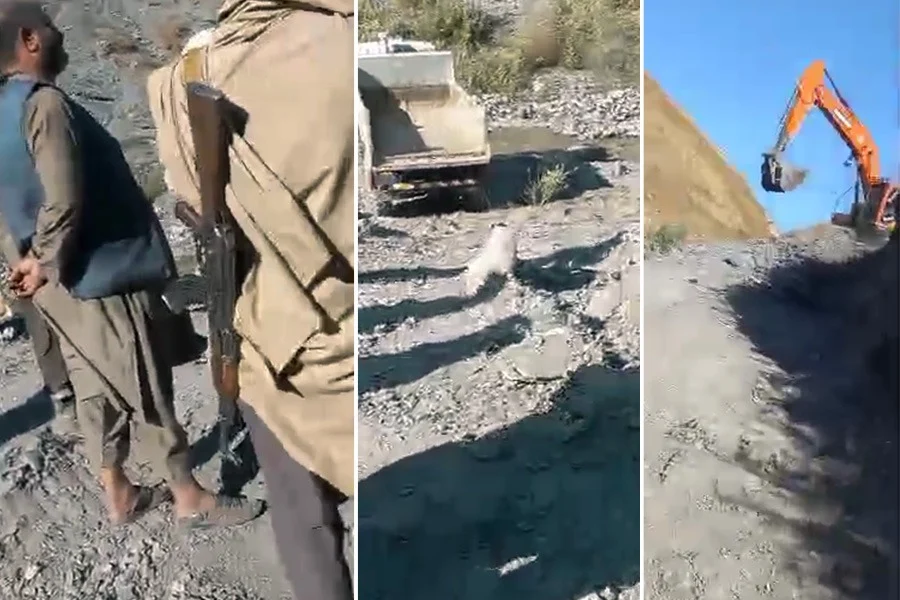
Several residents of Khwahan District in Badakhshan province have complained about Amanuddin Mohammadi, the Taliban’s deputy district governor. They say he has seized state-owned and private land belonging to residents, handed it over to miners, and extorts money from them.
Some Khwahan residents say Mohammadi is from Jaro Payan village in the district. They say he seized about 10 kilometers of “state-owned stone-quarry streams,” from “the lower end of Roinzar hamlet to below the Jabilrang gorge,” and distributed it among the people of Jaro Payan and Roinzar. They say he collects extortion money from them on a weekly basis.
The residents of these areas say that this local Taliban commander’s fighters, along with individuals affiliated with the group, abuse their positions to harass people, forcibly take money from them, and hand it over to the Taliban’s deputy district governor.
According to residents of these areas, a man known as “Mullah,” the brother of the Taliban’s deputy district governor, and Atiq, son of Mir Alam from Roinzar and the Taliban’s mayor in Khwahan District, extort money and bully residents in connection with the seizure of land and gold mining sites, as well as the distribution of land for shops. They say the money collected by Atiq and the deputy district governor is embezzled.
These Khwahan residents say that Mawlawi Abdul Wahab, son of Pahlawan from Bostanak village, who is currently serving in the Taliban’s “Block Four Bal-Muawaza,” is present in the area together with Ghulam Farooq, son of Payenda; Shams, son of Khiradmand from Jaro Payan village, who is the deputy financial commander of a Taliban border battalion in Jawzjan Province; and Shams, son of Abdul Qayum, an armed man.
According to these residents, when another mining company from outside the village tried to begin operations in the same area, the named individuals beat the drivers and workers of that project, opened fire on them, and threw their tents and equipment into the river. They add that the Taliban’s deputy district governor has not addressed the petitions and complaints of residents concerning the disputed area.
The residents stress that they have submitted petitions to other Taliban institutions, but the group’s deputy district governor has threatened them, saying that if they do not withdraw their petitions, they will be labeled as “Arbaki (former government uprising forces)” and “rebels.”
Likewise, according to claims by Khwahan residents, the Taliban’s deputy district governor has seized about 20 hectares of land in the Sayedabad forest area of the district and sold it to miners. They say his partner is a man named Shah Agha Jan, an officer in the foreign liaison department of the Taliban’s General Directorate of Intelligence (GDI), who is originally from Kunduz province and is one of his close friends. According to them, they have sold each “five-package” plot for 1.5 to 3 million Afghanis.
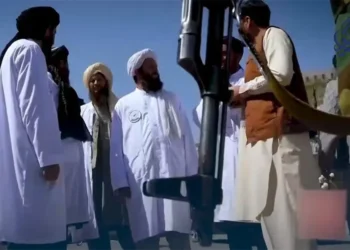
Meanwhile, videos obtained by the Hasht-e Subh Daily show armed men arguing with workers, with both sides claiming ownership. Excavation tools and equipment can also be seen in the videos.
In another video, a man says: “Atiq, pull out your Kalashnikov and fire; he’s shooting. He has drawn his Kalashnikov.” According to sources, the Taliban’s deputy district governor and Atiq threaten the miners in these videos and expel them from the area.
These concerns are being raised at a time when several senior Taliban officials, including the chief of the group’s army staff, are directly or through affiliated individuals involved in land grabbing and the plunder of mines in Badakhshan. Multiple reports by the Hasht-e Subh Daily show that these Taliban officials have established dozens of their own affiliated companies in Shahr-e Buzurg District and other mining areas of Badakhshan and are engaged in extensive mining operations.
The findings of Hasht-e Subh Daily’s reports show that the activities of large and organized networks linked to Taliban officials to extract minerals continue at full intensity, and that this process is being carried out systematically through force, corruption, and collusion with some Taliban leaders.
Former Taliban governors have also, without exception, been involved in the extraction and smuggling of minerals. Sources also confirm that the replacement of Taliban officials in this province takes place based on financial and mafia-style deals. According to sources, any local official who pays more in bribes to the group’s senior officials is sent to Badakhshan for a period of time as an official of the group.
Over the past month, the Taliban have ordered that the extraction of minerals by residents be halted and that they must obtain work permits from the group’s Ministry of Mines. However, sources confirm that this measure has also become another source of income for the Taliban, and that those working at the mining sites continue to mine by paying bribes, during the day and mostly at night.
You can read the Persian version of this report here:
غصب زمین و باجگیری از معدنکاران؛ باشندهگان خواهان معاون ولسوال طالبان را متهم میکنند