Local sources in Herat report that five Taliban governors from western Afghanistan traveled last week to meet Hibatullah Akhundzada, the supreme leader of the group. According to these sources, the Taliban governor of Herat has been detaining and imprisoning women as a means of demonstrating loyalty and compliance with Akhundzada’s directives. The sources add that these restrictions and pressures have intensified not only against women but also in relation to men’s hairstyles and beard grooming.
Following a surge in the detention of women and girls on charges of not wearing the Taliban-mandated burqa in Herat, sources confirm that Noor Ahmad Islamjar, the Taliban’s governor of Herat, faces a growing risk of removal due to rising insecurity, armed robberies, and certain ethnic considerations. In response, he has been escalating the crackdown on women and imposing broader restrictions in an effort to secure his position and prove his loyalty to Hibatullah Akhundzada. According to sources, he has issued a strict and unequivocal order that no woman may move through the city without wearing a burqa.
Sources add that Islamjar has applied maximum pressure on women to present a defensible record before Akhundzada and earn his approval. The suppression of women, sources say, is now regarded as one of the most reliable ways of attracting the Taliban Supreme Leader’s attention.
One source says: “The Taliban governor of Herat has issued an urgent order to enforce mandatory hijab. Forces from the Ministry for the Propagation of Virtue and Prevention of Vice have been going as far as the gates of private homes in the Jibrael area and other neighborhoods, warning residents to observe the hijab and ordering women to stay indoors. Large numbers of Taliban forces have also been deployed at every intersection, particularly along the Lailami Road. In the past few days, dozens of women have been detained, and some have been subjected to insults, humiliation, and verbal abuse. Across the city, daily life is growing harder for residents. Every local Taliban official is now racing to prove their loyalty to Hibatullah.”
This comes after a senior official of the former government had previously told the Hasht-e Subh Daily that Hibatullah Akhundzada had reassigned Noor Ahmad Islamjar to another province, but that pressure from a neighboring country had prevented his removal from Herat. Sources had also confirmed at the time that Islamjar had said he would teach at a religious school after his removal and would not leave Herat.
Despite this, women and girls have expressed deep alarm over the intensifying atmosphere of repression in the city, saying a “terrifying situation” has taken hold in Herat and that everyone is living in fear.
One young woman in Herat says, “I left home today, and the situation was terrifying. By the time I reached [location omitted for security reasons], I had recited my prayers a thousand times. I had never seen the city like this before.”
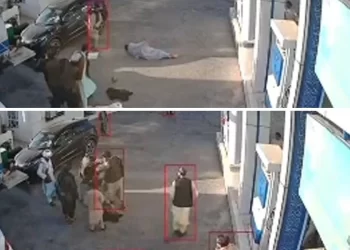
Another woman, who witnessed the detention and beating of women in recent days, says: “I reached the Almas-e Sharq gate and saw a large crowd. A woman wearing a prayer headscarf was about to be taken away because she was not wearing a face mask and had makeup on. Her husband tried to resist, and the Taliban beat him with kicks. The day before, Taliban Morality Police were patrolling throughout every area of the city.”
Earlier sources had reported that around 50 women were detained during the first two days of the Taliban’s enforcement of the ban in Herat. Taliban members forced them and their family members to sign pledges before releasing them. Sources confirmed that the women were subjected to insults, humiliation, and verbal abuse at the time of their arrest.
Meanwhile, the new Taliban order has drawn widespread condemnation from human rights organizations. In the most recent development, Amnesty International described the detention of women in Herat province over non-compliance with the Taliban’s prescribed dress code as deeply alarming, saying the arrests are a stark reminder of the ongoing suppression of women’s and girls’ rights in Afghanistan.
Amnesty International emphasized that every woman has the right to decide what she wears, to move freely, to participate in public life, and to live without fear or intimidation. The organization called on the Taliban to immediately disclose the whereabouts of the detained women, guarantee their safe return, and end all actions that target women based on their attire. Amnesty International also urged the international community to increase pressure on the Taliban to bring an end to what it described as the “systematic oppression of women and girls” in Afghanistan.
Richard Bennett, the United Nations (UN) Special Rapporteur on Afghanistan, responded to reports of the detentions by calling the practice unlawful and unacceptable. He stated that the detentions must stop and that the women must be released immediately. “I am deeply concerned that for the third consecutive day, dozens of women in Herat are being arbitrarily arrested and detained for allegedly violating the Taliban’s dress code,” he said.
This comes even as the Taliban’s Directorate of Information and Culture denied the previous day that women and girls were being detained for not wearing a burqa, dismissing the reports as “rumors” with no basis in fact. The denial came even though just the previous Thursday, the Taliban had issued an order stating that women who did not wear a burqa would be imprisoned.
You can read the Persian version of this report here:
وفاداری به هیبتالله؛ آیا محرومیت زنان به بازی قدرت در میان طالبان تبدیل میشود؟