Afghanistan’s present crisis is not merely the result of war, foreign intervention, or the collapse of state institutions. Beneath all three lies a deeper crisis: the insistence that an ancient and culturally diverse country must be understood through a single, predetermined definition.
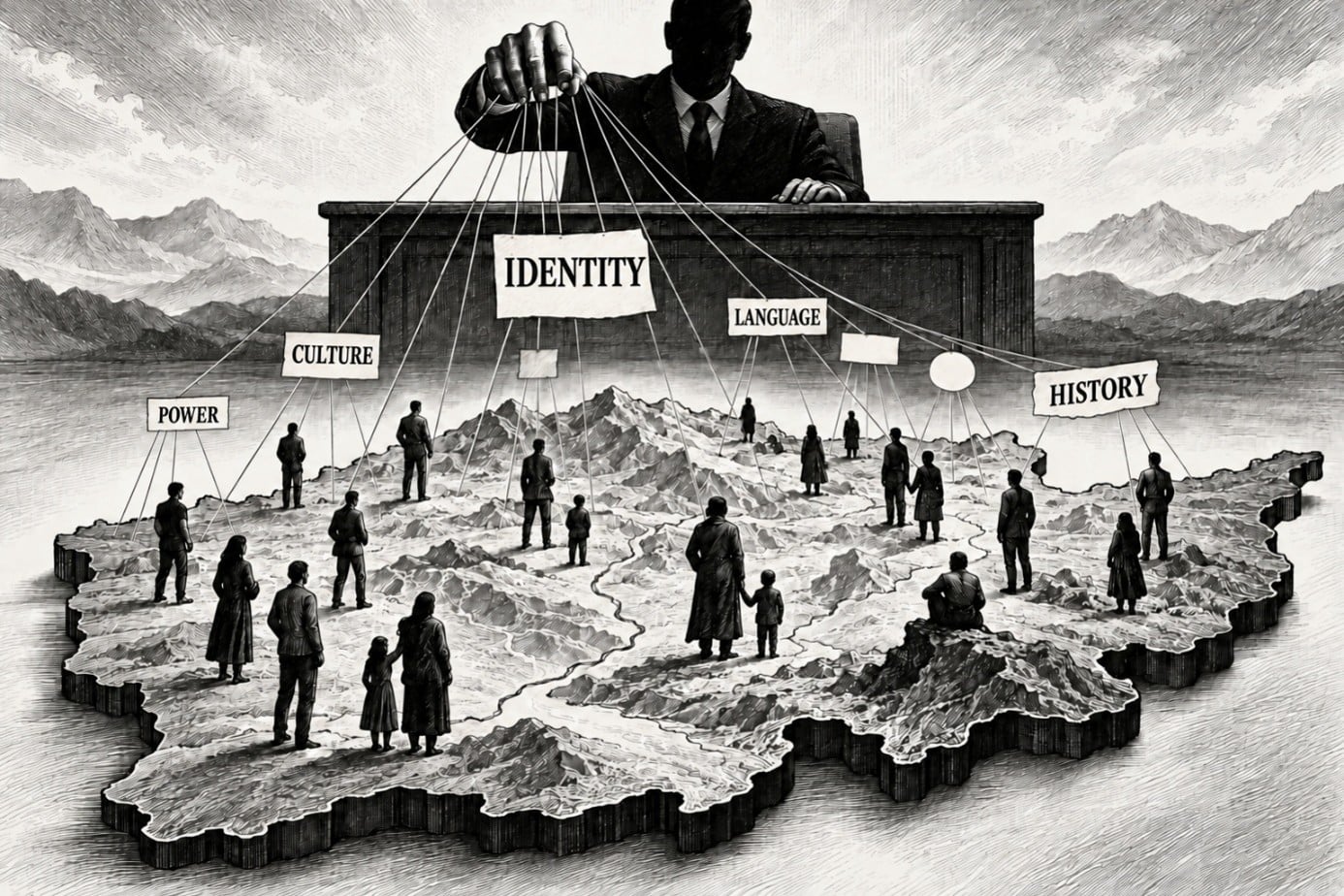
Under this logic, a person belongs only by becoming “fully Afghan”, not merely a citizen of the state, but someone expected to submit to its official narrative of the past century, as well as its prescribed understanding of history, identity, language, culture and power. Anyone who rejects part of that narrative is treated not as a critical citizen, but as suspect, separatist or foreign. “Fully Afghan, or Nothing” is the name of this logic: a system that reduces national belonging to complete obedience.
The consequences of this thinking are now before us. A country that was supposed to become unified and strong through extreme centralisation instead faces competing historical narratives, deep mistrust over identity, economic dependency and the fire-sale of its natural resources, mass migration and social fragmentation, and a profound crisis of political legitimacy.
Whenever society has asked, “Where do I stand within this state?”, the prevailing answer has been: first conform to the official definition, accept our authority, and only then may you speak of your rights. Such an answer may secure obedience for a time, but it cannot create belonging.
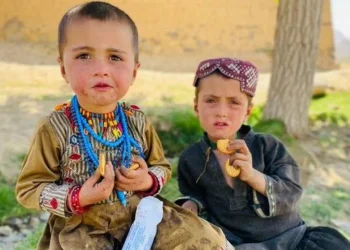
The bitterest contradiction is that this political doctrine has not protected ordinary Pashtuns either. A system that has repeatedly spoken in their name has made their lives, poverty, illiteracy and deprivation part of the price of preserving power. Pashtun young men have died on the front lines; their villages have become arenas of competition among rival powers; and their futures have been consumed by extremism, migration and poverty. Meanwhile, the familiar elites claiming to represent them have continued to secure political privilege.
Criticising state-led Afghanisation is therefore not hostility towards Pashtuns. On the contrary, it means separating ordinary Pashtuns from a political machinery that has turned their suffering into a source of legitimacy.
Long before Afghanistan became the name of a modern state, this land stood at the intersection of civilisations, languages, memories and identities. Khorasan, Ariana, Herat, Balkh, Kabulistan, Badakhshan, Hazarajat and Turkestan, along with many other historical names and regions, remain part of the collective memory of its peoples. No rational state seeking to build a future would treat these layered memories as rivals to its sovereignty.
Yet over the past 146 years, beginning with the British-backed accession of Abdur Rahman Khan in 1880, the dominant political project has repeatedly attempted to bind a highly centralised state to a uniform identity. The roots of this outlook can also be traced to state-building under the Durrani rulers. Military force was used not only to control territory, but also to impose an official narrative and push other histories to the margins.
This project assumed different forms in different periods. At times, it advanced through military campaigns, forced displacement, confiscation, and repression. At others, it operated through school textbooks, the renaming of places, the language of administration, an official version of history and the unequal distribution of power.
Its purpose was to dissolve society’s actual diversity into a single political mould. The language used was that of national unity. But unity founded on the denial of part of the population is not unity; it is enforced silence. Nations are not created by decree. They emerge through consent, equality and a shared sense of ownership over the state.
The problem does not lie in the word “Afghan” alone. For many people, the term signifies citizenship and attachment to the country, and that experience cannot simply be dismissed. The problem begins when a national designation is made to carry the supremacy of one ethnic and historical narrative, while others are expected to abandon part of their identity and memory as the price of acceptance.
A common national name becomes legitimate when everyone can recognise themselves within it, not when one group reserves the right to define it while everyone else is left only with the obligation to accept.
I call this condition the “spell of power”. The phrase does not refer to anything supernatural. It is a metaphor for a political mind imprisoned by a belief whose failures have repeatedly been demonstrated, yet whose abandonment is still regarded as unthinkable.
Those caught under this spell equate preserving their monopoly with preserving the country. If society is devastated but the centre of power survives, they call it victory. If remaining in power requires them to bargain away independent decision-making, national resources, public dignity and even the future of coming generations, they still refuse to retreat.
Common sense revises a policy when it repeatedly produces war, poverty and collapse. A political mind under the spell of power, however, interprets failure as a reason to intensify the very same policy.
This is why the defenders of this system so often turn to foreign powers in moments of crisis. They may invoke independence, honour and national sovereignty, yet welcome intervention, political bargains and external sponsorship whenever these help them remain in power.
Values are sacred for as long as they protect the monopoly. Once they obstruct political survival, they become negotiable. This is not an accidental contradiction. Those who regard the country as their political property do not see foreign interference primarily as an assault on its people. They see it as an instrument for retaining, or recovering, that same property.
Yet the failure of enforced uniformity does not mean the rejection of coexistence. On the contrary, its end could mark the beginning of a genuine nation. Afghanistan will begin to overcome its identity crisis when no one is forced to choose between a historical identity and political membership in the country.
Tajiks, Pashtuns, Hazaras, Uzbeks, Turkmens, Aimaqs, Baloch, Nuristanis, Pashai and others must not be guests within a dominant narrative; they must be equal owners of the state. Languages and historical memories should not be treated as security threats. The state must cease to act as the guardian of one identity and become the guarantor of everyone’s rights.
Escaping this spell does not mean replacing one monopoly with another. Reverse ethnic domination is not the answer to ethnic domination. The answer is a new political compact that limits, distributes, and makes power accountable.
State institutions must reflect the country’s actual diversity. Local government must carry genuine authority. Resources must be distributed fairly. And national identity must be formed from below, through the consent of the people. No name, however old or widely used, can substitute for justice.
The Quran itself presents human diversity as a means of mutual recognition, not as a licence for supremacy and domination:
“We made you into peoples and tribes so that you may know one another. Surely, the most honoured of you in the sight of God is the most righteous among you.”
— Qur’an, Surah al-Hujurat, 49:13
This may be the clearest answer to the Taliban’s claim to possess an exclusive authority to speak for God on earth. God did not declare any ethnicity, language, style of dress, or political apparatus inherently superior. The Qur’an identifies righteousness as the measure of human worth, and it did not appoint the Taliban to judge who possesses it.
People increasingly understand that culture, history and identity cannot be changed by administrative command. Resistance to homogenisation is not necessarily a rejection of the country; it may be the final attempt to save it.
Those who describe every demand for equality as hostility towards Afghanistan must answer a basic question: which Afghanistan are they trying to preserve, one that belongs to everyone, or a territory in which people are permitted to belong only on condition of obedience?
“Fully Afghan, or Nothing” is not a choice the people have made. It is an ultimatum imposed on them by the structure of power. The future begins when that ultimatum is wit