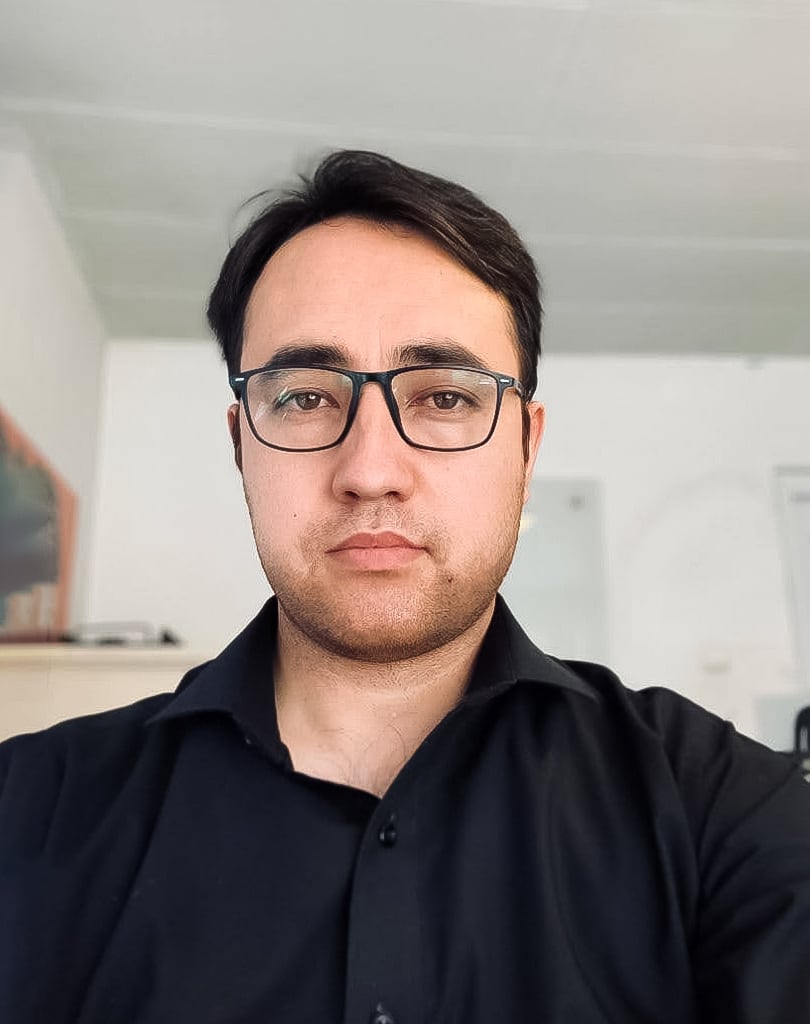

Aisha Wahab had barely taken her new seat in the U.S. House of Representatives when Afghanistan entered her political conversation.
It is a striking scene. She was born and raised in the United States, spent part of a difficult childhood in the American foster care system after losing both parents, and has said herself that America raised her. Yet upon reaching one of the most important political positions of her life, she quickly began speaking about a country in which she had never lived.
Given that background, and her doctorate in social work, one might have expected her first national concerns to focus on the society that shaped her: the high cost of living, housing, healthcare, immigration, or the deep political struggle between Democrats and Republicans. Instead, one of her early public interventions concerned Afghanistan, the Taliban, and the need for the United States to maintain diplomatic engagement with those ruling Kabul.
For Afghans, the Taliban are not an abstract foreign-policy issue. Their name is tied to war, killings, bombings, repression, and the exclusion of women from education and much of public life. So a natural question arises:
Why did Afghanistan enter her political agenda so quickly?
For years, Zalmay Khalilzad was one of Washington’s most important interpreters of Afghanistan. Much of his influence was built under Republican administrations. The irony now is that the newest prominent Afghan-American political figure has emerged from the Democratic Party.
Perhaps this is merely coincidence. Or perhaps politics begins arranging the pieces for the next table before the current one has even been cleared.
There is no evidence that Aisha Wahab is the “next Khalilzad.” Her comments may simply reflect an Afghan-American politician responding to questions about her ancestral homeland. But politics becomes interesting when coincidences begin to look historically familiar, and Afghanistan has a long history of such familiarity.
The Politics of Intermediaries
The use of intermediaries has been part of Afghanistan’s political history for generations. In 1880, after costly wars in Afghanistan, Britain had learned a simple lesson: influencing a country does not always require occupying it. Sometimes a predictable government is cheaper than maintaining an army.
The bitter part of this history is that sections of Afghanistan’s own elite also helped reduce the price of external influence. At different moments, a few promises, privileges, or political concessions were enough to open doors from the inside. Domination does not always arrive with an army; sometimes an intermediary turns the key from within.
Abdur Rahman Khan came to power in this environment. Britain recognized him, provided financial and military assistance, and in return Afghanistan’s foreign policy was constrained by the interests of British India. Abdur Rahman was not simply a British puppet; he had ambitions and policies of his own. But that is precisely the point: an intermediary does not need to be obedient. It is enough for his interests to overlap with those of a great power.
The 1893 Durand Agreement was another example, a decision made between Abdur Rahman and an imperial representative whose consequences remain politically relevant more than a century later.
Britain also built networks of political agents, tribal chiefs,s and influential local figures along the frontier. The logic was simple: if you cannot govern everyone, find those who can influence the rest.
When Britain’s dominant role faded, the method did not disappear; the principal external actor changed. Washington, too, often came to understand Afghanistan through a relatively small circle of elites, from Mohammad Naim Khan to Abdul Haq.
After 2001, this logic became even clearer. The United States did not want the fall of the Taliban to be understood simply as a Northern Alliance victory over Pashtuns. Khalilzad later explained that Washington was also looking for Pashtun figures who opposed the Taliban.
It was in this environment that Hamid Karzai rose to prominence: a figure acceptable to parts of the Afghan political establishment and workable for the West.
The names had changed. The formula had not changed very much. Perhaps no one in the modern era embodied this role more completely than Zalmay Khalilzad.
In the 1990s, he argued for engagement with the Taliban. After 2001, he played an important role in shaping Afghanistan’s new political order. Nearly two decades later, he became Washington’s chief negotiator with the Taliban.
Khalilzad did not create the Taliban. The movement emerged from a combination of Afghanistan’s civil wars, religious networks, regional dynamics, and Pakistani support. But he became one of the key architects of the process that transformed the Taliban from an insurgent movement into a direct negotiating partner of the United States.
On 29 February 2020, Khalilzad signed the Doha Agreement with Mullah Abdul Ghani Baradar. The Afghan Republic was not a principal signatory. The agreement helped set the course for the American withdrawal and altered the balance of power in the Taliban’s favor.
Hamid Karzai had also pursued reconciliation with the Taliban years before Doha. The High Peace Council was created, contacts expanded, and Qatar became an important channel for negotiations. What began as a policy of “reconciliation” eventually moved beyond an internal Afghan process and became direct negotiations between Washington and the Taliban, culminating in Doha.
This raises a deeper question, not merely who negotiated, but who had the right to make decisions about the future of millions of Afghans without their genuine participation?
The People Left Outside the Room
Perhaps the most important character in this story is the one who has rarely had a seat at the table: the Afghan people. At one time an empire negotiated with an emir; later embassies dealt with ministers, intelligence services with commanders, and finally the United States negotiated directly with the Taliban. Yet most Afghans, with all their ethnic, political, and social differences, have had little real role in defining the terms of these bargains.
They usually enter the story after the decisions have been made, to pay the price: war, displacement, poverty, repression, and yet another attempt to start from zero.
But blaming Britain, America, or other foreign powers for everything would hide another part of the truth: the confusion of Afghanistan’s political elites and the opportunities they have repeatedly lost.
Among Tajik, Hazara, Uzbek and other non-Pashtun communities, Afghanistan has never lacked politicians, intellectuals or educated young people. What has often been missing is the ability to converge around a shared political project and build a common center of power.
Some of these elites, in their attempt to appear “national” or “representative of the people,” have reproduced the very model they claimed to oppose: personality-centered politics, top-down bargaining, and networks built around individuals rather than institutions. At times, becoming “national” seems to have meant imitating those who had written the rules of the game for generations rather than changing those rules.
Imitating an opponent’s game does not automatically make one a better player—especially when the other side understands the networks, habits and rules of that field far better.
The cost of this confusion has not been limited to the failure of individual leaders. The inability to build a common political program has also weakened the possibility of a broad alliance against political monopoly, discrimination and Taliban rule.
A society that might have united around justice, equal citizenship, women’s freedom and a fair distribution of political power has repeatedly been fragmented by leadership rivalries and short-term calculations. The Taliban have benefited not only from their own coercive power, but also from the inability of their opponents to transform widespread public dissatisfaction into a common political will.
This criticism is not directed at Tajiks, Hazaras, Uzbeks or Pashtuns as peoples. The problem is political elites. Ordinary Afghans have paid far more for this political game than they have been allowed to play it.
Perhaps Afghanistan’s curse is not one ethnicity, one foreign country, or one individual. The deeper problem is a political structure that continually creates a need for intermediaries.
As long as Afghanistan lacks functioning institutions; as long as citizens cannot peacefully change those who govern them; as long as communities are not partners in a fair political compact; and as long as national decisions do not pass through legitimate institutions, someone in London, Washington, Islamabad, or elsewhere will always be ready to say:
“I understand Afghanistan. Talk to me.”
Yesterday it was an emir. Then a khan or a sardar. Then a commander. Then a technocrat or an Afghan-American diplomat.
Tomorrow, perhaps, it will be a member of Congress.
It is still too early to judge Aisha Wahab. There is no evidence that she will become Khalilzad’s successor. But the speed with which Afghanistan entered her political discourse is reason enough to reopen an older file: 146 years of the politics of intermediaries.
Perhaps the most important lesson of that history is simple:
A country that cannot represent itself will eventually have others choose its representatives for it.
Afghanistan will begin to break this cycle not by searching for a “better intermediary,” but by building a political system in which no emir, warlord, ambassador, technocrat, or politician can whisper into the ears of powerful states and claim:
“Afghanistan is me.”