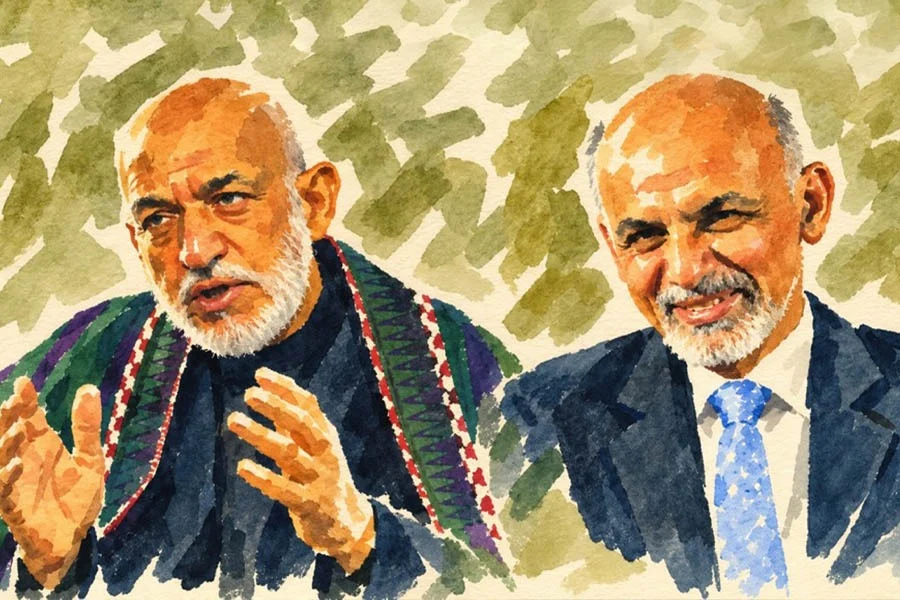
How many times must people trust a political leader before they are entitled to demand an accounting? Can someone who spoke of “saving the country” while in power return after its government has collapsed and present himself once again as a guide to its future? These questions concern Hamid Karzai and Ashraf Ghani, but they also concern us: why do we sometimes accept the image a leader creates before examining his record?
Those who played a decisive part in governing the Afghan republic are still trying to reshape how they are seen, both in Afghanistan and in the West. One speaks from Kabul about dialogue and the country’s future; the other explains the collapse to European television audiences through his own experience. Both have the right to speak. But a platform and a measured tone cannot replace an answer to a basic question: what did they do with the power they held?
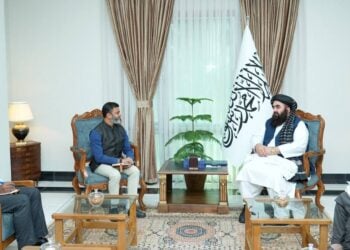
A few days ago, reports said Taliban forces went to Karzai’s residence and prevented a group of tribal elders from meeting him. There is a bitter irony here. A former president who still receives political visitors in Kabul appeared in the news this time as the man whose visitors had been turned away by the Taliban. Some saw the incident as evidence of the restrictions placed on him; others saw an opportunity for him to rebuild his political image. Without further evidence, we cannot know the motives behind the incident.
Karzai’s circumstances are nevertheless different from those of millions of ordinary Afghans living under Taliban rule. He lives in a guarded residence in Kabul that was provided to him during the republic. His meetings still make the news, and despite reported restrictions, he has travelled abroad in recent years. Reports describe a trip to Germany for medical treatment and meetings with officials and diplomats during his time in Europe. The question is not why he was able to seek treatment or travel. It is why former leaders still have access to powerful circles and the media when so many people who bear the consequences of their decisions struggle even to tell their own stories.
Karzai came to power at a moment when the Taliban’s defeat and the efforts of many Afghan groups, including those who had fought against the Taliban, created an opportunity to build a different political order. The republic was meant to place power in the hands of law and accountable institutions. Instead, networks of patronage, competition for positions, and corruption took root. Karzai was not solely responsible; other Afghan leaders and foreign backers also played a part. But a man who led the government for so many years should explain why it remained dependent on individuals, and why repeated talks with the Taliban produced no clear framework for protecting people’s rights.
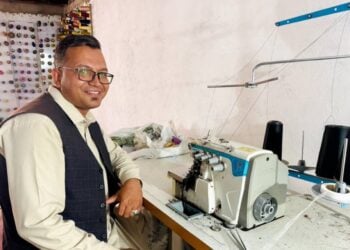
Karzai’s name also appears in the history of Turquoise Mountain, a foundation established with his support, that of then-Prince Charles, and the involvement of Rory Stewart. The foundation says it has continued work since the Taliban’s return, including programmes to help women weavers earn an income in Kabul, Jowzjan and Balkh. Nathalie Paarlberg, who works for the organisation, has written a book about Afghanistan and has spoken about continuing Europe’s dialogue with the Taliban. None of this proves that the foundation is a political instrument of Karzai or that its work was designed to normalise Taliban rule. It does, however, raise a legitimate question for this and similar organisations: at what point can contact with those in power, undertaken to help people, begin to make their political authority seem ordinary or acceptable? Answering that requires transparency about relationships and funding, independence in how programmes operate, and serious attention to the views of Afghan women.
Ghani, meanwhile, has been given an opportunity to present his account to Western audiences after years away from Afghanistan. The three-part documentary The Last Days of Kabul, broadcast by the Dutch public broadcaster VPRO, places his most extensive interview in exile at its centre. It was produced by Germany’s LOOKSfilm in co-production with NDR and in association with ARTE and VPRO. Its producers list several German funding bodies and the European programme Creative Europe MEDIA. Afghan citizens, women’s rights activists and other decision-makers also appear in the series. These facts do not establish that the film was commissioned to clear Ghani’s name. But the prominence of his account makes it all the more necessary to test his claims against documents and the testimony of those left vulnerable when Kabul fell.
Ghani took office in 2014 promising reform, and some reforms, including changes to public procurement, were introduced. Yet the concentration of decisions in the presidential palace, the management of the security institutions, and the erosion of political trust are also part of his record. Reports by the U.S. Special Inspector General for Afghanistan Reconstruction examine how such factors contributed to the collapse of Afghan security forces. The Doha agreement and the withdrawal of U.S. forces also played major roles; responsibility for the disaster cannot be assigned to one person alone. Still, no new account can erase questions about Ghani’s decisions in office or his departure on the day Kabul fell.
For Afghans, the most important question is this: what part did Karzai and Ghani each play in weakening the republic and bringing about its collapse? What decisions did they make, what opportunities did they squander, and how do they answer for the consequences today? Since the Taliban’s return, to what extent have their positions and actions helped make Taliban rule appear normal? Their records and the evidence must guide the answers. It is then for the people of Afghanistan to judge whether these men deserve a return to political life, not for Western circles far removed from the suffering and consequences of their decisions.
Western audiences should ask these questions too. The history of the Afghan republic cannot be understood solely through the words of its former presidents or the frame of their interviews. If rebuilding leaders’ images takes the place of examining their records, Afghans may once again be offered familiar faces and fresh promises without any change in how power is exercised. Karzai and Ghani have the right to tell their stories. The people of Afghanistan have the right to question those stories, weigh the evidence, and reject them.