“What breaks people is not suffering or an unfortunate fate; it is when life loses its meaning. And meaning does not exist only in pleasure, joy, or happiness; one can find meaning even in suffering and in death.”
— Viktor Frankl
A year ago, while flipping through a Dutch magazine, my eyes fell on a photograph from Afghanistan, accompanying a long feature about an Afghan man traveling from the Netherlands to Kabul and Herat. His perspective and narration were charming and entertaining, as if life in that land flowed normally. That same day, I sent a message to a friend in Bamyan Province and wrote, “Hello, hope you’re having a good day!” She replied briefly, “Hello, but we don’t have days that can be good.”
Since that message, I haven’t dared to speak with my friends and acquaintances who still live in Afghanistan. And yet, the question grows sharper in my mind every day: How do women in Afghanistan endure life? Amid so many restrictions and so much suffering, in such a dark world, how do young girls give meaning to their lives?
To understand this, and to understand how a single day begins for a woman in Afghanistan, I turned to Arya and asked her to share her daily experiences.
Arya Balkhi is a 24-year-old woman living in northern Afghanistan. She writes short stories and was in her final year of the Faculty of Law and Political Science when Afghanistan collapsed. She says that when the north fell, they fled toward Kabul, but on the way, they heard Kabul had fallen too. As her friends and relatives scattered and migrated, she grew lonelier each day. Her heaviest regret, the one that still weighs on her heart, is that she couldn’t graduate from university, and fifteen years of school and study went to waste.
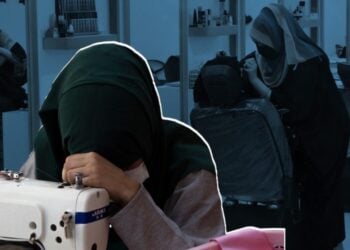
Arya says that when universities closed their doors to women, she went to a beauty salon to learn cosmetology and keep herself occupied. But before long, that work, too, was banned, and she was again confined within the four walls of her home. After some time, she began searching for online universities and literary and cultural circles. She continued her online studies and joined a literary association. She says, “Instead of drowning ourselves in thoughts about what our future might be, we turned to action. Every door that closed, we walked to another. When the health institutes were shut down, we turned to tailoring. It’s painful to hold a needle instead of a pen, but for survival, and for even a shred of meaning in life, for the tiniest act of resistance, it is still something that gives hope.”
Arya recounts that one day, she and her sister went to the bank to collect her sister’s salary. She was a teacher, and her wages hadn’t been paid for six months. Taliban soldiers forced the women out of the bank’s courtyard. When the women protested, the soldiers beat them with rifle butts and whips. A soldier, full of arrogance, said, “In six months, the world will recognize us. Then we’ll trample you into the ground.” Ever since that day, whenever the topic of recognizing the Taliban comes up, her heart trembles.
At times, Arya feels suffocated by the lack of structure. She says, “We don’t know what plans we have for tomorrow. I busy myself with housework, my mood grows tight, and I wait for someone to say something so I can lash out and release all this built-up sadness…” When she tries to tell her mother about her state of mind, her mother responds dismissively: “What else do you want, girl? You eat free bread and sit safely at home, what troubles could you possibly have?” Arya only shakes her head and says, “Nothing.” She goes to sleep knowing tomorrow will be no different from today, without thinking about the next day at all. What terrifies her is how repetitive and exhausting her complaints have become, how she has begun to doubt herself: What if I get used to this? What if we all get used to this situation and slowly turn into a Taliban member ourselves? That fear frightens her deeply.
Arya speaks about the suicides among young girls. She tells of a sixteen-year-old in their area who attempted suicide twice, and of another girl, her neighbor, who took her own life. She says when girls feel unbearably suffocated, when loneliness and lack of direction trigger crippling anxiety, they are left with two options: suicide or marriage. She has witnessed many weddings, girls who, overwhelmed by isolation, aimlessness, and frustration, even at very young ages, marry and then quickly become mothers.
Arya says there are still a few moments of joy. A small group of young writers gathers secretly. They even lie to their families about where they’re going because they cannot reveal what they do when they meet. They read poetry, tell stories, and confide in each other. These meetings, held under fear and uncertainty, become their small pockets of happiness, the moments that keep them moving forward and give them refuge. Hidden within their quiet, bittersweet laughter, they keep joy and life alive.
You can read the Persian version of this Afghan woman’s story here: