• 8AM.MEDIA
  • ویب‌سایت فارسی
  • پښتو ویب‌پاڼه
  • اۉزبېکچه ویب‌سایت
  • Podcast
Sunday, November 15, 2026
Hasht-e Subh
  • Home
  • News
    • Afghanistan News
    • World News
  • Opinion
    • Editorial
    • Analysis
  • Reports
    • Daily Reports
    • Investigative Reports
  • Society
    • The story of people
  • Women’s Word
  • Columns
    • Three Years After Afghanistan’s Fall: The Taliban’s Resurgence
    • Towards Equality
    • The Resurgence of the Taliban: Two Years Since Afghanistan’s Fall
    • Hebatullah Report Special Edition
    • Resistance for Education Special Edition
    • Special Column on Taliban’s Education Curriculum
    • Nawroz
  • Interviews
  • Contact Us
    • About Us
    • 8AM MEDIA Annual Awards
    • Submit an Article to Hasht-e-Subh
  • 8am.mediaBack
Subscribe
No Result
View All Result
  • Home
  • News
    • Afghanistan News
    • World News
  • Opinion
    • Editorial
    • Analysis
  • Reports
    • Daily Reports
    • Investigative Reports
  • Society
    • The story of people
  • Women’s Word
  • Columns
    • Three Years After Afghanistan’s Fall: The Taliban’s Resurgence
    • Towards Equality
    • The Resurgence of the Taliban: Two Years Since Afghanistan’s Fall
    • Hebatullah Report Special Edition
    • Resistance for Education Special Edition
    • Special Column on Taliban’s Education Curriculum
    • Nawroz
  • Interviews
  • Contact Us
    • About Us
    • 8AM MEDIA Annual Awards
    • Submit an Article to Hasht-e-Subh
  • 8am.mediaBack
No Result
View All Result
Hasht-e Subh
No Result
View All Result

Poppy Cultivation Surges in Afghanistan as Russia and the Taliban Square Off Against the UN

Translated by Farhad Farhaad | Originally written in Persian by Shujauddin Amini

Mohammad Farhaad Mohammad Farhaad
15 November 2026 - Solar Hijri Date: 1405/08/24 [t_time:1794723360]
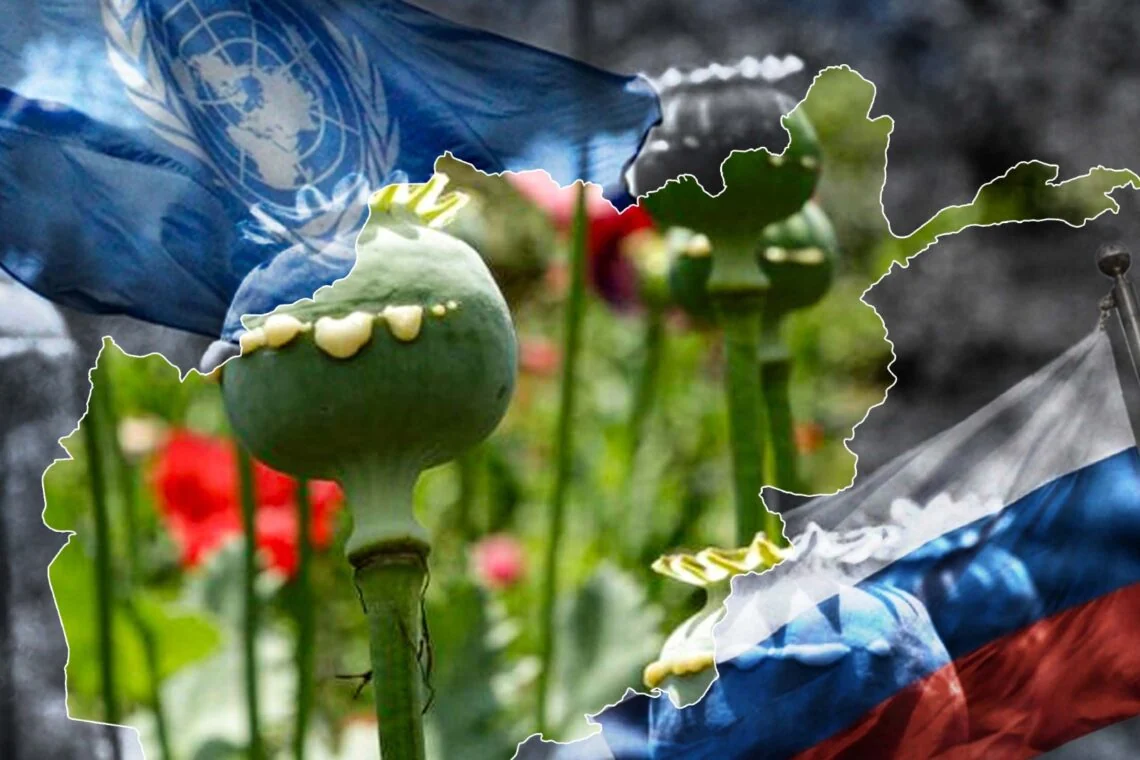
A collage shows opium poppy pods inside a map of Afghanistan beside the flags of the United Nations and Russia, amid a UN report on rising poppy cultivation. (Photo credit: Social Media)

Social Media

The United Nations Office on Drugs and Crime (UNODC) has recently reported an increase in poppy cultivation and opium production in Taliban-controlled Afghanistan in a newly published report. According to the report, the area under poppy cultivation in Afghanistan in 2026 has risen by 330 percent compared with last year, from about 10,000 hectares to more than 43,000 hectares. Opium production has also increased by 400 percent compared with last year, reaching about 1,500 tonnes.

The Taliban’s position on such reports is known in advance: absolute rejection and denial, even if the report was prepared by a credible global body that has duly observed the principle of “impartiality” in its work. Experience shows that when a report exposes the Taliban’s weaknesses, the group rejects it without question, and the body that prepared it is accused of bias and of taking orders from certain countries. By contrast, reports in line with the Taliban’s tastes and interests are accepted wholesale, and the body that prepared them is even thanked.

Meanwhile, Russia, to use a colloquial expression, has become more royalist than the king. It has not only openly backed the Taliban’s position but has also described the United Nations (UN) report as “unbalanced” and “custom-made political propaganda”: “Preparing custom-made political and propaganda material does not help such a struggle.” The Russian Foreign Ministry has also claimed that the Taliban regime is serious about destroying drug production facilities and, to that end, launches operations every day in various parts of Afghanistan.

The rejection of a UN report on Afghanistan, and by a permanent member of the UN Security Council at that, certainly deserves reflection. This is especially so when it involves defending a regime that has no official standing at the UN and is not expected to be recognized by the organization. More importantly, only Russia has opposed the content of the report. Pakistan did this in the not-so-distant past, and it has apparently now handed this mission over to Moscow. The rest of the world, especially UN member states, has stayed silent, or has not said a word on whether it accepts or rejects the content of the report. The attitude of the other countries makes clear that their silence signals satisfaction with the content of the report, not opposition to it. On this basis, Russia, as a permanent member of the Security Council, stands alone in defending the Taliban, and none of the other UN members has joined it. For the Kremlin, this is not an advantage but a disadvantage, and all for the sake of pleasing a regime that has yet to meet the conditions for recognition by the world.

Russia’s recent stance reminds the reader of India’s stance on Pakistan’s attacks on Afghanistan. From the moment tensions began between Islamabad and the Taliban until now, all countries of the world have remained silent in the face of Pakistan’s attacks on Afghanistan, but only New Delhi has issued statements in defense of the Taliban and against Islamabad. Of course, this too is mostly due to its longstanding enmity toward Pakistan, not necessarily explicit support for the Taliban’s conduct. Now Moscow has followed in New Delhi’s footsteps, though mostly regarding the recent UN report, not in all circumstances.

When Moscow rises to defend the Taliban, and at the cost of standing against a UN report, it surely has some compulsions or perceives some benefit. Otherwise, it would not want to be seen as the Taliban’s lone supporter. For nearly two years, Russia has faced a fait accompli: the recognition of the Taliban regime. Now that Russia has released the last arrow in its quiver, it apparently has no option of retreat. When a country recognizes the Taliban regime, it follows that it must praise the group’s performance, at least in certain areas, though not necessarily in all. On this basis, to make its official relationship with the Taliban regime appear justifiable, Russia is compelled to create a positive image of the group in some areas. These include counternarcotics, since the production and trafficking of drugs originating in Afghanistan are a serious concern for Moscow and the Central Asian republics.

In Moscow’s view, even if the Taliban have failed in combating poppy and opium, the effective solution lies in encouraging the Taliban, not in highlighting ever more of the group’s weaknesses and shortcomings. This too is among the requirements of recognizing the Taliban regime and maintaining an official relationship with it. For Moscow, it does not matter when the effectiveness of the “strategy of encouragement” will become evident. Likewise, it does not matter whether it would resort to a “strategy of pressure” if the first strategy remains fruitless.

Setting Russia aside, the UN report severely challenged the Taliban’s grandiose and bombastic claims about fighting drugs, if it did not render them entirely ineffective. For more than five years, the Taliban have continuously claimed to have a clear record in the war against poppy and opium. In its earlier reports, the UN did not reject the Taliban’s claims, though it did not explicitly endorse them either. It is unclear whether this was out of carelessness or because of other factors. Some other Western institutions have also occasionally reported on the Taliban’s relatively successful efforts in this regard. Some countries have likewise tried to keep the Taliban pleased by avoiding a tough stance. Now, with the publication of this report, the Taliban have virtually been disarmed. This means there apparently remains no area in which they can claim to have performed well, and countries like Russia can no longer come to their defense with full hands.


You can read the Persian version of this article here:

افزایش کشت خشخاش در افغانستان؛ صف‌آرایی روسیه و طالبان در برابر سازمان ملل
ShareTweetSendSendShare

Related Posts

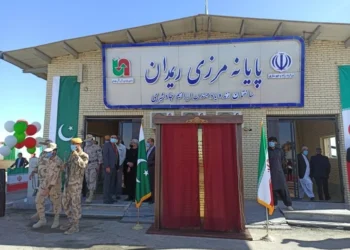
Officials and border guards gather outside the Rimdan border terminal on the Iran-Pakistan frontier, with Iranian and Pakistani flags on display. (Photo credit: irna.ir)
Daily Reports

Trucks Stall at Iran’s Rimdan Border as Afghanistan’s Fruit and Vegetable Exports Spoil

15 November 2026 [t_time:1794723352]
An official reviews the detailed plan for Parcel 2.2 of Kabul New City, where residents say a businessman demolished about 200 plots. (Photo credit: mudh.gov.af)
Daily Reports

Businessman Seizes Residents’ Land in Kabul New City Amid Alleged Taliban Collusion

15 November 2026 [t_time:1794720281]
Map of Bamyan province highlighted in red inside the 3D map of Afghanistan.
Afghanistan News

Sources: Taliban Insult, Threaten and Detain Two Female Healthcare Workers for 24 Hours in Bamyan

15 November 2026 [t_time:1794715397]

Latest

Loading latest news...

Popular stories

  • A scanned copy of the Taliban order outlining new restrictions requiring female doctors to have a mahram when working with male colleagues. (Photo credit: 8am.media)

    Taliban Order Female Doctors to Have Male Guardians to Work With Male Colleagues

    Share
    Share Tweet
  • Araghchi Warns: US Must Choose Between Accepting Iran’s Proposal and Continuing the War

    Share
    Share Tweet
  • ISIS-Khorasan: A Real Threat to the People of Afghanistan and a Political Opportunity for the Taliban

    Share
    Share Tweet
  • UN Report Reveals Shifts in Family Attitudes and Rise in Domestic Violence in Afghanistan

    Share
    Share Tweet
  • Taiwan Accuses China of Escalating Military Activities in the Western Pacific

    Share
    Share Tweet

Podcast

Insights
Insights

Join Lynne O’Donnell for 8AM’s podcast series, Insights.
Lynne talks with generals, diplomats, soldiers, journalists, politicians, activists, people who have front row seats for conflicts around the world, and citizens with a story to tell, happy or sad. For this first series, Afghanistan is the focus. Lynne and her guests talk about the collapse of the republic in August, 2021, and the impact since — for the people of Afghanistan, for the security of the region, for the safety of the world. It’s important, interesting and insightful.

Insights/22: Controlling the Narrative with Mina Sharif
byinsights8am

Controlling the Narrative

Lynne O’Donnell talks with Mina Sharif, author, activist, women’s rights campaigner, educator and mentor. They discuss who controls the narrative and who speaks for Afghanistan’s people when the Taliban appear to have seized control not only of the country but of the message, too.

Have a listen

Insights/22: Controlling the Narrative with Mina Sharif
Episode play icon
Insights/22: Controlling the Narrative with Mina Sharif
Episode Description
Episode play icon
Insights/21: Media Meltdown with Zahra Joya
Episode Description
Episode play icon
Insights/20: Terror Inc with Scott Richards
Episode Description
Episode play icon
Insights/19: Busting Stereotypes with Bushra Gohar
Episode Description
Episode play icon
Insights/18: Media Matters with Waliullah Rahmani
Episode Description
Episode play icon
Insights/17: What Goes Around Comes Around with Sima Samar
Episode Description
Search Results placeholder
Hasht-e Subh

8AM Media, also known as Hasht-e-Subh Daily, stands as Afghanistan's premier independent and non-profit newspaper, resonating as a beacon of journalistic integrity since its establishment in June 2007 by esteemed Afghan journalists and human rights advocates. With a steadfast commitment to citizen journalism and civic education, Hasht-e-Subh Daily has earned its place as the most esteemed publication in the nation.

Publisher: Sanjar Sohail
Email: [email protected]
Executive Director: Parwiz Kawa
Email: [email protected]

Read More

Poppy Cultivation Surges in Afghanistan as Russia and the Taliban Square Off Against the UN

Trucks Stall at Iran’s Rimdan Border as Afghanistan’s Fruit and Vegetable Exports Spoil

Two Aircraft Collide at Miami International Airport in US

UNICEF: Poverty, Conflict and Climate Crises Threaten Children’s Future

Fire Destroys 59 Tents at Syrian Refugee Camp in Lebanon

Editor’s Choice

Every Saturday morning, 8AM MEDIA English Services Department will guide you through the week’s biggest stories from Afghanistan and the international community.

Subscribe

© 2026 - ©Hasht-e Subh Daily

No Result
View All Result
8am.Media
پښتو ویب‌پاڼه
ویب‌سایت فارسی
اۉزبېکچه ویب‌سایت
  • Home
  • News
    • Afghanistan News
    • World News
  • Opinion
    • Editorial
    • Analysis
  • Reports
    • Daily Reports
    • Investigative Reports
  • Society
    • The story of people
  • Women’s Word
  • Columns
    • Three Years After Afghanistan’s Fall: The Taliban’s Resurgence
    • Towards Equality
    • The Resurgence of the Taliban: Two Years Since Afghanistan’s Fall
    • Hebatullah Report Special Edition
    • Resistance for Education Special Edition
    • Special Column on Taliban’s Education Curriculum
    • Nawroz
  • Interviews
  • Contact Us
    • About Us
    • 8AM MEDIA Annual Awards
    • Submit an Article to Hasht-e-Subh
  • 8am.media

© 2026 - ©Hasht-e Subh Daily