After the Taliban returned to power, Afghanistan witnessed the emergence of one of the most significant waves of civil resistance in its contemporary history. The protest movements of Afghanistan’s women took shape in response to their systematic exclusion from education, employment, political participation, and public life, and gradually became one of the most important voices of resistance against the Taliban’s policies.
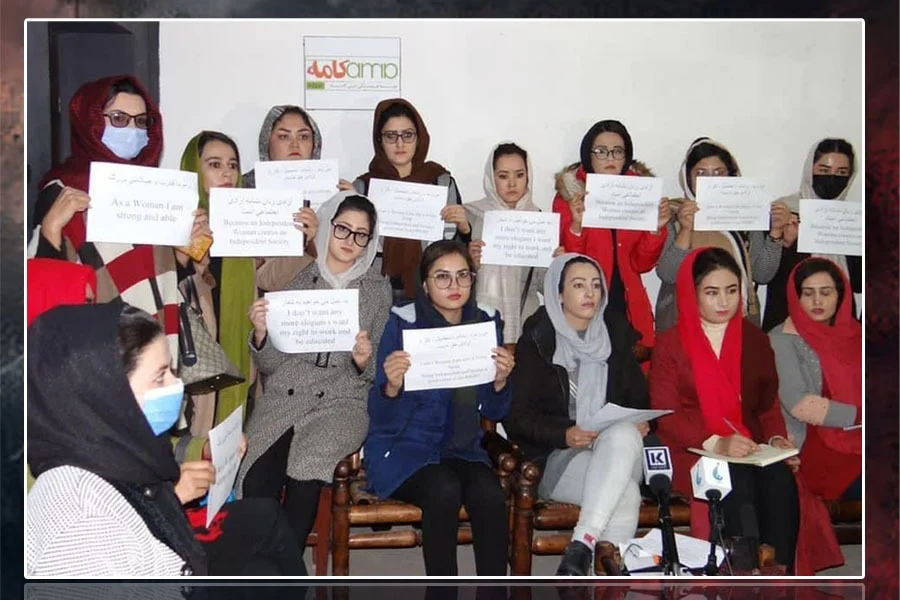
Unlike many civil movements before 2021, these movements formed largely spontaneously, in a decentralized manner, and from within society itself. At a time when nearly the entire civil and political space had been suppressed, protesting women voiced their demands through street demonstrations, small gatherings, media and online activities, graffiti, and other forms of civil resistance.
By examining the activities of 19 women’s protest movements, along with data on 1,035 protest events and 580 activities held in closed venues, this article seeks to examine the characteristics, scope, and consequences of these movements. The main argument of the article is that the women of Afghanistan are not merely victims of an oppressive system, but political, social, and civil actors who resist a system built on organized gender discrimination.
From this perspective, the situation of Afghanistan’s women can be examined within the framework of the concept of gender apartheid. Although this concept is not identical to racial apartheid in South Africa in terms of the nature of the repression, in both cases we face a system that deprives one human group of equal rights and participation in society based on an identity characteristic.
In the days and weeks following the collapse of the Republic, women in Kabul and several Afghanistan’s provinces took to the streets and, despite the risk of arrest, torture, threats, and violence, chanted the slogan “Bread, Work, Freedom” and other protest slogans. These protests were not merely a reaction to a specific decree or policy, but an expression of the formation of a social movement in which women defined themselves not simply as victims of repression, but as agents and political actors.
Afghanistan’s Women’s Movements: Civil Resistance Under Repression
The protest movements of Afghanistan’s women can be analyzed within the framework of theories of civil resistance, leaderless activism, and new social movements. These movements formed at a time when official civil institutions, political parties, free media, and many public spaces had been suppressed. Therefore, unlike classical movements, which usually have centralized leadership, a defined organizational structure, and extensive resources, many of Afghanistan’s women’s movements took shape as grassroots, bottom-up movements.
Protesting women entered the arena of resistance from their homes, universities, workplaces, social media networks, and the streets. This characteristic is one of the most important distinguishing features of the women’s movement in Afghanistan after 2021.
Formation and Expansion of the Movements
The women’s protest movements first formed in some provinces and then in Kabul, and gradually grew into networks inside and outside Afghanistan.
Their main demands were:
- The right to education and schooling
- The right to work and employment
- The right to political participation
- Civil liberties
- Gender equality
- Freedom of movement
- The right to be present in public spaces
- An end to gender discrimination and repression
These protests later spread beyond Afghanistan as well, and the women of Afghanistan in Europe, the United States, Canada, and some Asian countries also continued their protests and advocacy.
Women’s Protest Movements of Afghanistan
This study has identified 18 protest movements:
- Afghanistan Women’s Political Participation Network
- Unity and Solidarity of Afghanistan Women
- Afghanistan Women’s Movement for Equality
- Afghanistan Women’s New Future Movement
- Afghanistan Justice-Seeking Women’s Movement
- Women for Justice and Freedom Movement
- Women’s Movement Towards Freedom
- Women’s Motion Network (WMN)
- Critical School
- Women Movement For Peace And Freedom
- Afghanistan Women’s Light of Freedom Movement
- Afghanistan’s Powerful Women’s Movement
- Progressive Forces of Afghanistan Movement
- Purple Saturdays Movement
- United Women’s Movement of Afghanistan for Freedom
- Afghanistan Women’s Solidarity Movement
- Historic Transformation Movement of Afghanistan’s Women
- Afghanistan Women for Peace and Freedom Movement
and other networks and groups connected to women’s resistance.
Of course, this list does not include all of the women’s movements in Afghanistan. Because of the security situation, many groups carry out their activities in secret or out of public view, and it is not possible to document their activities. Therefore, these 18 movements mainly represent the visible part of the women’s resistance movement in Afghanistan.
Forms of Struggle and Protest
To continue their resistance, the women’s movements in Afghanistan have employed various forms of protest, including:
- Street demonstrations
- Small and secret gatherings
- Gatherings in closed venues
- Graffiti
- Media activities
- Activities on social media
- International campaigns
- Symbolic protests
- Documentation of violations of women’s rights
- Engagement with international institutions
More than 100 instances of graffiti have also been recorded as part of these activities.
Slogans such as:
“Bread, Work, Freedom”
“Education, Work, Freedom”
“No to Compulsory Hijab”
“Justice, Justice; We Are Tired of Captivity”
“Don’t Take Away My Studies”
“No to Gender Discrimination”
became symbols of the resistance of Afghanistan’s women.
The Geography of the Struggle
Women’s resistance was not limited to Kabul. Women in different regions of Afghanistan, particularly in parts of the north and west of the country, organized their protests. However, as repression increased, many activities moved from the streets to closed spaces and then to the online sphere.
At the same time, the women of Afghanistan abroad also created protest and advocacy networks and tried to carry the voices of women inside Afghanistan to the United Nations (UN), governments, parliaments, the media, and the international community. In this way, the resistance of Afghanistan’s women turned into a transnational movement that went beyond the geographical borders of Afghanistan.
Repression of Protesting Women
The Taliban have used various instruments of repression against these protests, including:
- Arrest
- Threats
- Torture
- Intimidation of activists’ families
- Security pressure
- Forced silence
- Forcing activists to emigrate
In this study, at least 67 cases of arrests of protesting activists have been recorded. These figures were compiled through conversations with detainees and the collection of information from protest movements.
One of the most worrying aspects of this repression is the effort to humiliate and break the character of protesting women and force them into coerced confessions. In some cases, videos of confessions by people who were in Taliban custody have also been published.
These methods show that the repression of women is not limited to preventing street gatherings, but is part of a broader policy to silence dissenting voices.
Likewise, some of the Taliban’s methods of social control, including the system for monitoring women’s clothing and behavior and the treatment of prisoners, bear similarities to social control policies in some regional systems, particularly the Islamic Republic of Iran, which has become one of the sources of inspiration for the Taliban in implementing controlling and social policies.
From “Woman Fighter” to “Woman Victim”
One of the most important findings of this study is the change in the narrative about the women of Afghanistan.
After August 15, 2021, protesting women presented a new image of the woman of Afghanistan: an aware, courageous, independent, and political woman who fights for her rights.
However, in many international media and political narratives, the women of Afghanistan have mainly been portrayed as victims of the Taliban.
Without doubt, the women of Afghanistan are victims of widespread human rights violations. But limiting their identity to that of “victim” can have a dangerous consequence: their political voice, leadership capacity, and social agency being ignored.
A woman who protests in the street, builds organizations, documents human rights violations, and communicates with international institutions is not only a victim; she is a political actor.
Therefore, alongside supporting women as victims of human rights violations, the international community must also recognize them as political actors and holders of social legitimacy.
The Struggle of Afghanistan’s Women and the Experience of the Struggle Against Apartheid in South Africa
The struggle of Afghanistan’s women can be compared, historically and theoretically, with the anti-apartheid movements in South Africa.
Of course, racial apartheid in South Africa and what is today referred to as gender apartheid in Afghanistan are not identical in historical, legal, and structural terms. Nevertheless, there is one important point in common between the two situations: the systematic discrimination against and segregation of a human group and the denial of equal rights to that group.
In South Africa, the struggle against apartheid was not limited to the struggle of one individual or one party. Rather, a broad network of people, women, young people, unions, and civil organizations stood against the system of discrimination.
Women also played a fundamental and decisive role in this struggle.
In Afghanistan today, too, women are standing against a system that deprives them, based on gender, of education, work, freedom of movement, political participation, and equal presence in society.
From this perspective, the main message must be clear:
The women of Afghanistan should not merely be rescued; they must be recognized as the main forces in the struggle for their own freedom and must have a presence in decision-making about the future of their country.
A Request to the World’s Women Politicians
Over the past two decades, many prominent women politicians around the world have spoken about the rights of Afghanistan’s women and have supported their education, political participation, and freedom, including Hillary Clinton, Laura Bush, Cherie Blair, and a number of other women politicians and influential international figures.
During her political career, and particularly during her tenure as United States Secretary of State, Hillary Clinton made women’s rights one of the important issues of her foreign policy. Today, the women of Afghanistan are asking her and other women politicians around the world to ensure that support for Afghanistan’s women does not remain limited to speeches and statements.
Likewise, Cherie Blair, who has worked in the field of women’s rights for years and, alongside other political and social figures, has spoken about the situation of Afghanistan’s women, can once again be the voice of Afghanistan’s women.
This request is not addressed only to them, but to all women politicians, members of parliament, ministers, political leaders, and women’s rights activists around the world.
Today, the women of Afghanistan need your genuine solidarity more than ever.
We ask you to stand beside the women of Afghanistan, not only as victims of a humanitarian crisis, but as women who are themselves fighting for freedom, equality, and the future of their country.
If you have supported the education of girls, the political participation of women, and the empowerment of Afghanistan’s women over the past twenty years, now is the time to turn that support into political and practical action.
Conclusion
The protest movements of Afghanistan’s women after August 15, 2021 are regarded as one of the most prominent examples of civil resistance under severe repression in the contemporary world.
These women have not remained silent despite threats, arrests, torture, and security pressure.
They have fought not only for bread, work, education, and freedom, but are also fighting for their right to determine and define the future of Afghanistan.
Therefore, the international community must change its narrative about the women of Afghanistan.
The women of Afghanistan are not only victims; they are fighters, leaders, organizers, journalists, students, human rights activists, and political actors.
Recognizing this reality is the first step toward creating a policy that is effective, just, and grounded in the realities of Afghanistan’s society.
Recommendations
- The international community should recognize the women’s movements of Afghanistan as political and social actors.
- Protesting women and genuine representatives of women’s movements should be present in negotiations and decision-making processes about the future of Afghanistan.
- The activities and struggles of Afghanistan’s women’s movements should be documented regularly and systematically.
- Governments and international organizations should provide greater security, financial, and political support to women activists, particularly those working inside Afghanistan.
- Media narratives about the women of Afghanistan should go beyond the image of the “mere victim” and present them as victims, as resisters, and as political actors as well.
- Countries around the world should adopt more effective political and legal measures to recognize and confront gender apartheid in Afghanistan.
- Women politicians and women leaders around the world, including Hillary Clinton, Laura Bush, Cherie Blair, and other prominent international figures, should once again stand beside the women of Afghanistan and turn their support into practical action.
The women of Afghanistan no longer want others to merely speak about them; they want to be present themselves in decision-making about the future of Afghanistan.
You can read the Persian version of this article here:
زنان افغانستان؛ از قربانیان سرکوب تا کنشگران مقاومت مدنی و مبارزه با آپارتاید جنسیتی