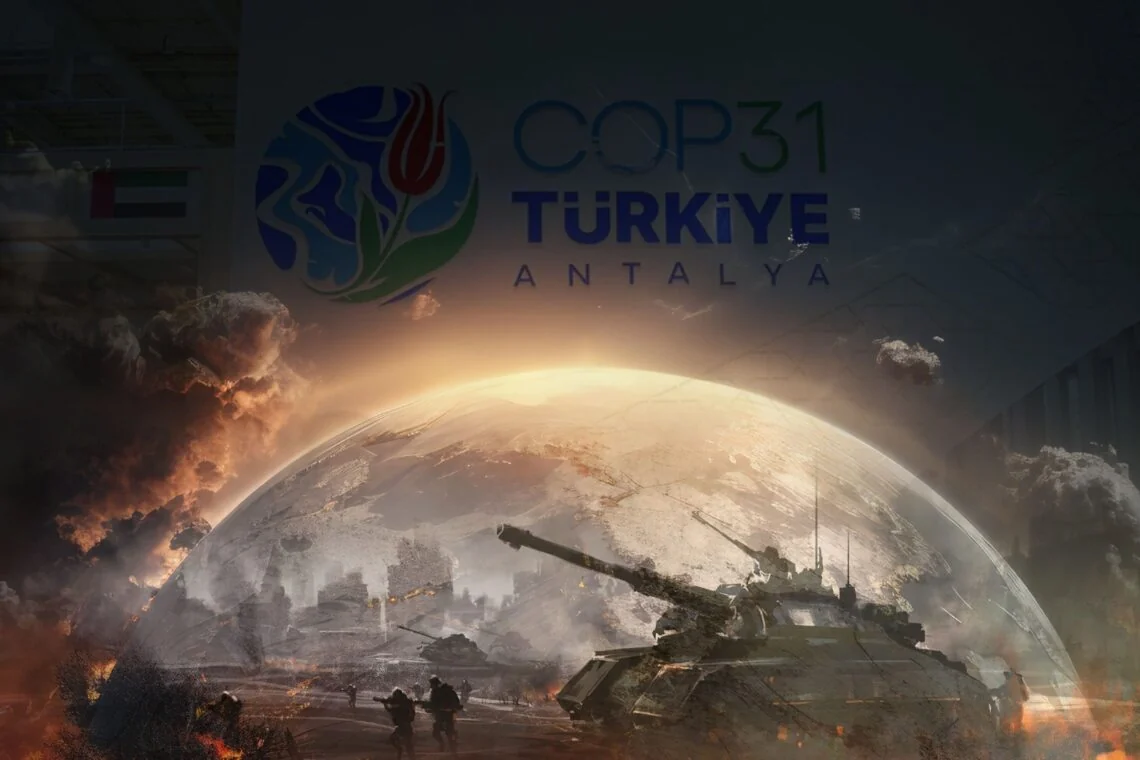
While leaders of dozens of countries gathered in Antalya to discuss food, clean energy, resilient cities, and climate finance, a harsher reality than ever revealed itself: the 31st Conference of the Parties (COP31) should have had only one agenda, which is ending the wars. All world leaders were present at this summit, and war destroys precisely those systems that the summit claims to be working to save. Without ending the wars, the other agenda items remain incomplete, superficial and, ultimately, performative.
War undermines all the core issues of the COP. Food systems collapse, health infrastructure is destroyed, energy supply chains are disrupted, and cities are turned into ruins. Rebuilding this devastation is itself one of the most resource-intensive and polluting activities in the world. From the perspective of the economics of pollution, war not only produces direct pollution but also imposes enormous external costs, including the destruction of natural resources, increased greenhouse gas emissions from the production of weapons and the reconstruction of war-torn areas, and the loss of ecosystem services. These costs are not fully accounted for in any official climate balance sheet.
The United States, as one of the largest historical and current polluters in the world, has once again withdrawn from serious climate commitments, while at the same time playing a role in creating or prolonging tensions and wars in different parts of the world. Withdrawal from the Paris Agreement and the prioritization of military and geopolitical spending send a clear message to the world: when the world’s largest economy and one of its largest polluters weakens its commitments, the foundations of global cooperation are shaken. While vulnerable countries are seeking assistance to adapt to climate change, enormous resources are being spent on weapons and on managing the consequences of war. This contradiction calls the credibility of the entire climate process into question.
Afghanistan is one of the countries most vulnerable to climate change in the world, even though its share of greenhouse gas emissions is negligible. If assistance from the Green Climate Fund (GCF) and other sources of financing does not reach Afghanistan, the degradation of natural resources will accelerate. Fertile soil will be lost, water resources will become more limited, forests will burn, and floods and droughts will intensify. The direct consequences of this trend are increased poverty, food insecurity, and instability. Under such conditions, drug trafficking, as one of the few remaining sources of income, is strengthened, forced migration increases, and the ground is prepared for the growth of armed groups and terrorism. Gender discrimination, which is already severe, is intensified when combined with the climate crisis. The consequences of this situation will not be limited to the inside of Afghanistan; migration, drug trafficking, and regional instability could affect the security of neighboring countries and even Europe.
Afghanistan’s observer delegation at COP31 could have drawn the world’s attention with a logical and well-documented argument. The delegation should have said loudly: “We have come for the people of Afghanistan, not to legitimize any government. Our annual climate damages have exceeded one billion dollars. If assistance does not arrive, the consequences, including migration, drug trafficking, instability, and terrorism, will extend beyond borders.” Presenting the Third National Communication, even informally or through public documentation, could have provided a basis for moral and technical pressure. Separating the suffering of the people from the political status of those in power was the strongest bargaining tool, and it was rarely used.
From my perspective, as an environmental expert who has worked in Afghanistan for years and now lives in the Netherlands, the danger to Europe is also serious. If European countries do not cooperate with one another and prefer military and short-term priorities over climate commitments, the green continent may turn into a yellow one within the next ten years. Countries that were pioneers of climate policies and in which Green parties held a prominent place have today turned once again to the use of fossil fuels, the very fuels that had previously been planned to be phased out. The energy shock, inflation and rising security costs have weakened the political will to implement climate commitments. If this trend continues, Europe’s climate credibility will suffer, and its green identity will fade more and more.
The first week of COP31 showed that many leaders came to this summit more for bilateral meetings and to send messages to the green public opinion of their own countries than to resolve the climate crisis. On the sidelines of the meetings, they spoke about wars, but war and the resulting military spending have no clear place on the main agenda. Guterres warned at this summit that even tripling adaptation financing would cover less than 30 percent of the real needs of vulnerable countries. The $1.3 trillion financing target also faces a gap of about $840 billion under the current trajectory. These figures show that the distance between promises and reality grows every day.
Bilateral agreements, such as investments by China and development banks in Turkey, and commitments related to reducing methane emissions, although positive, do not replace collective commitments and structural reforms. When the largest polluters and military powers devote their priorities to war and military security, climate negotiations turn into a show for domestic consumption.
Summary
COP31 could have been a historic moment if world leaders had put only one issue on the table: ending the wars as a precondition for any climate progress. Without it, talking about electricity supply, resilient cities and climate finance resembles temporary relief more than anything else. Afghanistan is a clear example of how neglect of vulnerable countries can impose security and human costs on the entire world. Europe, too, if it is not serious about implementing its climate commitments, will not only lose its credibility but will in practice move toward renewed dependence on fossil fuels and the weakening of its green identity.
Conclusion
Peace is not a side issue but a fundamental precondition for any sustainable climate action. Otherwise, future COPs will also continue with the same shows and unfulfilled promises. The cost of war and the cost of the climate crisis are ultimately paid from the same pocket. Until this contradiction is resolved, the damages grow every day, and the credibility of the climate process will be eroded more and more.
Sources
- Statements by Antonio Guterres at the Leaders’ Summit and press conference of COP31, Antalya, November 2026 (United Nations Framework Convention on Climate Change (UNFCCC) and UN News).
- Reports from the first week of COP31 on the climate finance gap and the $1.3 trillion target (UN News, Earth.org and Carbon Brief).
- Analyses of military spending and of greenhouse gas emissions resulting from war and reconstruction (the economics of pollution and international reports).
- The status of Afghanistan’s First National Communication (NC1) and Second National Communication (NC2) reports, and restrictions on access to the GCF.
- Media reports on the return of some European countries to the use of fossil fuels following energy shocks and rising security costs.
You can read the Persian version of this article here:
کاپ ۳۱ و فریب بزرگ: وقتی جنگها ادامه دارند، سخن گفتن از اقلیم فقط نمایش است