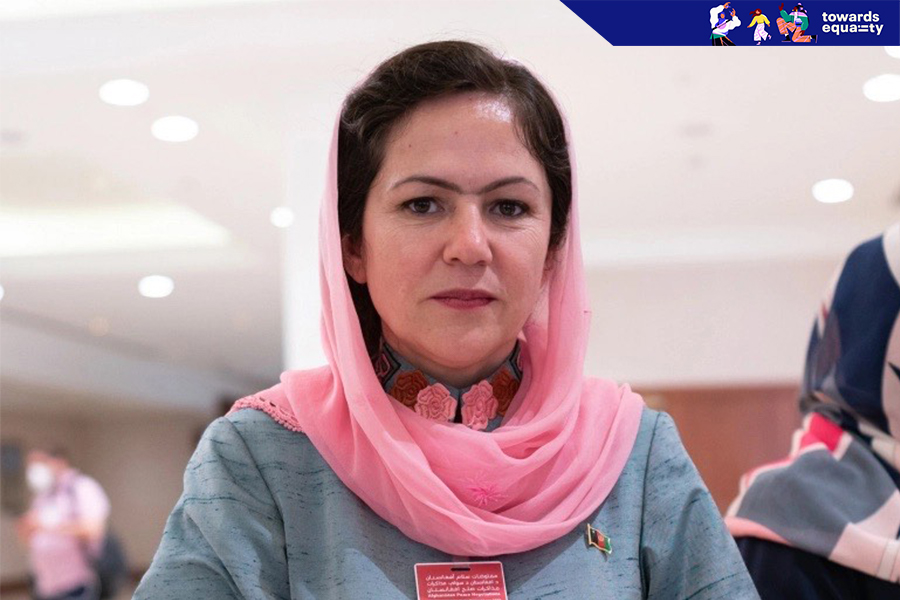
Interview by Haanya Malik, Hasht-e Subh
The situation for women and girls in Afghanistan has severely worsened since the Taliban took over the country in August 2021. The new regime has banned girls from middle school, high school and universities as well as barred women from most fields of employment. Women must also wear head-to-toe clothing in public and aren’t allowed in parks and gyms. Despite protests, women have been excluded from public life and deprived of their fundamental rights and livelihood. As we mark International Women’s Day on March 8, Hasht-e Subh reached out to former deputy speaker of the Afghan parliament and women’s rights activist Fawzia Koofi, to get her perspective on the situation of women in Afghanistan and what is being done to change it.
Fawzia Koofi was one of the few female members of the government team tasked with negotiating with the Taliban in 2020. She was nominated for the Nobel peace prize for her efforts towards peace. She is also an outspoken advocate for the rights of women. Currently in exile, she is the leader of the political party Movement of Change for Afghanistan.
Hasht-e Subh: With the Taliban in power, the rights of Afghan women have been severely limited, leaving them without access to basic facilities and human rights. In this context, can we even discuss the concept of equality?
Fawzia Koofi: Absolutely not. The idea of equality in Afghanistan is unfortunately a far-off dream. Historically, attempts to establish social and gender justice in Afghanistan have faced difficulties in actual implementation, and these issues have never been incorporated into political systems. Over the past two decades, people have been able to voice their grievances and opinions through social and media channels. However, since the Taliban took control, any talk about justice or equality has been banned, and the power they wield is solely their own. Not only women, but men are also denied the right to political involvement and activities.
In countries where women have better conditions, it has taken a lot of effort and changes in laws and culture to advance gender equality. What is your perspective on the current situation for women in Afghanistan?
The fight for women’s rights and equality around the world has been a long and difficult journey. Laws, cultural norms, and societal structures had to be changed in order for women to be recognized as equal citizens. March 8, World Women’s Solidarity Day, is dedicated to recognizing the struggles that women have gone through to achieve justice and equality.
Afghanistan, however, faces unique challenges due to its repressive culture, lack of opportunities, and frequent wars. This makes it difficult for women to create a movement that can truly change society. Despite the difficulties imposed on them by the ruling group, women should see these challenges as opportunities to reshape the women’s movement in Afghanistan.
For Afghan women to effectively change their narratives and cultures, they must understand the importance of unity. Many of the restrictions imposed on women by the Taliban in the name of religion have no religious justification and are simply a means of exerting power. In order to challenge this power, women must come together.
How should men have responded to such a situation? Should they have stood by women?
It was expected that those who have been affected by the restrictions imposed on women, such as fathers of daughters who are unable to attend school, would form a movement. But so far, a dynamic civil movement has not materialized. There have been some recent reactions, but they have been focused more on the fact that the issue has reached a breaking point. Those who have fought for this cause in the past are now in prison, but no struggle can be won without sacrifice.
The lack of access to education, work, and university for Afghan girls harms not only the individuals themselves, but also the social foundations, structures, and rights of people in Afghanistan. If everyone realizes this, both men and women should come together to fight for change. However, it seems that the people have not yet come to this conclusion. If they do not take action and fulfill their responsibility, they will not contribute to building a new system. The people must be the ones to determine their own fate and form a movement so that there is an alternative in case the Taliban cannot rule in the future.
What is your perspective on the role that culture, religion, and social dynamics play in shaping the current status of women in Afghanistan? Do you believe that certain segments of society perpetuate the status quo for religious and traditional reasons?
I don’t think that a part of society supports the Taliban, but I think that a part of society is neutral. They are neutral because they believe the situation is only temporary and caused by outside factors. Because Afghanistan has been shaped by external elements in the past, people have become distrustful and have a lack of faith in their own ability to bring about change. In the past, social changes were either imposed by external forces or suppressed by governments.
In the past, the Taliban’s way of thinking was rooted in outdated customs and traditions. However, in recent years, there has been a shift in mentality, particularly in the remote area I represented. People now believe that their daughters should attend school and they have offered to repair school buildings and asked for help in finding jobs for their daughters.
However, the rise of the Taliban raises concerns about the potential reversal of the social and intellectual progress that has been made in Afghanistan, causing people to view the Taliban as the only reality and leaving no future for education and schools. It is crucial that we maintain our efforts toward civil progress to avoid the belief that the Taliban is the only option available.
Do you think the international community sees the Taliban as the only option ?
The Taliban wants to be seen that way, and the global community believed that there was no alternative to the Taliban and this was the prevailing view until recently. However, this perception is changing, and thus it is crucial to focus on changing the political climate. The significance of girls attending school and university cannot be ignored. The ban on women has no religious foundation and is merely a display of power by the Taliban. However, if the focus is only on opening educational institutions without altering the overall environment, it will only be a partial solution to the problem. All sources of pain must be eliminated. Despite the importance of girls’ education, it cannot be improved until the environment changes.
What is being done to change that environment ?
Our objective [at Movement of Change for Afghanistan] has been to establish and support the Afghan women’s movement both domestically and internationally, recognizing that women face the greatest pressure from the Taliban government among the Afghan people. The path of struggle and the goals must be consistent, even though there may be various organizations, structures, movements, and titles related to women’s rights that operate in different forms and have different names. Our main focus is to bring these groups together and form a united front, especially with those outside of Afghanistan such as political leaders, civil society leaders, experts, media personnel, and the younger generation. The purpose of these organizations is to bring the voice and issues of Afghan women to the attention of the world, highlighting problems and proposing solutions for Afghanistan, as well as raising support for women within the country.
Finally, what is your message?
My message to Afghan women is that it’s okay to have differing opinions on certain issues. In a society where everyone thinks alike, it means that the members of that society are not really thinking. Differences in opinions allow us to expand our perspectives and make well-informed decisions, but it’s important to clearly state our stance beforehand. The Afghan women’s movement should not allow differences to cause division among women. Instead, we should strive for a unified and strategic goal. Currently, Afghan women need to come together in terms of force, opinion, message, and voice more than ever before. Historically, Afghan women have relied on men, but I want to emphasize that we are capable of doing things on our own. The political leaders and the world should trust the women of Afghanistan, who face numerous challenges every day. Women in Afghanistan are capable of leading the charge in creating change and making history.