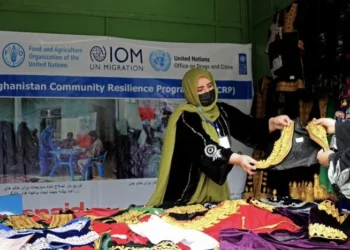
In one of the remote areas of Kabul city, the steady, rhythmic sound of sewing machines fills a small room. Upon entering the workshop, the first thing that catches one’s attention is a set of hands that never stop moving: women, each absorbed in a part of the work. One is delicately sewing colorful beads onto fabric, another is finishing the last row of embroidery. Several other women sit behind sewing machines, turning fabric into clothing and craft. In one corner of the room, bundles of fabric, thread, and raw materials are stacked together, materials that are to be sent to other homes across different parts of the city. This is not just a small sewing and handicrafts workshop; for dozens of women, it is a bridge between despair and hope, and a path toward financial independence.
Amid the women’s coming and going, a middle-aged woman walks calmly past the tables. At times she checks the quality of the work, at times she sorts the orders, and at times she guides the women.
Aamina Mirzai is a 48-year-old woman whose life’s ups and downs clearly reflect the fate of many women living in the shadow of poverty, restriction, violence, and inequality. Her story begins with a forced marriage in childhood and leads to the creation of a network of breadwinning women, women who today, through skill and work, have achieved a measure of economic independence.
A Childhood That Ended Too Soon
Thirty-five years ago, when Aamina was only 13 years old, her family married her off to a 55-year-old man. She believes that widespread insecurity, severe poverty, and her family’s inability to provide for basic living needs were among the main reasons that drove her father to force her and her sisters into marriage at a young age, against their will.
Aamina was still a child when she went to her husband’s house; a man who had already been married several times before her. But this time, hoping to have a child, he had taken Amina as his wife. This marriage, however, marked the beginning of the most difficult and bitter years of life for this 13-year-old child. Today, she speaks calmly about those years, but behind every sentence, one can sense the weight of painful memories and prolonged suffering.
Amina says: “For many days we had nothing to eat. I was still a child, but I had to do heavy housework. If I couldn’t, I was punished.”
At the age of 15, Amina’s responsibilities grew. By this age, she had also become a mother. While many of her peers were still engaged in childhood games and attending school, Amina had to raise her own child.
According to her, those years made her grow up far earlier than her actual age, while at the same time increasing her capacity for endurance and resilience. “Despite all the hardships of those days, I always told myself things would get better, that it was for the best, and that I should endure. I had no other choice anyway.”
A Skill That Changed the Course of Life
Amid all those difficult and discouraging days, a small window of hope opened in Amina’s life. In Amina’s neighborhood (Maidan Wardak, First District of Behsud), one of the charitable organizations held a sewing training course. Amina seized this opportunity and made every effort to learn the craft better than others.
She knew well that learning a skill could change her life, not only to cover living expenses, but also to gain part of the independence that had been taken from her for years.
For many women in Afghanistan, learning a trade does not simply mean finding a job; it means gaining the ability to make decisions about their own lives and futures. For Amina, too, sewing carried exactly this meaning.
After completing the six-month training course, she began her work by sewing clothes for neighbors and local women. The income from this work was small, but that modest income marked her first step toward economic independence, a small step that later changed the course of life for her and dozens of other women.
Being Left Alone and Carrying On
At the age of 23, just as Amina was beginning to discover her own abilities, her sick and elderly husband passed away. She says her husband lived with her for only ten years, ten years that, in her own words, left her with nothing but suffering, deprivation, and regret.
After her husband’s death, Amina no longer saw any reason to stay in the village. She decided to chart a new path for her future and her child’s, and eventually packed up and set off for Kabul.
Life in the city was not easy for Amina; she had to work, take care of her child, and adapt to a new environment, all at the same time. She spent her days working and her nights attending literacy classes, an effort to make up for the opportunity that had been taken from her in childhood.
With perseverance and determination, Amina continued her education and eventually managed to complete her studies through the twelfth grade. She recalls those days this way: “Every day I told myself that if anyone was going to change your life and your child’s life, it was you yourself, so keep going.”
The Beginning of a Big Dream with Two Thousand Afghanis
Ten years ago, when Amina had established herself as a skilled tailor and craftswoman in various fields of sewing and handicrafts, she decided to expand her activities. She wanted to bring more women together with her, women who, like herself, lived under the pressure of poverty, heavy family responsibilities, violence, and social restrictions.
According to her, the same organization provided her with a long-term loan of two thousand Afghanis, an amount that may have seemed small at first glance, but became the starting point of a path that later created income-generating opportunities for dozens of women.
With this money, Amina purchased raw materials such as thread and fabric and distributed them among women, house by house, so they could do beadwork, sequin work, and fine embroidery on them. She would collect the finished products, sell them, and reinvest the resulting income into expanding the work. Over time, the network of craftswomen grew larger, and the quality of the products attracted more customers.
As orders increased, Amina decided that, in addition to distributing work to homes, she would also set up a workshop, a space where women could work alongside one another, share their experiences, and learn new skills.
Gradually, more women joined this network, many of whom were themselves heads of households, responsible for covering their families’ expenses.
Amina speaks proudly of the path she has traveled: “I started with two thousand Afghanis in borrowed money; now I have 70,000 Afghanis in capital. Alongside the capital, I am proud that we have kept dozens of women employed and taught dozens of others the trade.”
Today, dozens of women work through this network in various fields, including sewing, embroidery, fine needlework, and beadwork. Some work in the workshop, while others produce items at home.
According to her, the final years of the previous government were the best period for her business. During those same years, her child graduated from university and entered the job market; at the same time, the workshop’s economic activity also saw significant growth. Her capital had grown from the initial two thousand Afghanis to more than 80,000 Afghanis.
Continuing the Path Amid Restrictions
With the collapse of the previous government, conditions also became more difficult for women craftspeople and entrepreneurs. A shrinking market, restricted direct contact with major customers, rising prices of raw materials, and existing restrictions on women’s presence in social and economic spheres are among the factors that have affected Amina’s work and that of her colleagues.
Amina says her income and the volume of orders have dropped by more than half compared to the past, and the prosperity of previous years no longer exists. Even so, the workshop’s activity continues, quieter than before, but not stopped. “About 50 women still work with me. Conditions have become difficult, but we try not to stop. These days, too, will pass.”
Amina’s child is now an educated young man who, after four years of studying law, has begun working at one of the companies.
You can read the Persian version of this report here:
از ازدواج اجباری تا کارآفرینی؛ روایت تابآوری زنی که برای دهها زن فرصت کار ساخت