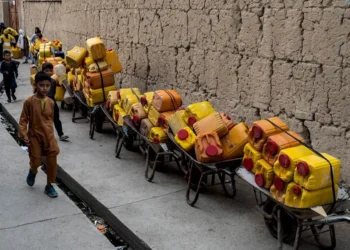
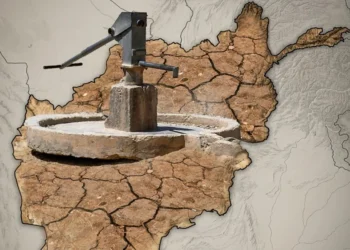
A severe water shortage and rapidly declining groundwater levels have plunged thousands of families in Kabul into serious hardship. Residents say they spend hours waiting for piped water or are forced to buy what they need at steep prices from tankers and mobile vendors, all while grappling with poverty and unemployment. They describe lives consumed by queuing for water trucks or spending their meager incomes on water from roving vendors. International research corroborates these accounts. Studies document a dramatic decline in groundwater levels, extraction rates far exceeding natural recharge capacity, and deteriorating water quality, placing the city on the brink of a sustained and potentially irreversible crisis.
Ziba, a resident of District 6 in Kabul, says the wells in her neighborhood have been dry for some time, leaving her community without reliable access to water. She notes that although rainfall increased in 2026, the shortage persists, and nothing has changed for residents trying to get water.
“We buy piped water for household use at 65 afghanis per kilowatt-hour, but even that water is not fit for use,” she says. “It only comes twice a week, and on no predictable schedule. Things are better when there is electricity. In summer, when the heat is at its worst, there is electricity but no water. When water comes, the electricity is out. We face enormous problems with water. There may come a day when even this supply disappears entirely.”
Ziba adds: “A bottled water cart comes through the alley, and we buy from it daily at 20 afghanis per liter for cooking and drinking. Some of these suppliers provide decent water, but others do not, and the taste varies noticeably. You never really know how it is purified. It would make far more sense to build a proper, organized water system for Kabul rather than drilling more and more wells, so that people could finally be free of these burdens. We used to have a garden, and we grew things in it, but the fruit trees have all withered and died. A neighbor down the alley put in a private water line, and people come from far away just to collect from it. Young children haul large barrels on their own. They carry the heaviest share of this crisis.”
Hikmatullah, a resident of District 7 in Kabul, says: “From the city’s pipes, water flows for just one hour in every 24, and even then in such a thin trickle that you cannot fill a single barrel in 10 minutes. The water is salty and full of grit, making it unfit for drinking or cooking. Rich and poor alike are forced to buy bottled water. Most people in difficult economic circumstances simply boil that water and use it regardless. Even though city water comes for only a short window, the water bill remains high. The problem is worse in flat areas, but for those living on the hillsides, water may arrive once a week and for only a few hours. They buy whatever they need from tanker trucks.”
He adds, “Paying for both bottled water and tanker deliveries is yet another burden piled onto the poor. Many families fall behind on rent but still have to pay for water just to survive. In most places, the water smells foul.”
The cost of obtaining water weighs heavily on low-income families, with many forced to spend a portion of their daily earnings solely on purchasing it.
Haya (pseudonym) is a resident of District 11 in Kabul. She says her family spends more than 7,000 afghanis (approximately USD 100) on water every month.
“Our well was 180 meters deep, but last year we still had to extend the pipe further because the water table had dropped,” she says. “This year we are facing the same problem again. We have been without water for nearly two months. Every day we spend 50 afghanis on bottled water, and every two days another 200 afghanis on a tanker delivery. In a month, that comes to more than 7,000 afghanis.”
Haya is unequivocal: “Even when water is available, it is not drinkable, not the city supply, and not the well water either. Despite how deep the well goes, the water has no acceptable taste. The city supply is completely unusable. We saw how contaminated it was in previous years, and now, when we try to use it for drinking or tea, it turns very dark or develops a kind of film on the surface.”
Moqaddas, a resident of the Sarai Shamali area of Kabul, shares Haya’s alarm over the city-wide water shortage. She says that on top of everything else, the absence of water has become one of the most serious problems she and her neighbors face around the clock. “More than 10 families live in the building where we stay, and everyone buys water,” she says. “Rent has gone up so much that moving is not an option. Right now we pay 6,000 afghanis a month for two rooms with the most basic facilities, and we spend another 200 afghanis every day on water.”
Zohra, another resident of the same area, says her building has had no water for more than a year, and the well has dried up completely. “I live on the fifth floor and have children under five years old. It is incredibly hard,” she says. “I have to collect the water myself and carry it up five flights of stairs. Sometimes all I can manage is bottled water for drinking. For laundry or washing carpets, I go to my mother’s house.”
Hasiba, a resident of District 4 in Kabul, says: “We all know by now that Kabul is facing a water crisis, particularly in densely populated neighborhoods. Our home is in Chahrahe Shahid, and four families share the building. City water comes once a week, and only when there is electricity can we actually collect it. When the power is out, the difficulties multiply. If we buy water, we spend more than 1,000 afghanis in a single week, and even that is not enough for as many people as we are.”
She adds, “Water tankers are reluctant to come at all. When we call them, they say they will not come to our area for less than 1,000 afghanis because the distance is far and the roads are unpaved. So they simply do not come. This is not our problem alone. It is the problem of thousands of other families facing the same shortage. We can only hope that one day this will be resolved for all our people.”
According to a study published in the journal Environmental Earth Sciences, groundwater levels in Kabul’s urban areas have declined significantly since the early 2000s, dropping by as much as several meters per year in some neighborhoods. The trend has been especially severe in urban zones where extraction rates far outpace the limited natural recharge capacity of the aquifers.
A separate study in the same journal found that the quality of Kabul’s groundwater has also deteriorated sharply, with contamination from urban sewage and other pollutants rendering it unfit for drinking across many areas without extensive treatment.
Findings published in both Environmental Earth Sciences and the journal Sustainable Water Resources Management show that Kabul’s rapid population growth, unplanned urban expansion, and the spread of deep wells have pushed groundwater extraction well beyond the natural recharge rate of the aquifers. The studies note that this mounting pressure has broken the balance between recharge and extraction, accelerating water level declines across large parts of the city.
The Guardian has previously reported that Kabul stands on the edge of a serious and potentially irreversible water crisis. Its report found that groundwater levels in the city have fallen by roughly 20 to 30 meters over the past decade, with extraction rates substantially exceeding the natural replenishment capacity of underground reserves. The report warned that widespread well failures have driven growing dependence on unsustainable sources, and that if the trend continues, Kabul could soon face a large-scale and irreparable water crisis.
You can read the Persian version of this report here: