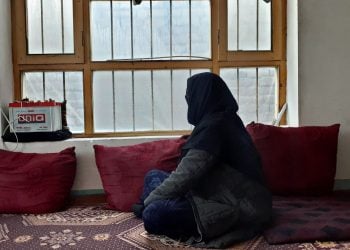
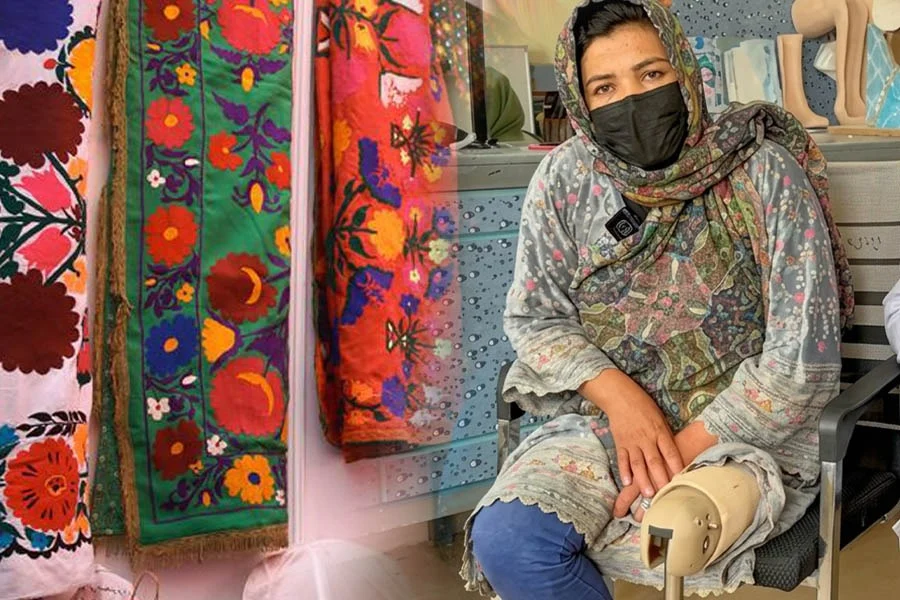
Several girls and women with disabilities in Kabul say that despite physical limitations and economic hardship, they are working to cover living expenses and achieve financial independence. They add that the shrinking of job opportunities for women has made access to work and income even more difficult.
Zohra, who holds a Baccalaureate and trained as a teacher, was left paralyzed in her legs for a period following an accident.
Zohra’s husband died four years ago, and since then she has single-handedly supported her three children. She now works as a weaver and covers part of her own and her children’s living costs this way.
“I had an accident, and my legs were paralyzed. I still have limited mobility, but for the sake of my children I keep myself strong, and for now I am busy with weaving. There is no opportunity for work in the field I studied,” she said.
Zohra says she had also registered with the Taliban’s Ministry of Martyrs and Disabled, but her application was not accepted. She is calling on the relevant institutions to provide her with employment so that she can cover her own and her children’s living costs.
Narges Yousofi (pseudonym) is another young woman who lives with a disability as a result of contracting polio. She is an athlete and, before sports clubs were closed to girls, worked as a bodybuilding and fitness instructor.
Narges says she first learned this profession to improve her own physical condition and later turned to teaching in the field. But after sports clubs were closed to girls, she lost her job opportunity as well.
She now trains women at home and is also learning tailoring alongside her sport. Even so, she says her income has decreased compared to the past.
“My income is not good compared to the period of the Republic, but I am doing my best. My request to the officials is to reopen the clubs or to provide work opportunities for us so that we girls can work too,” Narges said.
Neda (pseudonym) finished school but has been unable to continue her education. She is now busy with tailoring and beadwork, skills she says she learned through her own effort.
Neda’s right leg is shorter than the left, but she says this limitation has not stopped her from trying to earn an independent income. “The reason I learned tailoring and beadwork was that I did not want to depend on anyone. So that I would have at least some income of my own,” she said.
Neda says her income covers about 50 percent of her living expenses. However, her demands are not limited to herself. “The wish of all the girls of Afghanistan is work and education. There are few work opportunities for us with disabilities,” she said.
This comes as the Taliban have deprived women and girls of the right to education, schooling, and work. Women with disabilities, in addition to being affected by the restrictions imposed on women, have also been deprived of many of their rights because of their disability.
You can read the Persian version of this report here:
زنان دارای معلولیت در کابل: برای استقلال اقتصادی فرصت کار میخواهیم