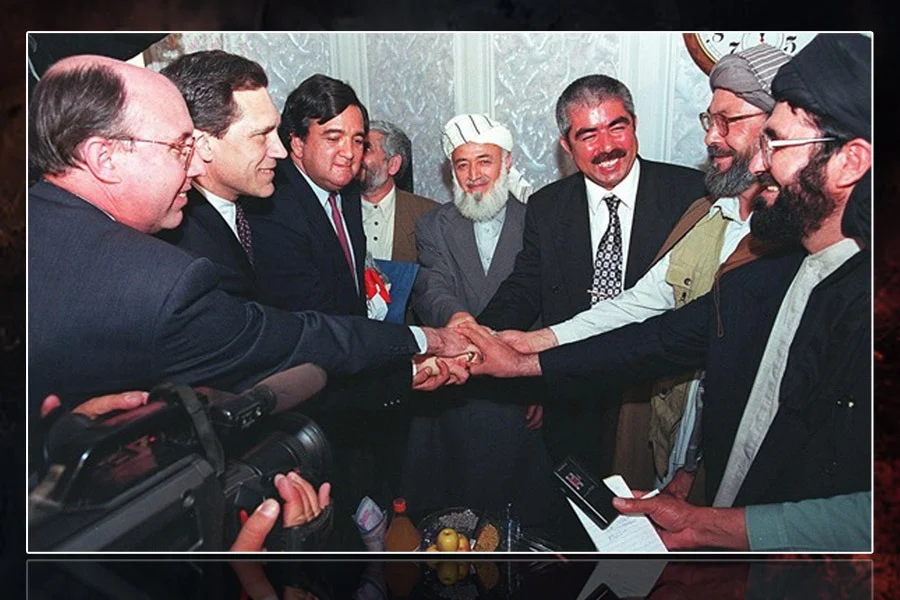
The Northern Alliance’s story is one of a historic opportunity gained and then lost. In the late 1990s, forces with years of rivalry and even a history of fighting one another- from Ahmad Shah Massoud and Abdul Rashid Dostum to Mohammad Ismail Khan, the Hezb-e Wahdat party, and the forces of Abdul Rasul Sayyaf- reached a shared conclusion in the face of the Taliban: none of them could survive alone. For a moment, Tajik, Hazara, Uzbek, and other forces across the country stood together, not to claim a share of a single center of power, but because they needed one another.
One question keeps recurring: how did this multi-ethnic coalition manage, for a time, to challenge the historical logic of power in Afghanistan, yet fail to turn that victory into a new political order? After the Taliban’s fall in 2001, why did this mutual need not become the foundation of a lasting political agreement? Why were its leaders instead absorbed into positions, privileges, and networks of power, allowing centralism to return and, twenty years later, the Taliban to reach Kabul once again? This is a story about that moment, when the spell cracked but did not break.
The value of an alliance in history should not be measured only by the number of fighters involved, the cities captured, or the outcome of the final battle. Some alliances matter because they prove that an order once seen as natural and unchangeable can, in fact, change. The United Front, better known as the Northern Alliance, was one such moment.
Its importance was not purely military. From a political philosophy standpoint, power shifted for a time from domination over others to a mutual need for one another. When one group’s survival depends on another’s presence, eliminating a rival becomes difficult; the rival turns into a necessary partner.
This is what could be called the cracking of a colonial-era spell, not a hidden or proven conspiracy, but the legacy of a political pattern Afghanistan has fallen into repeatedly: a powerful center, scattered peripheries, leaders who negotiate separately with that center, and communities that look upward for their share instead of building horizontal ties with one another. In such an order, the defining question is always who controls the center, rather than how everyone can share in building it.
For a moment, the Northern Alliance changed that question. Its significance lay not in one ethnic group replacing another, since that would have changed nothing, but in forcing several social and political centers to accept that none of them alone constituted Afghanistan.
Yet the alliance carried a fundamental weakness: it was united against an enemy more than united around a shared future. Its members knew whom they opposed but never agreed on how they would govern together after victory. A negative alliance holds together because its members share a common enemy. A positive alliance holds together because its members agree on the rules of living together, even after that enemy is gone. The Northern Alliance built the former, but never turned the latter into an institution.
Before the September 11 attacks, the Front was in a difficult military position. The Taliban controlled most of the country, and opposition forces had been pushed back into parts of the north and northeast, though resistance held steady. On September 9, 2001, Ahmad Shah Massoud was assassinated. Two days later came the September 11 attacks, and the United States’ entry into the war changed its course entirely. As American operations began in October 2001, the balance of power shifted rapidly, and Kabul fell out of Taliban control that November.
At this point, the contradiction emerged: the United Front’s forces won on the battlefield but never translated that victory into a political system.
After the Bonn Conference, many United Front leaders entered the new government structure. Figures from Jamiat took over the key ministries of defense, interior, and foreign affairs, while Hezb-e Wahdat, Junbish, and other factions also received shares of power. But at the top, something different unfolded. Abdul Sattar Sirat won an internal vote among the Rome group by nine votes to Hamid Karzai’s two, yet that majority did not secure him the position. Ethnic and political considerations, along with U.S. involvement in the Bonn process, ultimately placed Karzai at the head of the interim administration.
This was not simply the choice of one individual. It marked the return of a historical assumption to the architecture of power: that Afghanistan’s stability depends on a centralized leadership governing the country from above. A few years later, the 2004 constitution reinforced this pattern, creating a highly centralized presidency instead of transforming the multi-centered anti-Taliban coalition into a balanced, participatory structure. From that point, the need for cooperation gradually gave way to the need for control of the center, the same spell that has shaped Afghanistan for the past 146 years.
Under the new system, vast foreign resources flowed into the country. Ministries, provincial posts, contracts, projects, budgets, security support, and international legitimacy all became instruments of politics. Co-opting a political faction does not always require paying its leader directly; it can be enough for individual coalition members to enter separate networks of position, privilege, and resources, so that their survival no longer depends on the survival of the alliance itself.
The underlying formula had changed. Before 2001: a common threat led to mutual need, which led to alliance. After 2001: foreign resources and state privileges led to separate relationships with the center, which reduced mutual need and produced fragmentation.
Responsibility for this, however, does not rest with the West alone. Perhaps the sharpest criticism belongs to the leaders of that movement themselves, and to today’s leaders as well. They had, and still have, the opportunity to convert a military and political alliance into a lasting political agreement, but many instead returned to their parties, spheres of influence, commanders, families, and personal interests. The alliance never became an institution.
At the same time, the post-2001 order, rather than strengthening horizontal ties among communities, reconnected everyone to the center once again. Proximity to the presidential palace brought a larger share of power; access to an embassy, a foreign network, or a source of funding brought greater influence. Horizontal cooperation weakened, and vertical competition took its place.
This is where the spell was rebuilt. Twenty years later, the consequences of that weakness became evident in 2021. When the government collapsed under President Ashraf Ghani, many former leaders were no longer part of a living coalition. Each retained his own network, former position, wealth, foreign ties, or sphere of influence, but no shared structure remained capable of uniting them once more into a single political force against the Taliban.
Even before that collapse, there was Doha. The United States negotiated directly with the Taliban, while the Afghan government remained absent from the central stage of talks. The very force that had been fought for two decades became, once again, the principal actor at the table, as the republic and the anti-Taliban forces grew increasingly fragmented.
At times, watching resistance forces stranded in the West, still waiting for support, prompts an unsettling question: do they ever wonder what this all means? Had the West planned, since 2001, to co-opt the Northern Alliance only to hand power back to the Taliban twenty years later? There is not enough evidence to support such a claim, but the historical outcome speaks for itself: a system built on vast foreign resources absorbed much of the country’s independent political forces, weakened their mutual reliance on one another, and ultimately, that same foreign power negotiated directly with its former enemy before leaving the scene.
From this perspective, the Northern Alliance defeated the Taliban but could not break the historical spell of the Afghan state: the concentration of power, the centrality of individual figures, separate deals with elites, dependence on foreign patrons, and the failure to build a lasting agreement among communities.
Perhaps this is today’s lesson. Afghanistan will break free of this cycle only when its ethnic groups, regions, and political forces come together not merely to defeat a common enemy, but to build a shared order, one in which no one has to first seek favor at the presidential palace or a foreign embassy to secure their place.
That spell will truly break only when alliance shifts from a coalition in war to a contract in politics, one that does not collapse with the death of a leader, the arrival of a foreign power, or the division of a few government seats.
You can read the Persian version of this analysis article here: