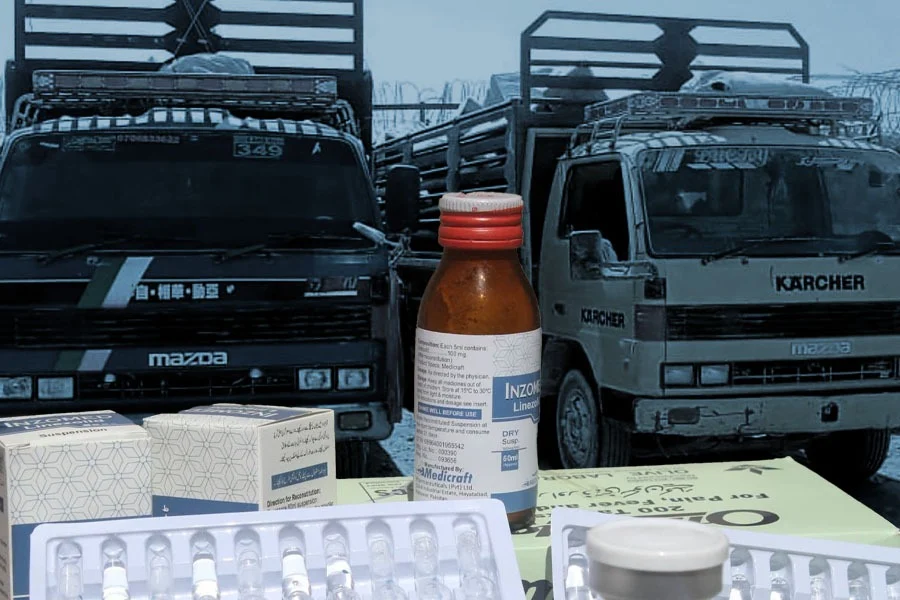
Several residents of the southern provinces say that eight months after the Taliban banned the import of medicine from Pakistan, the country’s markets are still full of Pakistani medicines smuggled into Afghanistan. According to them, the supply of Pakistani medicines in the markets of the southern provinces has increased compared with the past.
Field findings for this report, gathered from a number of pharmacies in Kandahar province, show that Pakistani medicines with recent production dates are still widely available in the markets of the country’s southern provinces, despite the import ban.
A salesperson at a large pharmaceutical company in Kandahar province says Pakistani medicines are still being smuggled into Afghanistan as before, despite the ban. He confirms that every two days he brings dozens of tonnes of medicine into Afghanistan from Pakistan through the Spin Boldak route. He says he pays set sums of money to Pakistani soldiers and the Taliban along the way, and also gives them a share, before delivering the medicines to Afghanistan’s markets.
This medicine seller says dozens of companies similar to his operate in the various border provinces and areas between Pakistan and Afghanistan, smuggling Pakistani medicines into Afghanistan and then supplying them to pharmacy owners.
He says: “Every two days, we bring a large container full of Pakistani medicines into Afghanistan at night through the Spin Boldak route.”
Another member of a medicine transport company, who smuggles Pakistani medicines into Afghanistan’s markets, particularly those in the southern parts of the country, through the Spin Boldak route, says these medicines are still entering the country as before. However, he says it is ordinary people who ultimately suffer from this situation.
This seller says medicines smuggled from Pakistan into Afghanistan lose their quality along the way, and their prices have risen by 60 percent compared with the past.
According to him, when the routes between Afghanistan and Pakistan were open, the cost of transporting a shipment of medicine by truck from Pakistan to Spin Boldak District was between 60,000 and 80,000 Pakistani rupees. But after the official closure of the crossings and the narrowing of smuggling routes, the cost of transporting one container of medicine from Pakistan to Spin Boldak has now reached 800,000 Pakistani rupees. He adds that all of these costs are added to the price of the medicines in the same load.
He adds that because the medicines enter through smuggling routes, they remain under the sun for a long time along the way and lose their quality. Smuggling costs also push up the prices of these medicines.
Rising Prices and Declining Quality of Afghanistan’s Domestic Medicines
A member of a pharmaceutical company in Lashkargah, the capital of Helmand province, says a very large volume of medicines is currently being smuggled into Afghanistan through the Bahramcha route in Helmand and Spin Boldak in Kandahar, to the extent that these medicines are being transferred to the markets of half of the country’s provinces. He adds that the prices of medicines in the markets have risen sharply compared with the past, and people are forced by necessity to buy these medicines at very high prices.
This trader says: “The quality of Afghanistan-made medicines has become much worse, and their prices have risen to the same level as Pakistani medicines. As a result, people are forced to buy Pakistani medicines instead of those produced in Afghanistan, because the quality of Pakistani medicines is better than that of Afghanistan-made ones, while the prices of both have become almost the same. If I may say so, Pakistani medicines are now being smuggled into the country across the borders of Helmand and Kandahar provinces and are reaching half of Afghanistan. All senior officials are also aware of this matter.”
Involvement of Senior Taliban Officials in Medicine Smuggling
Meanwhile, a driver who smuggles medicine shipments into Afghanistan through the Bahramcha route in Helmand province says he has personally smuggled Pakistani medicines into the country by truck several times. Citing his own observations, he says senior Taliban officials are involved in the movement of goods smuggled from Pakistan into Afghanistan. According to him, they collect between 700,000 and 800,000 Pakistani rupees from each cargo truck for the transport of all kinds of goods.
This driver adds that senior Taliban officials in Kabul, to earn more income, try to deploy forces close to them in the border areas and entrust them with the responsibility of controlling the borders. According to him, individuals in the offices of Mohammad Hassan Akhund and Abdul Ghani Baradar play a role in the process of appointing these forces. According to him, ordinary Taliban fighters at the borders usually do not have mobile phones and, on the orders of the commander of the relevant security post, directly receive the money collected from smugglers. He stresses that people who refuse to pay the amounts demanded by the Taliban are detained, and their goods are sent to customs.
Residents of various provinces of Afghanistan have repeatedly complained about the rising prices of Pakistani medicines in the country’s markets.
Two months ago, the Taliban’s Minister of Public Health, speaking at a gathering in Kandahar province, acknowledged that medicines are being smuggled into Afghanistan from Pakistan’s border areas. At that gathering, he said the import of medicine from Pakistan to Afghanistan is strictly prohibited, and no one is permitted to do so. However, he admitted that some individuals are bringing these medicines into the country illegally.
The smuggling of Pakistani goods into Afghanistan is not limited to Helmand and Kandahar provinces, but also continues through the provinces of Zabul, Paktika, Paktia, Khost, and Nangarhar.
You can read the Persian version of this report here:
از ممنوعیت واردات تا شراکت در قاچاق؛ داروهای پاکستانی چگونه به بازارهای افغانستان میرسند؟