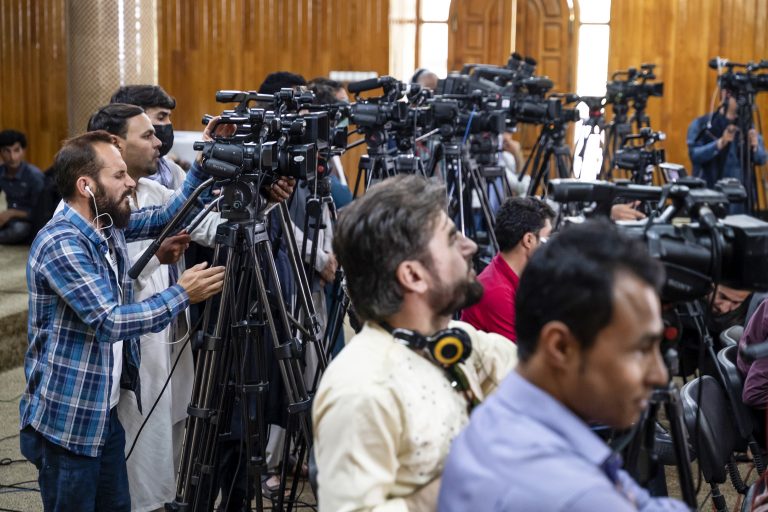
The media landscape under Taliban control appears grim. Since taking over Afghanistan, the Taliban have imposed extensive bans, rendering access to information and news circulation nearly impossible. Media outlets within the country face self-censorship and a lack of freedom in their operations and expression. Various Taliban entities, including their intelligence apparatus, have instilled a restrictive and intimidating atmosphere for journalists and media organizations. Alongside prohibiting music, entertainment, and political programs on television, and enforcing mandatory veiling for female presenters, all media must submit their content for approval before dissemination. Some media experts argue that domestic outlets have transformed into “Taliban propaganda machines” under pressure. Over the past two and a half years, the group has detained, tortured, and interrogated journalists repeatedly. In the latest incident, the group detained three journalists, prompting Nai, the organization supporting open media in Afghanistan, to announce a temporary suspension of its activities.
Domestic and international organizations supporting media and journalists have previously stated that media activities in Afghanistan remained highly precarious in 2023, with survival becoming “difficult” for them. According to statistics released by international bodies, at least 110 instances of violence against journalists were recorded in the past year, with two journalists killed in Afghanistan.
Nai, the organization supporting open media in Afghanistan, has reported that approximately 40 journalists were detained by Taliban insurgents in 2023, with some released from temporary detention centers and others after spending several months in Taliban prisons. The organization, active in various media sectors for nearly two decades, has recently announced the temporary suspension of its activities due to certain challenges.
Mujib Khalwatgar, the head of Nai’s office, stated, “The leadership of Nai, the organization supporting open media in Afghanistan, decided in their latest meeting in January this year to temporarily halt Nai’s activities inside Afghanistan.” According to him, no representative from Nai will engage in activities in Afghanistan thereafter.
Previously, Reporters Without Borders stated in its annual report that Afghanistan remains the most dangerous country for journalists. In its 2023 report, the organization noted that the Taliban suppressed independent media in Afghanistan and detained journalists on charges of espionage. The annual report states: “Espionage charges against journalists are among the tactics used in Afghanistan. Since regaining power in August 2021, the Taliban have been suppressing independent media. They detained twenty-one journalists in 2023.”
The United Nations Educational, Scientific and Cultural Organization (UNESCO) also stated in its 2023 annual assessment that Afghanistan witnessed two cases of the assassination of journalists.
However, Reporters Without Borders, in its latest statement, has warned against the “new wave of arbitrary arrests” of journalists by the Taliban. Following the detention of three journalists, the organization stated: “A new wave of arbitrary arrests by the Taliban intelligence has begun, and within two days, three journalists were detained in Kabul.” The organization urged the Taliban to cease their oppressive and intimidating policies against journalists. According to the organization, the media community in Afghanistan is facing a concerning wave of detentions.
Last week, the Afghanistan Journalists Center (AFJC) announced that Ahmad Jawad Rasouli and Abdul Haq Hamidi, two media officials in Kabul, were detained by Taliban intelligence and transferred to an undisclosed location. Additionally, Ezzatullah Zwab, the managing director of Mina magazine, was detained by the Taliban two days ago on the Kabul-Jalalabad route. Mr. Zwab’s sons confirmed his detention on social media, stating that he was arrested while traveling from Kabul to Jalalabad. Nusrat Arman, one of Mr. Zwab’s sons, stated that the Taliban assured him that his father was detained only for clarification on a matter and would be released soon. However, the Taliban did not explain the basis for interrogating his father.
Meanwhile, following the detention of these journalists, the International Federation of Journalists (IFJ) has also condemned the continued suppression of media by the Taliban. In a statement, the organization labeled the journalists’ detention as a continuation of the suppression of independent media in Afghanistan.
However, Sadiqullah Tawhidi, former Advocacy Director of the Afghan Journalists Safety Committee (AJSC), told the Hasht-e Subh Daily that the Taliban are never ready to accept human rights and freedom of expression. According to Tawhidi, since August 15, 2021, the group has restricted all human freedoms and arrested dozens of journalists. Mr. Tawhidi adds, “It is now said that around thirty journalists are imprisoned. Serious censorship is prevalent. All news is censored by this group. The few girls who are active in the media in Kabul and a few in other cities have separate offices and are forced to wear masks.”
The former Advocacy Director of the Afghan Journalists Safety Committee (AJSC) states that access to information is severely restricted, and the Taliban do not respond to any questions, even denying journalists the right to inquire about security incidents involving the group. According to him, the Taliban have so far issued 14 restrictive decrees and guidelines against the media, highlighting the dire state of media under the Taliban regime.
Mr. Tawhidi emphasizes that 70% of media outlets in the country have ceased operations, leading to the departure of many Afghan journalists, while others have become unemployed and turned to non-professional jobs. Tawhidi adds, “Today, domestic media have turned into the Taliban propaganda machine.”
Over the past two years, media advocacy organizations have repeatedly criticized the oppressive policies and severe pressures of the Taliban against journalists. According to these organizations, before the Taliban’s takeover of Afghanistan, 197 television networks, 284 radio stations, hundreds of print publications, and over 1,800 active websites operated in the country.
Reporters Without Borders has cited the total number of media outlets in Afghanistan before the group’s rule as 547, adding that 2023 was a year of women’s withdrawal from media activities, with Taliban restrictions on women, including female journalists, persisting.
It should be noted that the Taliban have suspended the Access to Information Law, which was enacted and enforced during the previous government, despite earlier assurances that this law would remain in effect.
The relentless pressures by the Taliban against media activities have led Afghanistan to rank 152nd out of 180 countries in the 2023 World Press Freedom Index.
Currently, dozens of journalists have sought refuge in Iran and Pakistan due to Taliban reprisals, facing dire circumstances. These journalists accuse media support organizations of neglecting and endangering journalists and stress the need for their cases to be reviewed and for them to be relocated to a safe location.