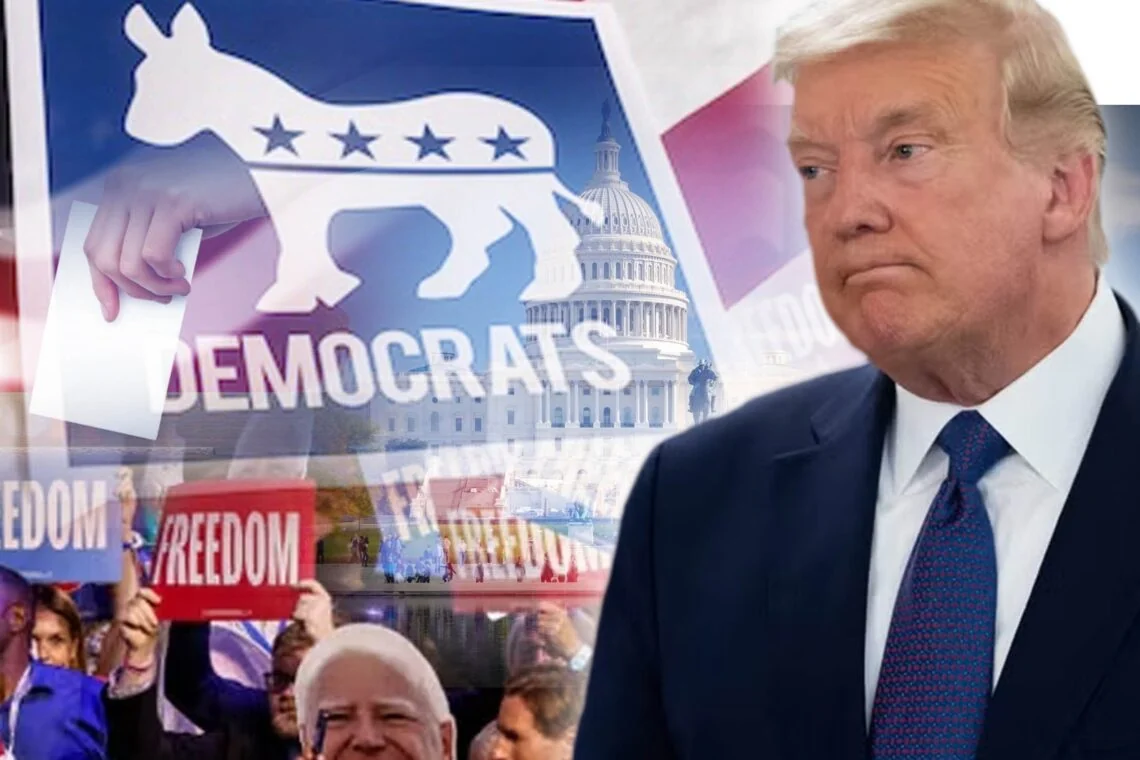
The Middle East has reached a point where not months, but weeks, days, and even hours are now decisive in determining its fate. The same is true for the fate of the United States midterm elections. The eyes of the world are also fixed on these elections and their results. Of course, the Israeli election, which is important in its own right, has already had its outcome made clear: Benjamin Netanyahu, the incumbent prime minister, can no longer form a government on his own, even if he is not removed from the scene altogether. The American election has also become more significant because of this country’s war with the Islamic Republic of Iran. That is to say, if the Republicans lose their majority in Congress, Donald Trump will lose his “freedom of action” in foreign policy, particularly in the war with Iran. This is not a definitive judgment, but one raised on the basis of the prevailing understanding of the war’s effect on the lives of Americans. Assuming Trump’s freedom of action is curtailed, the result would be a return of relative calm to the Middle East and a settling of the global energy market. The focus of this article is solely on this point.
Therefore, the question that arises is this: would a possible Democratic victory limit Trump’s freedom of action in dealing with Iran? In answering this question, several points are worth mentioning:
1) Trump has recognized the impact of the Iran war on the midterm elections, both because supporters of the war are few and its opponents many, and because his personal popularity has dropped somewhat as a result. When Trump decided to attack Iran and carried it out, he perhaps had no prior grasp of its possible consequences; otherwise, he would not have taken such a risk so easily. His avoidance of another attack on Iran these days stems from fear of the consequences of war and its negative effect on the elections. In other words, here the consequences of war and their influence on the elections work as a deterrent.
Now suppose the elections have been held and, contrary to Trump’s expectations, the Democrats have won (regardless of whether they obtain a “decisive” or a “fragile” majority). This does not necessarily mean Trump will back away from entering a new war with the Islamic Republic, because there will no longer be an election to act as a deterrent. Or rather, Trump will no longer have a valuable asset to lose that he needs to worry about. Therefore, he will not back down from a military confrontation with the Islamic Republic, unless a new development emerges, which is a separate matter.
2) Trump is known for “breaking structures,” meaning he is a person who gives little weight to structural, administrative, and legal constraints. It would be better to say that he wants the structure to be subordinate to him, not himself to be subordinate to the structure. He listens little to what others say and tries to be seen more and to have his demands accepted without question, even if they appear personal in the eyes of the other side. For this reason, at one of his campaign rallies, he told his supporters: “Pretend my name is on the ballot too.” This is precisely a reference to personality-centered politics rather than program-centered politics. He is also a rabble-rouser and often says things that the world’s media debate with experts for days, weeks, and months. His words and actions are enough to provoke a fierce uproar in the world, without his giving any thought to the consequences.
Hence, it is difficult for a person with such a character to attach importance to the arguments of Congress, even if it is in the hands of the Democrats. This is especially so because, with a loss in the elections, he will feel humiliated, and to suppress this feeling, he will try to ignite a new turmoil in some corner of the world, for which the start of another war with the Islamic Republic would serve him well.
Trump’s aim in the next war is also not necessarily to topple the Islamic Republic, but to force it to submit to an agreement that the White House can present as better than the Joint Comprehensive Plan of Action (JCPOA). From Trump’s perspective, such an agreement requires inflicting more damage on Iran, that is, starting another war and then returning to the negotiating table.
3) It must not be forgotten that the Islamic Republic of Iran stands opposite America, a system that is not very acceptable to either the Republicans or the Democrats. Of course, the degree of aversion to the Islamic Republic differs somewhat between the two camps, a difference that is not very decisive. If the Democrats do not support war with Iran and its overthrow, they do support imposing sanctions on it. Let us not forget that Iran truly felt the heavy burden of sanctions at a time when Barack Obama was in the White House. The Democrats welcome more pressure on Iran, mainly of an economic nature. It would be better to say that they want “behavior change,” even if they do not want “regime change.” This behavior change is not easily achieved, except by applying pressure, both military and non-military. Just as the Democrats and Republicans are serious and resolute in supporting Israel, they are the same in opposing the Islamic Republic. It is emphasized again that, depending on the situation, especially at the critical juncture of elections, the degree of support and opposition is adjusted.
Even now, the Democrats’ opposition to war with Iran is aimed at weakening the position of the Trump administration and pushing the Republicans off the stage, not necessarily because they are friends of the Islamic Republic. Therefore, if Trump attacks Iran again, he will have justifications, including once again highlighting the issue of Israel’s security, on which Democrats and Republicans are both very sensitive in defending the interests of Tel Aviv. He will also continue to stress that if the Islamic Republic is not contained, it will become the regional bully, and others, especially America’s Arab allies, will not be safe from the harm of its expansionism.
You can read the Persian version of this analysis here:
احتمال پیروزی دموکراتها؛ آیا «آزادی عمل» ترمپ محدود میشود؟