Recent remarks by Sergey Lavrov, Russia’s Foreign Minister, on the need to hand responsibility for managing the Afghanistan file to the countries of the region have once again placed Moscow’s strategic objectives toward the country in the spotlight. Speaking at the Fourth International Conference on Eurasian Security, held in Minsk on November 4, 2026, Lavrov stressed that countries outside the region have failed to resolve Afghanistan’s problems and that neighboring countries must assume greater responsibility for the country’s future. He also described the Moscow Format as one of the most important mechanisms for building regional consensus. On the surface, this position emphasizes strengthening regional cooperation, but at a deeper level it is part of Russia’s effort to limit Western influence, consolidate the position of the Taliban, and expand its own political, security, and economic influence in Central Asia and Afghanistan.
Since the Taliban’s return to power in August 2021, Afghanistan has become one of the most important security and political issues for the countries of the region. Despite the end of the military presence of the United States and the North Atlantic Treaty Organization (NATO), the activities of armed groups, drug trafficking, extremism, and political and economic crises continue to affect regional stability. In such circumstances, Moscow is trying to present itself as one of the main actors in managing the Afghanistan file and, by strengthening multilateral mechanisms, to shift decision-making on the country toward regional frameworks close to itself.
Russia’s first strategic objective is to prevent the return of the military and security presence of the United States and NATO to Afghanistan and its surroundings. From the Kremlin’s perspective, the withdrawal of American forces in 2021 provided an opportunity to rearrange the balance of power in the region, an opportunity Moscow does not want to see undermined by the return of Western military infrastructure to Afghanistan or the establishment of new bases in Central Asia. Earlier, at the eighth Moscow Format meeting on October 5, 2026, Lavrov had also described the deployment of NATO military infrastructure in Afghanistan and neighboring countries, regardless of its title or form, as unacceptable. Therefore, the emphasis on regional management of Afghanistan should be seen as part of Russia’s broader policy of limiting the West’s strategic presence in the Eurasian security sphere.
Moscow’s second objective is to turn the Moscow Format into the main axis for coordinating regional policies toward Afghanistan. This mechanism, which took shape in 2017, has provided a platform for dialogue among Russia, China, Iran, Pakistan, India, and the Central Asian countries. By strengthening this framework, the Kremlin is trying to move beyond the position of an interested actor and gain a more central role in shaping the region’s political and security agenda.
The importance of this approach became increasingly clear with Russia’s decision to recognize the Taliban regime in July 2025, a step that made Moscow the first country to take such an action. This decision signaled a gradual shift in Russian policy from cautious engagement with the Taliban toward establishing more formal relations and efforts to strengthen the regime’s political standing in regional equations. However, the eighth Moscow Format meeting in October 2026 showed that reaching regional consensus is not easy. Differences between the Taliban and Pakistani delegations over the activities of Tehrik-i-Taliban Pakistan (TTP) and over how the issue of terrorism should be reflected in the final statement prevented the issuance of a joint statement. This event showed that shared security concerns do not necessarily lead to political convergence.
For Moscow, while these differences are an obstacle on the path to regional consensus, they also create an opportunity to strengthen Russia’s mediating role. The Kremlin is trying to consolidate its position as the coordinating hub on the Afghanistan file by bringing conflicting views closer together. However, the meeting’s failure to reach a common position showed that turning this role into effective influence over regional decision-making still faces limitations.
Another issue in Russia’s calculations is the security of Central Asia. Afghanistan borders Tajikistan, Uzbekistan, and Turkmenistan, and the spread of insecurity there could have direct consequences for the countries of the region. The activities of Islamic State Khorasan Province (ISKP), the presence of transnational armed groups, drug trafficking, and the possible infiltration of extremist currents are among Moscow’s main concerns. Russia knows that instability in Afghanistan could affect the security of Central Asia and, as a result, the country’s political and military interests. For this reason, the Kremlin is trying, through engagement with the Taliban, to expand intelligence and security cooperation and to persuade the group to confront cross-border threats. However, the dispute between the Taliban and Pakistan over the activities of the TTP raises questions about the Taliban’s ability and will to contain armed groups.
Alongside security considerations, Russia seeks to use Afghanistan’s geographic position to expand its economic and trade relations with South Asia. Afghanistan can serve as a link connecting Central Asia with Pakistan, Iran, and South Asian markets. This capacity has become more important, particularly at a time when Russia’s economic relations with the West face broad restrictions. Expanding exports, participating in energy projects, developing railway lines, and gaining access to new markets are among Moscow’s economic goals in this area. Projects such as the Turkmenistan-Afghanistan-Pakistan-India (TAPI) pipeline, the Central Asia-South Asia Power Project (CASA-1000), and other regional connectivity schemes could also provide new opportunities for economic cooperation if stability is ensured in Afghanistan, although Russia is not the designer or main owner of all these projects.
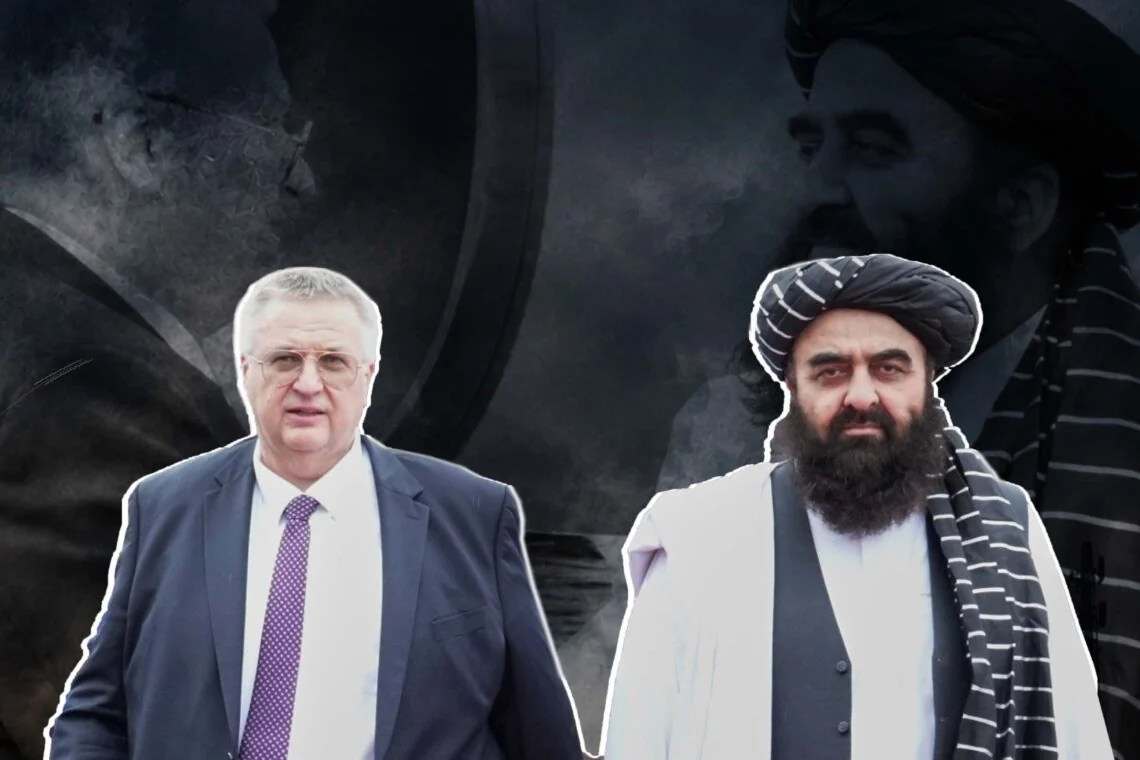
The Russian Deputy Prime Minister’s third visit to Kabul, made on November 12, 2026, with a delegation of more than 70 Russian businesspeople, can also be assessed within the framework of Moscow’s efforts to expand economic relations and make use of Afghanistan’s transit capacities. During the visit, ten trade contracts worth $103 million were signed between the private sectors of the two sides.
Russia’s relationship with China is another important dimension of Moscow’s policy in Afghanistan. The two countries share common views in opposing the return of the military presence of the United States and NATO, but their priorities in Afghanistan are not identical. China focuses more on the security of the Xinjiang borders, access to mineral resources, investment, and the development of trade routes, whereas Russia prioritizes maintaining political and security influence in Central Asia and preventing the presence of rival powers. China has greater economic capacity for investment in Afghanistan, but Russia is trying to preserve its political and security position. Therefore, cooperation between Moscow and Beijing, alongside shared interests, may also be accompanied by competition over the degree of influence.
Another important part of Russia’s policy is political support for the Taliban and the effort to turn the group into Moscow’s regional partner. Russia expects the Taliban to prevent the expansion of ISKP activity, stop the transfer of insecurity to Central Asia, and provide the ground for the development of security and economic cooperation. In return, the Taliban also view relations with Russia as an opportunity to reduce their political isolation and strengthen their standing in foreign relations. However, Moscow’s approach faces a fundamental contradiction. On one hand, Russia wants stability and security in Afghanistan, but on the other hand, political support for the Taliban, without effective emphasis on the formation of an inclusive political structure, could lead to the continuation of internal disputes and the intensification of the legitimacy crisis in the country.
The change in Russia’s approach toward Taliban opponents can also be examined within this framework. In the 1990s, Moscow supported the Northern Alliance and forces opposed to the Taliban, but in recent years it has prioritized engagement with the regime established in Kabul. This change could limit the diplomatic space of anti-Taliban forces in Russia. However, to maintain its bargaining power, the Kremlin may also keep limited contacts with various political and ethnic currents of Afghanistan, although under current conditions its main priority is relations with the Taliban.
For Tajikistan and other Central Asian countries, Lavrov’s remarks are of particular importance, because developments in Afghanistan directly affect their security and the prospects for regional cooperation. Due to its long border with Afghanistan, Tajikistan holds an important position in the region’s political and security equations and can play an effective role in shaping a common approach among neighboring countries. Alongside its emphasis on border security and preventing the spread of extremism, Dushanbe supports Afghanistan’s stability, the development of trade, and the expansion of regional economic and transit links. Moreover, this country’s emphasis on the participation of various ethnic groups and communities in Afghanistan’s political structure reflects attention to the link between lasting stability and political inclusiveness. Greater responsibility for the countries of the region could be an opportunity to strengthen Tajikistan’s role in Afghanistan’s political and security processes, provided that this process is shaped on the basis of genuine and equal participation of neighboring countries and respect for their shared interests. Relying on its geographic position, experience, and regional ties, Tajikistan can, while expanding security and economic cooperation with Russia and other regional partners, play a more constructive role in strengthening Afghanistan’s stability, and at the same time stress the need to form an inclusive political structure with broad domestic support.
Finally, Lavrov’s remarks should not be regarded merely as an invitation to regional cooperation in resolving the Afghanistan crisis. This position is part of Russia’s effort to redefine the Eurasian security order and consolidate its standing as one of the main powers deciding on Afghanistan. Moscow wants to limit Western influence, turn the Taliban into its security and political partner, increase cooperation among regional countries within the framework of the Moscow Format, and use Afghanistan’s geographic position to expand its economic and strategic influence. However, disputes between Pakistan and the Taliban, Tajikistan’s concerns, the independent interests of China and India, and the Taliban’s crisis of political legitimacy make achieving these goals difficult.
You can read the Persian version of this analysis article here:
از خروج امریکا تا بازگشت روسیه؛ مسکو چه نقشهای برای افغانستان دارد؟