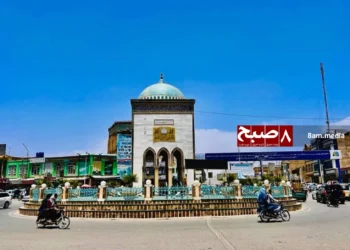
Several residents of Faryab Province, along with experts and former local officials, say that the Taliban’s recent decision to convert the Maimana Municipality Hotel into the administrative office of the group’s governor has sparked public outrage. They stress that this hotel was built with public funds and taxpayers’ money, intended to provide public services, host domestic and foreign guests, and facilitate cultural, sports, and exhibition events.
Engineer Javid Keywan, the former mayor of Maimana, told the Hasht-e Subh Daily: “The Maimana Municipality Directorate project began in 2017 and by 2021, more than 95 percent of it had been completed. This project was constructed through the efforts of the municipality staff, the advisory board, and the direct participation of the people to address the shortage of a modern guesthouse in Faryab Province. This hotel has the capacity to accommodate nearly 300 people and includes large halls, meeting rooms, VIP suites, a restaurant, and a sauna.”
Mr. Keywan added, “People expected this hotel to be offered for public tender and turned into a public-interest project. Every day, guests from the western and northern provinces stop in Maimana for rest, and this hotel could provide the necessary services for them. It was built using people’s taxes and rental revenues, and not a single afghani was taken from the state budget. Therefore, it should not be converted into an office for officials or government departments.”
The former mayor of Maimana stated, “This building was not designed as an administrative complex, and converting it into an office does not align with hospitality standards. The Taliban must reconsider this decision and allow this facility to remain for public use; otherwise, the gap between the people and the Taliban will widen further.”
Meanwhile, several residents of Maimana city in Faryab told the Hasht-e Subh Daily that this decision by the Taliban goes against the will of the people and effectively deprives the public of essential services while turning the facility into a private residence and workplace for officials.
Samiullah Qaisari, a resident of Maimana, said: “This hotel was built with public funds and taxes, and it is the people’s right to benefit from it. Using it for administrative purposes restricts public resources and leads to disappointment.” He added, “I am saddened and discouraged by this Taliban decision. How is it logical that a place intended to provide services and facilities to the people is turned, under the pretext of administrative work, into a resting place for officials? Without a doubt, such actions are not unexpected from the Taliban.”
Omar Naseem, another resident of Faryab, said: “People expect cultural programs, sports events, and exhibitions to be held in this hotel, not for it to become an office for officials. Taliban authorities can use existing government buildings for administrative affairs and preserve this hotel for public use.”
Taj-al-Nesa Aziz, a resident of Maimana’s First District, emphasized: “This hotel was built to host domestic and international guests and to hold cultural and social programs, not to be turned into administrative offices. The people of Faryab have the right to benefit from this facility and should not lose it due to misguided decisions.”
Urban development experts and local sources warn that this change in purpose not only restricts public access to a communal project and public asset but also eliminates opportunities for generating reliable local revenue.
Sayed Emaduddin Sharifi (pseudonym), the head of a construction company in Faryab, stated: “The Maimana Municipality Hotel was designed with modern hospitality standards, and its service capacity is especially crucial because the Herat-Balkh highway hosts a large number of travelers and guests from western and northern provinces every day. From a design and engineering perspective, it is entirely incompatible with administrative functions.”
Sharif Ayoubi (pseudonym), a businessman from Faryab, said: “Turning the Maimana Municipality Hotel into an administrative office not only disregards the rights of citizens but also causes significant economic losses.”
Ayoubi added, “This hotel, with a capacity of nearly 300 guests, could have generated sustainable revenue for the municipality and public-interest projects through hall rentals and catering services. Allocating it to administrative work eliminates temporary employment opportunities for staff and destroys revenue sources obtained from taxes and rentals. Additionally, cultural programs, exhibitions, and hospitality for domestic and foreign guests—which could have strengthened the local economy—will be lost due to this misguided Taliban decision.”
Reports indicate that the decision to use the hotel was made based on a proposal by the Taliban governor and approved by the group’s Office of the Prime Minister. However, the public and urban experts are calling for an immediate reversal and for this facility to be preserved as public property. They stress that preserving the hotel for its original purposes will safeguard the rights of the people.
You can read the Persian version of this report here:
از مهمانداری تا دفتر اداری؛ طالبان فرصتهای اقتصادی و فرهنگی میمنه را نابود میکنند