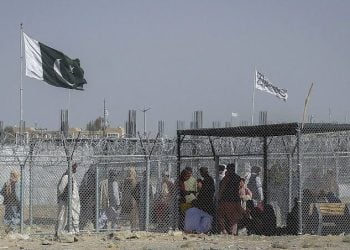

Sometimes what follows an event matters more than the event itself. Pakistan’s airstrike on the territory of Afghanistan, regardless of its scale and scope, once again revealed how low and insignificant the standing of the Taliban regime is in the eyes of the world. Following the strike, dozens of civilians were killed and wounded, Pakistan explicitly acknowledged responsibility for the attack, and the United Nations confirmed civilian casualties as well, yet so far no voice from the international community has been heard condemning the attack. Only India has condemned it, a condemnation understandable within the framework of its rivalry with Pakistan rather than any genuine concern for the interests of the people of Afghanistan.
The international community’s silence in the face of Pakistan’s attacks is not coincidental but stems from a clear reality: the steadily rising political weight of Pakistan and the steadily declining political weight of the Taliban on the international stage. Pakistan’s involvement in the dispute between the Islamic Republic of Iran and the United States, and its mediation between these two regional and global actors, has added to Islamabad’s political standing both regionally and globally. This may well have emboldened Islamabad to strike the territory of Afghanistan, a point that becomes more apparent when one considers the repeated praise from senior American officials for their senior Pakistani counterparts.
States, by the very nature of the international environment, tend to maintain ties with powerful actors and avoid sacrificing those relationships out of sympathy for isolated ones. In other words, most countries, when faced with two sides in a dispute, do not typically choose the side that appears to be in the right but rather the side that is more costly to ignore. Pakistan still holds such a position, but the Taliban do not. Therefore, the silence of most countries reflects less an indifference to the situation in Afghanistan than it does the differing standing of Pakistan and the Taliban within the hierarchy of power, both regionally and globally.
By contrast, despite their exaggerated claims of expanding ties with the world, the Taliban not only fail to enjoy a standing comparable to Pakistan’s but in fact occupy a far lower one. The Taliban have forgotten that maintaining limited diplomatic relations with a few countries is not equivalent to holding political weight in the international arena. The gap between the two becomes evident at critical moments: Pakistan pays no diplomatic price for officially acknowledging responsibility for the attack, while Afghanistan under Taliban rule is denied even a handful of statements of support.
The presence of the Tehrik-i-Taliban Pakistan (TTP) on the territory of Afghanistan also plays a role in the world’s silence. By now, most countries are not merely suspicious but certain of the TTP’s presence and activity on Afghan soil. Whether they take a public stance on the matter is a separate question. Accordingly, while the killing of civilians and the violation of Afghanistan’s sovereignty cannot be justified, the majority of countries likewise do not overlook another fact: the presence of the TTP in Afghanistan and the unresolved nature of this challenge between the Taliban and Islamabad. As a result, many governments may view Pakistan’s attacks as understandable, at least from a security standpoint, even if they disagree with the manner in which they were carried out. More importantly, some countries may, through their silence, be seeking to signal to the Taliban that a regime that harbors terrorists, or is unable to rein them in, cannot expect broad international support in times of crisis either. If this is the case, the world’s silence is not a sign of indifference but a form of pressure on the Taliban.
Setting aside the international community’s silence, the Taliban’s position on the matter is indefensible on two counts. First, the presence of the TTP in Afghanistan and its use of Afghan territory against Pakistan is undeniable. Whether Pakistan’s recent strike actually hit TTP hideouts, and whether civilians were among the casualties, is a separate matter. But these details do not change the core issue: the presence of the TTP in Afghanistan. Until this problem is resolved, Pakistan will always have a pretext to justify its military strikes. Second, although the Taliban govern a country, they have yet to build any deterrent capacity against Pakistan. Armed border raids, limited clashes, the temporary seizure of one or more security posts, and the killing of a few border soldiers, however significant they may be for propaganda purposes, do not amount to deterrence against Pakistan. For this reason, Afghanistan under Taliban rule remains a low-cost target for Islamabad to apply military pressure. A regime accused on one hand of harboring terrorists and unable on the other to defend its territorial sovereignty against foreign attacks finds itself isolated not only on the battlefield but in the diplomatic arena as well. Under such circumstances, escalating tension with neighboring countries, without possessing the means necessary for deterrence, imposes a high cost on the country rather than offering any way forward.
Within this same framework, the Taliban’s helplessness is evident in their response: the claim that Pakistan’s attack will be answered at “the appropriate time.” The repeated use of this phrase by Taliban spokesmen points to the group’s weakness in launching a retaliatory strike. Had a decisive blow against Pakistan actually been possible, a swift military response would have served an important function in persuading public opinion and demonstrating the regime’s authority. But when the response is postponed to an unspecified time for the umpteenth time, it can be said that the gap between the rhetoric and bluster of Taliban officials and the group’s actual operational capacities, in both the military and diplomatic arenas, remains as wide as ever.
You can read the Persian version of this analysis here: