Abstract
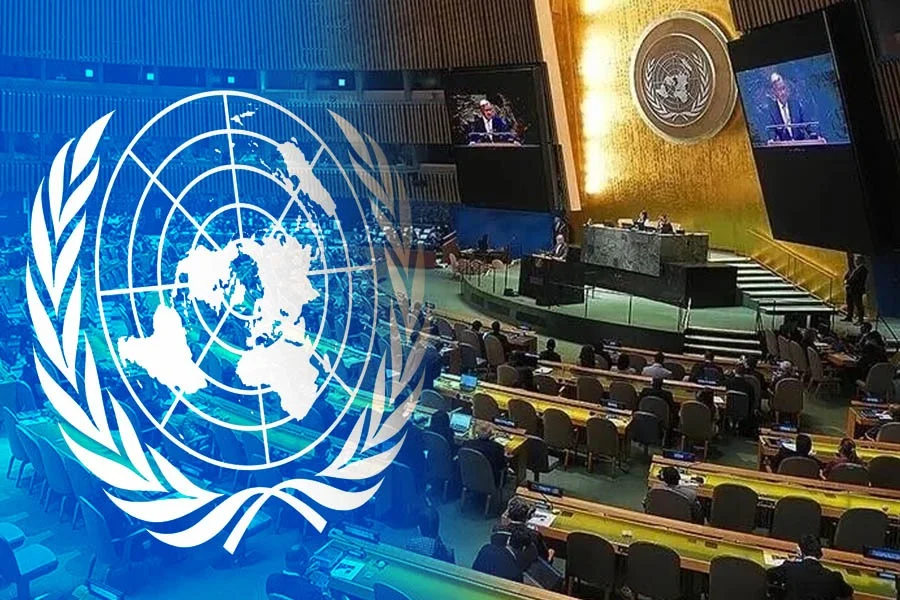
The 81st Session of the United Nations (UN) General Assembly (UNGA) is being held this month (September 2026) at a time when the international community faces a series of simultaneous crises. Wars and armed conflicts, widespread displacement, poverty and economic inequality, climate change, food insecurity, arms races, and declining trust in international institutions have thrown international relations into disorder. Despite the transnational nature of these challenges, a considerable part of the political discourse of states remains shaped by geopolitical rivalry, security considerations, the defense of national interests, and mutual accusations. Taking an analytical approach and drawing on official documents and reports of the UN, the United Nations High Commissioner for Refugees (UNHCR), the World Meteorological Organization (WMO), and the Stockholm International Peace Research Institute (SIPRI), this article argues that the main problem of today’s international system is not merely the growing number of crises, but the widening gap between the global nature of the problems and the largely national nature of states’ responses. If this gap persists, it could weaken the international order, make the enforcement of international law more selective, and allow power politics to dominate institutional cooperation even further. The article concludes that without rebuilding trust, strengthening the rule of international law, and creating a balance between national interests and the shared interests of humanity, the capacity of the UN to manage global crises will remain limited.
Keywords: United Nations, General Assembly, international law, multilateralism, power politics, peace and security, climate change, international order.
Introduction
The 81st Session of the UNGA is being held at a time when the world is going through one of the most complex periods of political, security, economic, and environmental change in recent decades. Prolonged wars, intensifying rivalry among major powers, rising military spending, the displacement of millions of people, climate change, and economic inequality are among the most significant challenges that have broken through national borders, and practically no country can consider itself immune from their consequences.
Because nearly all the world’s states are members, the UNGA is regarded as one of the most important political forums for raising these problems and searching for collective solutions. Yet the fundamental question is whether the political discussions of states this year are truly proportionate to the magnitude of the problems humanity faces.
At the start of the new session, the President of the 81st Session of the UNGA stressed the “rebuilding of trust” and the need to turn the UN into a more effective institution, noting that trust is not merely requested from states but must be earned through decisions, practical commitments, and visible results.
In his speech on September 22, 2026, the UN Secretary-General also warned that global divisions are widening and that war, inequality, the climate crisis, and technological developments cannot be treated as crises separate from one another, because all of them are linked to the question of how power is distributed and exercised globally. From this perspective, the 81st Session of the UNGA can be seen not only as an annual gathering of states, but as a mirror of the current state of the international order.
A Crisis of Priorities: Human Needs Versus Geopolitical Rivalries
One of the main contradictions of global politics today is the gap between people’s basic needs and the security priorities of states. For a large part of the world’s population, security, before being a matter of the balance of power, means access to food, housing, work, health care, education, a healthy environment, and a life free of violence.
Nevertheless, the foreign policy of states continues to be shaped mainly around concepts such as power, deterrence, regional influence, national security, and strategic competition. This does not mean that national security is unimportant; no international system can be sustainable without secure and stable states. The problem arises when the definition of security becomes almost entirely military, and the other dimensions of human security are pushed to the margins.
Global military spending figures reinforce this concern. According to a report by SIPRI, global military expenditure reached about 2.887 trillion dollars in 2025. This was the eleventh consecutive year of increase in global military spending, and global military expenditure rose by about 41 percent over the decade from 2016 to 2025.
The rise in military spending does not in itself prove that states have neglected human development, because countries face different security circumstances. But the continuation of this trend shows that states still devote a considerable part of their resources and political attention to hard security and military readiness.
This issue becomes more prominent when the human costs of wars are taken into account. According to UNHCR statistics, at the end of 2025 about 117.8 million people around the world had been forced to leave their homes because of war, violence, persecution, and human rights violations. This figure shows that international security cannot be measured solely through the calculations of states, because the final consequence of the failure of the global security system is felt in the lives of ordinary people.
The Return of Power Politics
Developments in recent years show that power politics has once again taken a prominent place in international relations. States, especially the major powers, try to preserve or expand their security and interests through a combination of military capability, economic strength, technology, coalition building, and political influence.
From the perspective of realist theory in international relations, this situation is not particularly unexpected. Realists hold that the international system lacks a powerful central government and that states are ultimately responsible for ensuring their own security. In such conditions, uncertainty about the intentions of others can push states to strengthen their own power.
The problem, however, is that an increase in one state’s security may be perceived by another state as an increase in threat. This situation, known in the literature of international relations as the “security dilemma,” can intensify arms races and mistrust even when no side wants direct war.
The political atmosphere of the UNGA is also, to some extent, a reflection of this reality. Leaders of countries use the UN podium not only to raise shared problems, but also to defend their own policies, criticize their political and military rivals, and explain their understanding of current crises. Such behavior is a natural part of international diplomacy; however, when the defense of national positions prevails over the search for common ground, the capacity of the UNGA to produce consensus declines.
International Law Between the Power of Law and the Law of Power
One of the most serious consequences of intensifying geopolitical rivalries is the growing pressure on international law. The Charter of the UN rests on principles such as the prohibition of the use of force, the peaceful settlement of disputes, the sovereign equality of states, and international cooperation. The core philosophy of this system is that the conduct of states should not be determined solely by their material capabilities; rather, legal rules should impose limits on all states.
In his speech at the 81st Session of the UNGA, the UN Secretary-General described peace as more than the absence of war and regarded it as requiring the restraint of power through law. This view raises one of the most fundamental questions of the contemporary international order: will the “power of law” govern international relations, or the “law of power”?
The problem of international law is not necessarily a shortage of rules. Article 38 of the Statute of the International Court of Justice (ICJ) refers to international conventions, international custom, the general principles of international law, judicial decisions, and international doctrine as the sources used to settle international cases, and countless binding resolutions also exist. The fundamental challenge relates more to the enforcement of these rules.
When states regard international law as binding on the conduct of a rival, but offer a different interpretation when assessing their own conduct or that of their allies, the perception of “selective enforcement” of international law is strengthened. The consequence of such a situation is not only damage to one particular rule; trust in the entire international legal system can decline.
This issue is more important for small and medium-sized countries. Major powers have more military, economic, and diplomatic tools to protect their interests, whereas weaker states depend more than anyone on rules such as sovereign equality, territorial integrity, the prohibition of the use of force, and the peaceful settlement of disputes. Therefore, the weakening of the rule of international law does not necessarily have the same consequences for all countries.
The Crisis of Multilateralism and the Structural Limits of the UN
Criticism of the performance of the UN should not be accompanied by the assumption that the organization is a world government that can stop wars on its own. The structure of the UN is based on cooperation among its member states, and many of its main powers, especially in the field of peace and security, depend on the decisions of the United Nations Security Council (UNSC).
In his opening speech to the UNGA a few days ago, the UNGA President explicitly pointed to the problem of the UNSC’s inability to act in some major crises, and stressed that whenever the UNSC fails to act, the credibility and effectiveness of the entire organization are called into question.
Hence, what is sometimes called the “weakness of the UN” is, in many cases, a reflection of disagreement among member states, especially the major powers. An organization created based on the consent and cooperation of states cannot easily act independently of the political will of those same states.
Nevertheless, multilateralism continues to retain its importance. Problems such as climate change, pandemic diseases, migration, food security, artificial intelligence, and the proliferation of weapons are transnational in nature. No power, however strong militarily or economically, is able to manage these issues alone.
As a result, the great paradox of the present era is that, precisely when the world needs international cooperation more than ever, trust among states has declined.
Will the Coming Years Be More Unstable?
Scientifically, it cannot be claimed with certainty that next year will necessarily be worse than the current year. International relations are influenced by numerous variables, and unexpected developments can change the course of crises. Political agreements, ceasefires, changes of government, economic pressure, international mediation, and even technological developments may moderate current trends.
Nevertheless, some indicators provide grounds for concern. The continuation of the war between Russia and Ukraine, the war of the United States and Israel and Iran, the challenge of oil tanker passage through the Strait of Hormuz and the Bab el-Mandeb Strait, rising military spending, continued widespread displacement, intensifying climate pressures, rivalry among major powers, and the difficulty of reaching international consensus in some cases show that the structural factors of instability remain in place.
If these trends continue, it can be expected that international politics will become more securitized and that states will devote more resources and attention to strategic rivalries. Such conditions may make cooperation on development, climate change, human rights, and poverty reduction more difficult and increase international instability further.
The deeper concern is not merely the increase in the number of conflicts, but the normalization of the use of force as an instrument of foreign policy. The more ordinary the use of force or the threat of it becomes, the more the existing normative and legal restraints against it will come under pressure.
Conclusion
The 81st Session of the UNGA can be regarded as a condensed picture of the contradictions of the contemporary international order. On one hand, states are more dependent on one another than ever; climate change, trade, migration, technology, diseases, and global security have moved beyond national borders and require the joint struggle of states. On the other hand, global politics still rests largely on power rivalry, national interests, and mutual mistrust.
The fundamental problem of today’s world is not a lack of awareness of the problems. Nearly all states speak about the importance of peace, development, the environment, and human rights. The real issue is the distance between the announcement of commitments and the practical conduct of states.
Reviving the effectiveness of the UN will also not be possible solely through administrative reform of the organization. As long as states, especially the major powers, do not apply international law equally, rather than selectively, to themselves and to others, trust in the multilateral order will not be easily rebuilt.
The important message is that the world faces a significant conceptual choice: the rivalry of states can be managed within a framework of rules, dialogue, and shared responsibility, but with a return to the logic of confrontation and force, all the achievements of humanity will be multiplied by zero. It may secure some national interests in the short term, but in a deeply interconnected world, its costs will eventually cross national borders and become uncontrollable.
Lasting peace is possible when the security of one nation does not necessarily mean the insecurity of another; when the development of one country does not lead to the destruction of the shared environment; and when political and military power cannot exempt states from their legal and moral responsibilities.
If the UN is to preserve its raison d’être, it must remain a space in which law takes precedence over force, dialogue over threats, cooperation over domination, and the shared interests of humanity over short-term political calculations. Achieving this goal is not easy, but the alternative would be a world in which the cost of the disputes among the powers is paid most by the people who have the least role in creating those disputes.
Finally, it is hoped that political rationality, international responsibility, and respect for human life will prevail over the logic of destruction and confrontation, and that whatever is for the good, peace, security, and prosperity of humanity will be realized by the will of God Almighty.
You can read the Persian version of this analysis article here:
مجمع عمومی سازمان ملل و بحران نظم بینالمللی: غلبه سیاست قدرت بر نیازهای مشترک بشری