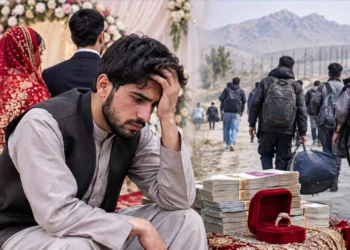
Several women and girls report that, with the Taliban’s restrictions and the elimination of institutions supporting women from the government structure, domestic violence against them has surged to unprecedented levels. Violence against women within the families of Taliban fighters has also been repeatedly documented. This report focuses on the living conditions of a woman who was married to a Taliban member for 400,000 Afghanis and subsequently subjected to severe physical abuse, to the point of losing consciousness. This woman, now compelled to live with a Taliban fighter, recounts a bitter and painful narrative, stating that she is treated like a sexual slave.
Mina, a woman married to a Taliban fighter for 400,000 Afghanis, was previously a teacher. According to Mina, her dreams and passion for teaching have been extinguished, and she now spends hours staring at the wall, unable to recall the last time she stood upright. She adds that she sometimes becomes so lost in her thoughts that she fails to hear her child’s cries. She says her mind is under such intense pressure that her brain struggles to process it.
Once a healthy, educated, and hopeful woman, she now stands on the brink of psychological collapse. Her eyes shed tears involuntarily, and her mind is overwhelmed with fear, anger, and a heavy silence.
Mina was born in a small village in Maidan Wardak province, where she tasted the bitterness of loneliness from her earliest moments. A tall woman with black hair, wheat-colored skin, and large eyes, her appearance carries a quiet beauty. Her name is tied to affection, yet her fate is filled with suffering and vulnerability.
She lost her father before she was born, a victim of ethnic conflicts. Her mother, her only refuge and hope, passed away shortly after Mina’s birth. Fate entrusted Mina to her uncle and his wife, who viewed her not as a human being but as a means to gain money. Without her consent, they married her off to a member of the Taliban, receiving 400,000 Afghanis as a bride price.
Mina says that from that day, her life became one of servitude in her husband’s home, where she experienced neither love nor respect. She repeatedly heard the phrase, “We bought you for 400,000; you didn’t come cheap.”
Living under the weight of domestic abuse, Mina says she was not even allowed to eat with others. She had to wait until everyone else was full, hoping something might be left for her. Without permission, she couldn’t take a bite of bread or a piece of fresh fruit. Whenever she spoke, she was silenced with insults and violence.
Mina recounts, “When they brought fruit, I was only allowed to eat after everyone else was satisfied and something remained. Even if there was plenty of fruit, I had to wait until it was infested with flies or worms and no one else wanted it—only then was it my turn.”
Three years have passed since Mina’s forced marriage. She now has a two-year-old child and is in her eighth month of pregnancy. A few days ago, when her child was hungry, she gave them a small piece of bread. This simple act provoked her mother-in-law’s anger, who demanded that her son, recently returned from duty, “teach his wife her place” and make her understand never to act without permission. Mina confirms that her husband beat her so severely that she lost consciousness. The fetus in her womb remained motionless for hours.
An educated woman who once studied religious sciences and taught girls in her village, Mina’s knowledge and awareness were seen as a threat by her husband’s family. The family, not only illiterate but deeply rooted in superstitious beliefs and humiliating traditions, viewed her education with suspicion.
Mina emphasizes that she has studied Islamic principles and always tries to respond to unjust behavior with calm and reason. However, her illiterate husband often feels inferior and belittled by her words. She says that, to assert his masculine dominance, he opposes even her simplest remarks and sometimes beats her relentlessly without any justifiable reason, solely to prove his control.
Discrimination, poverty, humiliation, violence, and loneliness have woven the fabric of this woman’s life. Doctors now say that, due to repeated physical injuries to her lower back, she can no longer control her bladder. Yet, her true pain lies not only in her body but in her wounded spirit, which has remained unhealed for years—a wound inflicted by the cruelty of her fate. Still, Mina fights with all her strength for her two-year-old daughter and the unborn child in her womb, grappling with life’s hardships and injustices, her voice unheard by anyone.
You can read the Persian version of this report here:
بردهای در لباس همسر؛ روایت تلخ مینه از ازدواج اجباری و خشونت طالبان