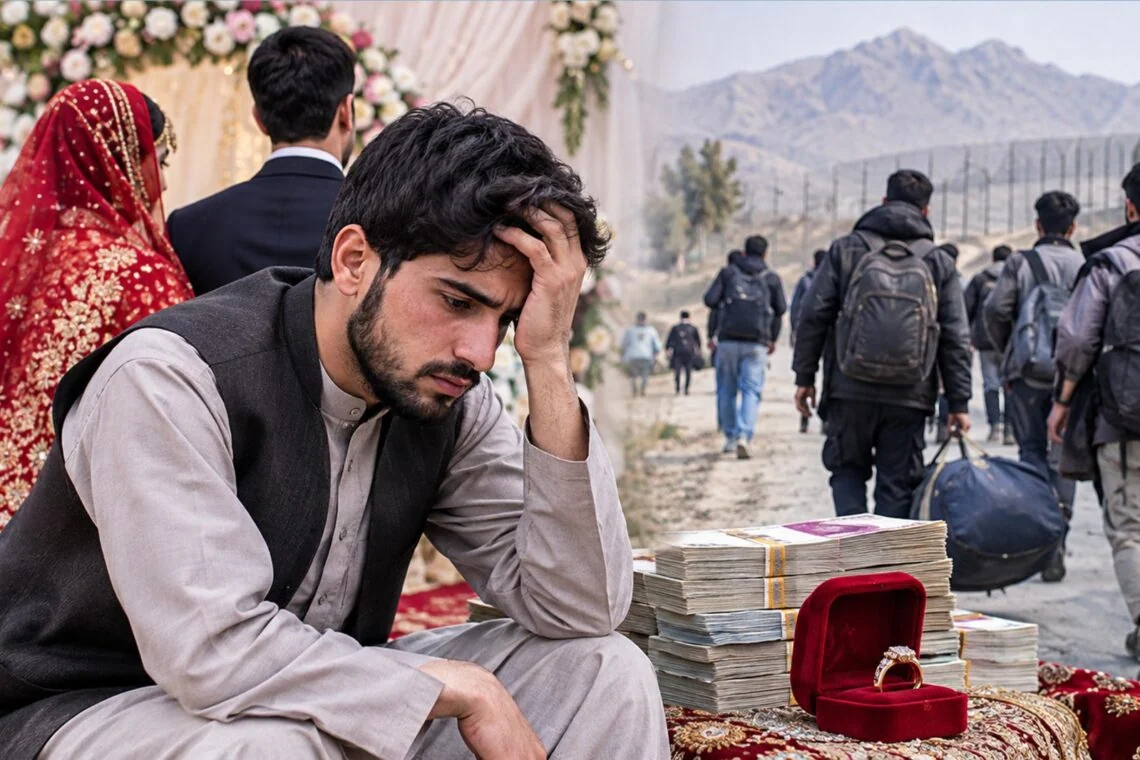
Many young people say the high costs of marriage and expensive customs have forced them to migrate to cover living expenses and the cost of getting married. According to them, when a young man cannot afford the costs of marriage through ordinary work and income in the country, he is left with no choice but to consider migration as a way to reach this goal. They say that although they dream of marrying and starting a life together, the high cost of weddings and family expectations have made this dream difficult and, at times, unattainable. Some migration experts warn that the migration of young people due to economic problems and the high costs of marriage carries numerous social and family consequences.
Nazir, a 30-year-old man who has been engaged for two years, says he has so far attempted to migrate three times to cover wedding expenses and pay the bride price. Despite the difficulties, he still intends to go to Iran to raise the costs of marriage.
He says: “I do not have the financial means to hold a wedding. Even though I am 30 years old, I have not yet been able to get married. I owe 400,000 afghanis in bride price, and paying this amount is difficult for me. There are no suitable job opportunities in our country, and even if a job is found, its salary barely covers daily living expenses, let alone paying for a wedding or building a house. The Taliban must take action to reduce wedding costs and prevent unacceptable and unnecessary customs so that young people can begin their life together without bearing such economic pressure.”
Qais, a young man who has attempted to migrate twice to cover his wedding costs, says he dreams of getting married and starting his life with his partner, but the high costs of a wedding are beyond his financial means.
He says that when a young person cannot cover the costs of marriage through ordinary work and income in his own country, he is forced to think about migration.
Qais adds: “I want to migrate only to find the money for the wedding. I have tried twice so far, but both times I was turned back at the border and returned. Even so, I have not given up on my decision, and I intend to take this dangerous route again. I know this route has many dangers, and I may even lose my life, but because I want to achieve my dream and begin my life together with my partner, I still think about migration.”
Jamshid, a Kabul resident who recently got married, says that holding a wedding ceremony with high costs leaves many young people facing debt and economic problems after marriage, a problem that can challenge their life together from the very start.
He says: “In my opinion, the groom should hold the wedding according to his financial means and avoid extravagance and unnecessary spending. Unfortunately, many young people put themselves under the burden of debt to hold a single wedding night, and afterward they spend long periods struggling to repay their debts. What is the benefit of inviting a few neighbors and friends for one night and feeding them, only to end up in debt to the wedding hall, the shopkeeper, and others? Everyone should hold a wedding according to their financial ability and begin their life together without debt and economic pressure.”
Meanwhile, Asifa Stanikzai, a migrants’ rights activist, referring to the consequences of young people’s migration due to economic problems and the need to cover marriage costs, says this trend can cause serious damage to the country’s economic and social structure. According to her, the migration of young people leads to the separation of families, an increase in emotional and social problems, greater dependence of families on money sent by migrants, and a decline in young people’s hope of building a future inside the country.
Ms. Stanikzai says: “In fact, when young people, instead of using their energy, talent, and abilities for the development of the country, are forced to look for jobs and economic opportunities in other countries, society loses an important part of its human capital.” In her view, promoting a culture of simplified wedding ceremonies, putting an end to financial competition between families, expanding job opportunities, and creating conditions for the economic independence of young people are among the fundamental measures in this area.
This expert says: “Raising families’ awareness about the consequences of heavy dowries and expensive customs, supporting small businesses, and providing economic facilities for young people are necessary. Education and a change in society’s attitude toward marriage are also very important, and the culture should be strengthened so that the criteria for forming a family are understanding, responsibility, and the ability to build a life together, not the amount of money, wealth, and financial capacity of families.”
Seyar Quraishi, an economic affairs analyst, warns that the continued migration of skilled and specialized labor from the country could, in the long term, leave companies and production sectors facing a shortage of specialized personnel. According to him, this shortage could slow the growth of production and the country’s economic development.
Mr. Quraishi adds: “In my opinion, the lack of sufficient job opportunities and the high costs of marriage are among the factors that force some young people to migrate to cover wedding expenses. Although the money that migrants send to their families can meet part of their economic needs, if skilled and specialized labor remains abroad for a long time, companies and economic sectors inside the country will face greater difficulty attracting specialized workers. This situation could reduce production capacity and slow the country’s economic growth.”
Earlier this month, sources said that the fingers and toes of several Afghanistan migrants had been broken as a result of mistreatment by Turkish police in the Maku border area.
The sources told the Hasht-e Subh Daily that Turkish police had tortured several migrants after detaining them while they were crossing the Iran-Turkey border.
Several Afghanistan migrants also complained some time ago about fraud and extortion by human smugglers on the route from Iran to Turkey. They said that smugglers, with various promises, persuade young people from Afghanistan to migrate through the Iran-to-Turkey route and charge between four and five thousand dollars for transporting each person. But according to these migrants, smugglers abandon some of them in the deserts of Iran instead of delivering them to their destination, and pretend that they have reached Turkish territory.
You can read the Persian version of this report here:
طویانههای سنگین و عروسیهای پرهزینه؛ جوانان برای رسیدن به آرزوی ازدواج مهاجر میشوند