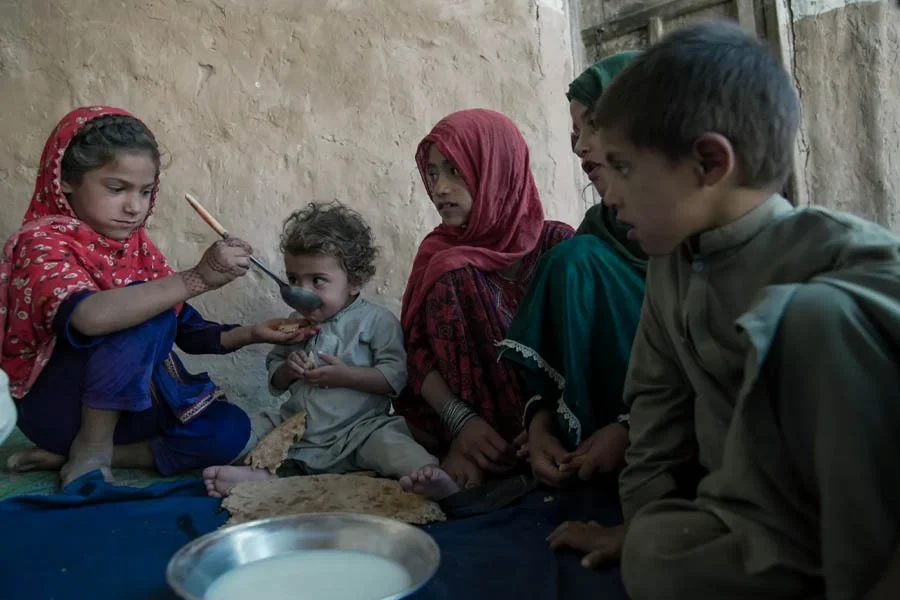
Amid a warning from the United Nations Children’s Fund (UNICEF) about rising malnutrition in the country, a family with two children suffering from malnutrition says that, with rising unemployment, it is unable to provide for its children’s basic needs. According to this family, the children going to bed hungry and the family’s inability to meet their basic needs have placed heavy psychological pressure on its members. The family says its children go to sleep hungry on most nights. Meanwhile, a number of economic experts say that declining income and rising costs of living and medical treatment have forced families to reduce the number of meals they eat. According to them, this shift in dietary patterns threatens children’s health more than that of other family members.
Zulgai (pseudonym), a father of six children who works as a street vendor in the Deh Afghanan area of Kabul, says that with a daily income of about 200 Afghanis, he cannot afford his family’s expenses. He says his children are young, and due to his meager income, his family is often unable to secure even enough food on many days.
This man says: “I work as a street vendor in Deh Afghanan. I have six children, and they are all young. I pay five thousand Afghanis in monthly rent. There is no work, and even if I try very hard, I only earn 200 Afghanis a day.”
Zulgai adds that this income is not enough to meet his family’s needs. He says: “With 200 Afghanis a day, how can I afford dry bread, cooking expenses, children’s clothing, powdered milk for the infant, and rent? I am forced to buy stale, leftover bread at a lower price just so we have something to cook.”
This father of six adds: “Most of the time, my children’s stomachs are not full, because nothing is left on the table. On top of that, I am in debt, and no one is even willing to lend me money anymore.”
Sahar (pseudonym), the mother in this family, says that being unable to provide for her children’s basic needs and properly care for them is painful for her. She says her children want whatever they see in the hands of other children, but the family cannot afford to buy it, and this situation is difficult for her.
She says that due to poverty, her children do not get sufficient and proper nutrition, and so far two children in this family have developed malnutrition. According to Sahar, she received food assistance for two months, but was unable to receive further assistance after that.
Sahar says: “My children do not have proper nutrition; they don’t even get enough food. So far, two of my children have become malnourished. I received assistance for two months, but I could not get any more help after that. I wanted to go clean houses somewhere, but there is no one to look after my children.”
This mother adds that her children going to bed hungry and her inability to provide for their basic needs have placed heavy psychological pressure on her. She says: “It is very painful that my children ask for food and I cannot give it to them. They go to sleep hungry at night. I cannot even buy them proper clothing. Sometimes the neighbors bring us bread or something else. We went to the district representative for help several times. They took down our names and identity cards, but no assistance has reached us so far.”
Meanwhile, Shekab (pseudonym), an economic affairs expert, says that children under two years of age, infants, and pregnant or breastfeeding women are the first victims of food shortages within families. According to him, vulnerable families include female-headed households, returning migrants, day laborers and the unemployed, families affected by drought and the loss of crops and livestock, and families facing heavy medical treatment costs.
This economic affairs expert says: “Declining income and rising treatment costs have led families to reduce the number of meals and turn to dry bread, tea, and cheap or even expired food. This shift in dietary patterns has threatened children’s health and, by creating hidden hunger resulting from a lack of vitamins and protein, has laid the groundwork for acute malnutrition, physical growth disorders, and a weakened immune system.”
This comes as the United Nations Children’s Fund (UNICEF) announced earlier this month that 3.7 million children in Afghanistan suffer from malnutrition, of whom about one million are suffering from severe and life-threatening malnutrition.
The organization had reported that this crisis has disproportionately affected young and vulnerable children.
UNICEF said that nearly 40 percent of children hospitalized due to severe malnutrition and health complications are infants under six months old. The organization added that since the beginning of the current year, more than half a million children have been hospitalized due to high-risk moderate malnutrition and severe malnutrition. According to the organization, cases of severe malnutrition accompanied by health complications have also increased by one-third compared to the same period last year.
This figure has risen from six thousand cases in July 2025 to eight thousand cases by July 2026.
You can read the Persian version of this report here:
سفره خالی و کودکان گرسنه؛ روایت مردی که دو کودکش از سوءتغذیه رنج میبرند