Over the past two days, New Delhi, the capital of India, and Islamabad, the capital of Pakistan, have witnessed suicide attacks that left dozens dead and injured. In New Delhi, at least eight people were killed and 20 others wounded, while a blast in Islamabad claimed the lives of at least 12 people and wounded 27 others. However, several former diplomats with experience in India and Pakistan have warned that the recent explosions in New Delhi and Islamabad mark the beginning of a new phase of tensions between the two countries, a conflict that could also engulf Afghanistan. According to these diplomats, Afghanistan has once again become the main battlefield for India and Pakistan’s proxy war, a situation that could have devastating consequences for the people and the security of the region.
On Tuesday, a suicide attack outside the gates of the district court in Islamabad left at least 12 people dead and 27 others wounded. Pakistan’s Ministry of Interior stated that the attacker detonated his explosives near a police vehicle. Witnesses described the scene as chaotic, and reports indicate the explosion was heard several kilometers away. Most of the victims were reportedly passersby or individuals attending court hearings.
A splinter faction of Tehrik-i-Taliban Pakistan (TTP), known as Jamaat-ul-Ahrar, has claimed responsibility for the attack. Mohsin Naqvi, Pakistan’s Interior Minister, said the assailant intended to enter the court compound but failed and instead targeted the police vehicle. Naqvi also claimed that the attack was linked to “India-backed elements and representatives of the Taliban in Afghanistan,” adding that investigations are underway.
Meanwhile, Pakistani Prime Minister Shehbaz Sharif strongly condemned the attacks in Islamabad and the military academy in Wana, South Waziristan, ordering investigations into both incidents. Sharif alleged that “the Kharijite seditionists” were operating from Afghan soil with Indian support and urged the international community to condemn India’s actions. He added that those responsible for the attacks in Islamabad and South Waziristan would be punished, describing both assaults as examples of “India’s state-sponsored terrorism in the region.”
At the same time, Pakistan’s Defense Minister Khawaja Asif announced that the country was effectively “in a state of war,” stressing that the Islamabad attack should serve as a warning for the entire nation.
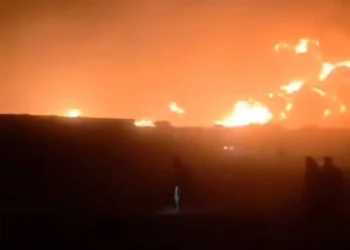
Pakistan’s accusations against India came just a day after a car bomb explosion in New Delhi. That blast, which occurred in a densely populated area near the historic Red Fort, killed at least eight people and injured more than 20 others. The vehicle’s owner was arrested by Indian police. Reports indicate that at least six cars and three rickshaws caught fire following the explosion.
Amit Shah, India’s Minister of Home Affairs, said all possibilities were being investigated and that security agencies would soon reach conclusions about the incident. Meanwhile, NDTV reported that the arrested car owner’s name is Salman, though Reuters noted it could not independently verify the arrest.
Indian Prime Minister Narendra Modi vowed that those responsible for the explosion near the Red Fort would be identified and prosecuted, stating that government agencies “will find the perpetrators of this plot.”
Reactions to the Attacks in India and Pakistan
Najibullah Alikhel, former Afghan ambassador to Pakistan, wrote on his X account that the recent bombings will further complicate relations between India and Pakistan. He added that the attacks come as Russian President Vladimir Putin is scheduled to visit India in December 2023. According to Alikhel, these developments not only escalate tensions between India and Pakistan but could also affect regional economic projects such as the China–Pakistan Economic Corridor (CPEC) and ongoing talks between Pakistan and the Taliban. He noted that mutual accusations have intensified and that despite Turkey’s efforts to foster understanding, Pakistan is facing broad security challenges.
Khairullah Azad, former chargé d’affaires of Afghanistan’s embassy in New Delhi, wrote on his Facebook page that the explosions and suicide attacks in Delhi, Islamabad, and Wana in Pakistan’s Waziristan region, along with the reactions from the leaders and officials of both countries and the notable response from the Taliban, all point to a new phase of proxy conflict between India and Pakistan, particularly within Afghan territory. He wrote, “It is true that various cities and regions of India and Pakistan will become part of the indirect battlefield between the two nations in the future, but the main stage of this new phase of proxy war is Afghanistan, especially areas near the Durand Line, and the people of Afghanistan will once again be its main victims.”
Bahar Mehr, a political analyst, wrote on X that the recent bombings in New Delhi and Islamabad show that extremist and fundamentalist groups are increasingly being used as covert tools in the rivalry between the two countries. He stated that when proxy conflicts replace diplomacy, the outcome is nothing but heightened insecurity, expanded intelligence competition, and greater operational space for terrorist networks. He warned that the consequences of this situation could drag all of South Asia into a new cycle of instability.
Mehr further wrote that if the region wishes to break this cycle, it must sincerely help the people of Afghanistan in confronting the Taliban, who serve as the primary base, shelter, and inspiration for terrorist networks, and instead of resorting to proxy warfare, pursue its interests through cooperation and legitimate democratic means.
These concerns come at a time when tensions between the Taliban and Pakistan have already led to the closure of Afghanistan–Pakistan border crossings for about a month, causing massive financial losses for traders on both sides. Earlier, Pakistani Newspaper The Nation reported that during the first 24 days of the closure, Pakistan’s economy suffered an estimated loss of around $200 million, halting its trade with Central Asian countries as well.
You can read the Persian version of this report here:
انفجار در دهلی و اسلامآباد؛ آیا آتش هند و پاکستان افغانستان را میسوزاند؟