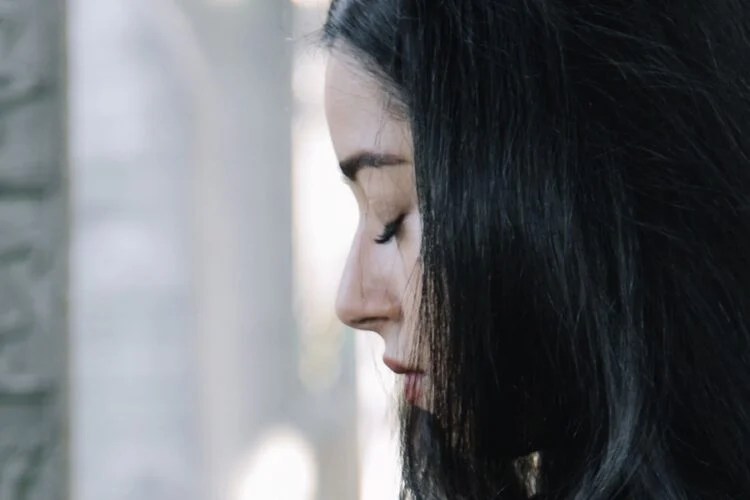
I know a woman who, in her own words, was never fortunate from the very beginning. Her life was marked by hardship and complications from the start. Every time life knocked her down, she got back up and, out of necessity, continued on her way.
Yet outwardly, she was a frail, quiet and kind-hearted woman. She was so delicate that anyone who saw only her appearance would never have imagined how heavy a burden life had placed on her slender shoulders. To me, her life can be divided into two parts: before her 17-year-old daughter fled and after. Of course, she had suffered greatly even before that. She had lost her young husband. But perhaps because I became familiar with her life mainly in the days after her daughter’s escape, her life in my mind is also divided into those two halves.
When she talks about her childhood and the beginning of her married life, she says: “I was young. According to the customs of the village, they married me off. My husband was several years older than me.” She considered his being older a sign of good fortune. She said her husband was a wise man. He was both a husband and a father to her. Then she says a sentence that perhaps summarizes the lives of women like her: “I was foolish. I was still childish. My husband was always looking after me and trying to encourage me to adjust to my new life, until I had a child. Once I had a child, my husband felt reassured about me and said, ‘Now you are tied down for good.’” That “chain” was a child.
Motherhood. Perhaps for many women, being a mother is both a chain to which they remain tied forever and a window of hope that opens onto a happier life. In other words, on one hand, it ties them to life, responsibility, home, society and a fate they sometimes had no choice in choosing. On the other hand, that same child can become their only source of hope, the very thing that makes them get up in the morning, struggle through hardships and still have a reason to carry on.
She had six children in quick succession, one after another, six children of different ages. When her youngest daughter was only seven months old in her womb, her husband suddenly died. She says: “After my husband died, I was left at a crossroads.” And she truly was. She had no husband, no income and no support amid the noise and turmoil of a society in which social problems and harmful customs had reached their peak.
Her eldest son had just turned 15 when she sent him to Iran, hoping he could find work and send money home to support the family. Her eldest daughter, who was herself still a teenager, suddenly became a second mother to her younger brothers and sisters. Their mother had to leave the children with her daughter while she went to the summer pastures in search of something to eat and bring home. But leaving her teenage daughter alone marked the beginning of another hardship.
Her daughter, Aqela, fell in love. In that small community, a young girl falling in love was not simply a personal emotion. It could become a source of shame for an entire family and bring trouble for relatives, especially the parents. Aqela’s love gradually became the talk of the village. The news reached her uncle. He became furious and said: “You are still a child and do not even know right from left. How dare you fall in love and bring shame on me?”
Eventually, the boy’s family came to ask for her hand in marriage, but her uncle firmly said: “Even if you come to ask for her hand for a hundred years, I will not give this girl to you.”
There was no shortage of gossip in the village, nor of those who carried rumors from one person to another, filling his ears with a mixture of truth and lies. He was told that Hakima had already arranged everything and intended to give her daughter to that family. Her uncle became angry and said: “If you have already arranged everything, why have you come to me? Go and let that woman, Hakima, give her daughter to you.”
Those anger and stubbornness ultimately pushed a teenage girl’s fate in a direction no one had imagined. The boy’s family decided to help Aqela elope, and she did.
But Aqela’s escape was not simply the escape of a girl. It was as if the weight of an entire society, a culture and a lifetime of judgment had suddenly fallen on her mother.
When she heard that her daughter had fled, she said: “The earth and sky came crashing down on me, as if a furnace and boiling oil had suddenly been poured over my head.” At that moment, instead of standing beside her in her time of need, people in the village told her: “You were the one who helped your daughter escape.” Then came an accusation that may have been even more painful than the escape itself: “She agreed to it. She was the one who sent her daughter away.”
Hakima said that at that moment, she felt as though the sky itself was collapsing on her. Darkness came over her eyes, and her head spun as if the whole world were standing against her and condemning her for something she had not done. She could not escape that accusation. In her anger and helplessness, she first cursed her daughter, Aqela, and then others who had played a role in what had happened.
But sometimes, in a moment of anger, a person says something that later echoes in their mind for the rest of their life. She later came to believe that the curse she had uttered that day had followed both her and her daughter. Aqela eventually became a bride.
She was still very young when she gave birth to two children in quick succession. But her motherhood did not last long. After the birth of her second child, a sudden, incurable illness overcame her, and death separated her from her two young children.
After her daughter’s death, Hakima carried another heavy burden alongside her grief: the unanswered question of whether the curse she had uttered that day had truly become tied to her daughter’s fate. Or was it simply the wounded mind of a mother who had spent years living under the weight of poverty, accusations, social customs and guilt? Or was it the result of words repeated over and over in a society where such words can exert power over people’s entire lives, becoming an inseparable part of life and making the already difficult path of women even more difficult?
Perhaps no one knows the answer to that question. But what I do know is that sometimes a woman does not break because of a single incident. Instead, she is gradually destroyed, and her spirit is sent into an eternal wilderness. All that remains is her body, which is forced to carry her through the rest of her life.
I was the one listening to her story. As she described those days, it was as though the deepest part of her bones were still burning. Under the weight of years of silence, judgment, coercion and fear, she had slowly worn away. And sometimes what people call “fate” is nothing more than the result of a chain of choices that a woman was never allowed to make for herself.